Best CrossFit workouts: 10 WODs for strength & fitness
Discover the 10 best CrossFit workouts for strength, endurance, and conditioning. Explore classic WODs, beginner-friendly routines, and workout tips.
Source: Unsplash
When Fran first appeared on CrossFit.com on 25 August 2003, CrossFit founder Greg Glassman challenged readers to beat original CrossFit athlete Greg Amundson's time of 3:59. More than 20 years later, athletes are still racing that clock.
Fran is the same 21-15-9 of thrusters and pull-ups it was in 2003, and so are Cindy, Helen, Grace and the other benchmark workouts in this guide.
That consistency is what makes these workouts so useful. The movements, reps and loads stay fixed, so you can repeat a benchmark every few months and see exactly how much fitter you've become: a faster time, an extra round, or the first time you finish it as prescribed.
In CrossFit, these workouts are called WODs, short for "workout of the day". A WOD is the main workout in a CrossFit session, with set movements, reps and a format such as "for time" or "as many rounds as possible". For the full explanation, read our guide to WOD meaning in CrossFit.
Below, you'll find 10 of the best CrossFit workouts for building strength and conditioning.
Each one includes:
- the full workout as prescribed (Rx), with loads in kg and lb
- what it trains and the equipment you need
- benchmark times to aim for
- a scaled version for beginners
- tips to pace it well
New to CrossFit? After the list, there's a section on beginner-friendly exercises, five simple WODs to start with, and how to scale any workout to your level. We'll finish with how to build a weekly routine around these workouts and track your progress.
If you run a CrossFit box, there's also a section on using benchmark WODs to fill classes, onboard beginners and keep members coming back.
I. What are CrossFit workouts?
CrossFit workouts combine three types of training: weightlifting, gymnastics (bodyweight movements such as pull-ups, push-ups and handstand push-ups) and cardio such as running, rowing and jumping rope.
CrossFit describes its method as constantly varied functional movements performed at high intensity. "Functional" refers to movements you also use in daily life, like squatting down to sit, lifting something off the floor or pushing a weight overhead.
Every CrossFit workout can be scaled. A competitive athlete might do a WOD with a heavy barbell while a beginner does the same WOD with a PVC pipe, and both finish having worked hard at their own level.
Most CrossFit classes last about an hour and follow the same structure: a warm-up, a strength or skill block, the WOD itself, and a cool-down.
How CrossFit differs from traditional gym workouts
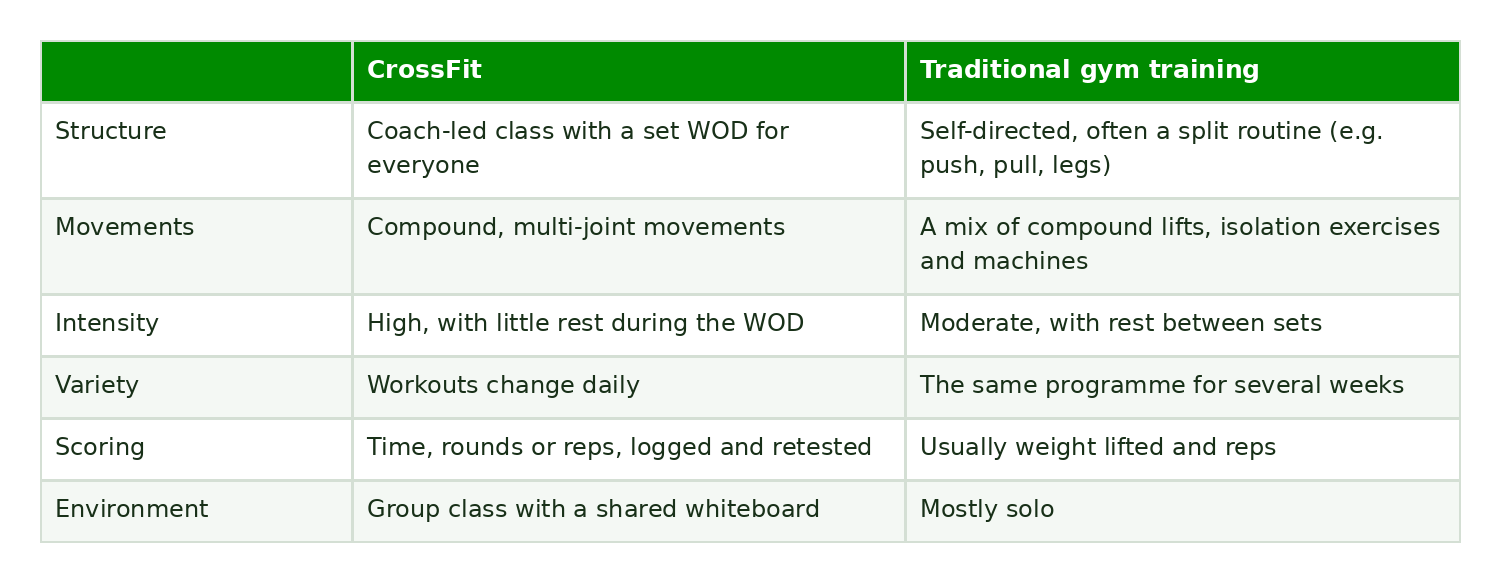
Traditional gym training suits people who want to target specific muscles or follow their own programme at their own pace. CrossFit suits people who want a coach to plan each session, enjoy training in a group, and want to build strength and conditioning in the same workout.
Many people do both, using gym sessions to work on weak points between CrossFit classes.
Common WOD formats you'll see in this list
Each WOD below follows one of these formats. Knowing them makes the workouts quicker to read.
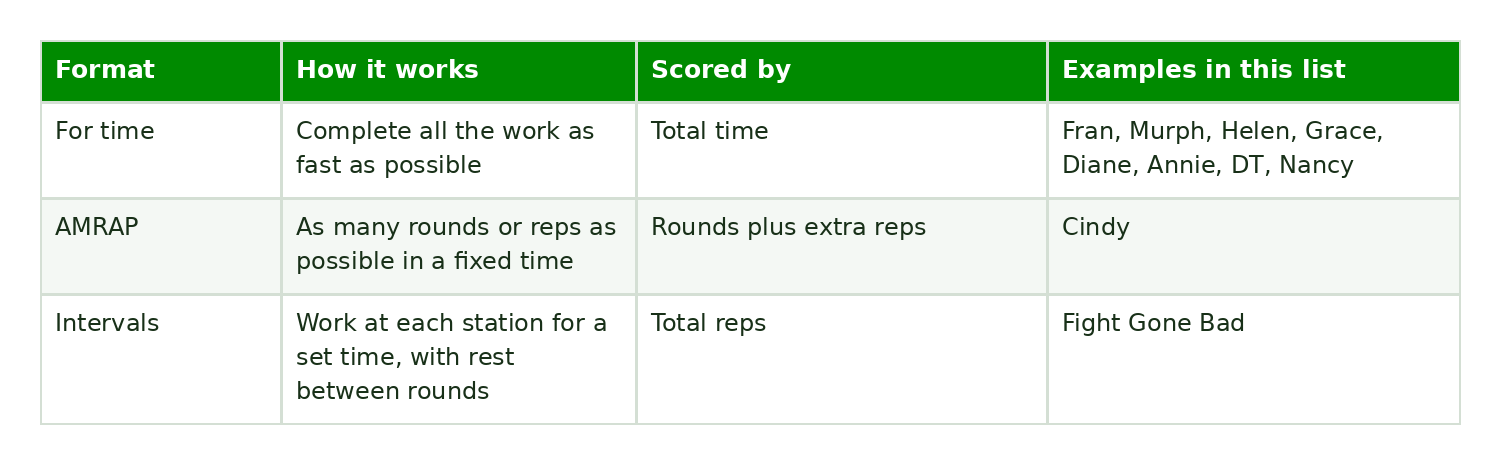
You'll also see rep schemes such as 21-15-9. This means 21 reps of each movement, then 15 of each, then 9 of each. Workouts marked Rx are done as prescribed, with the listed loads and movements. Scaled means you've adjusted the load, reps or movements to suit your level.
For more on how WODs are built and scored, see our guide to WOD meaning in CrossFit.
Benchmark WODs: The Girls and Hero WODs
A benchmark WOD is a repeatable workout with a prescribed format that athletes can revisit to measure their performance and improvements over time. CrossFit introduced its first benchmark workouts in the September 2003 CrossFit Journal article, "Benchmark Workouts".
Most of the best-known benchmark workouts fall into two groups:
1. The Girls
In September 2003, CrossFit founder Greg Glassman introduced the first six benchmark workouts in the CrossFit Journal:
- Angie
- Barbara
- Chelsea
- Diane
- Elizabeth and
- Fran
Grace and Helen followed in the months after. In November 2004, Glassman introduced six more workouts, including Nancy, in The New Girls.
Glassman gave the workouts female names, following the U.S. National Weather Service's practice of naming storms. He explained the inspiration behind this decision in the original Benchmark Workouts article.
CrossFit has continued adding Girls since then. The most recent batch on its official list was released in January 2021, introducing Grettel, Ingrid, Barbara Ann, Lyla, Ellen, Andi and Lane. You can find the complete list and original posting dates in the official CrossFit FAQ.
Seven of the ten workouts in this guide are Girls: Fran, Cindy, Helen, Grace, Diane, Annie and Nancy.
2. Hero WODs
These workouts honour fallen military service members, first responders and other members of the CrossFit community.
CrossFit began publishing Hero WODs in 2005 to commemorate those who made the ultimate sacrifice. The first was JT, introduced on July 6, 2005, in honour of U.S. Navy Petty Officer 1st Class Jeff Taylor.
You can read more about their history in CrossFit's article on Hero Workouts.
Hero WODs vary in length, intensity and movement requirements. Murph and DT are the two Hero WODs on this list, and you'll find the stories behind their names in their respective sections. You can also check their official Murph and DT workout descriptions.
Fight Gone Bad belongs to neither group. It's a separate benchmark workout.
CrossFit originally designed benchmark workouts to reappear at irregular intervals, giving athletes a way to measure their performance over time. Logging your score each time gives you a clear record of what has improved, whether that's your barbell strength, gymnastics or conditioning.
10 best CrossFit workouts to build strength and conditioning
These 10 WODs cover the main things CrossFit trains: short, intense sprints, long endurance efforts, barbell strength, gymnastics and mixed conditioning. Use the table to find the workouts that match your goal and equipment, then read each entry for the full workout, benchmark times and a scaled version.
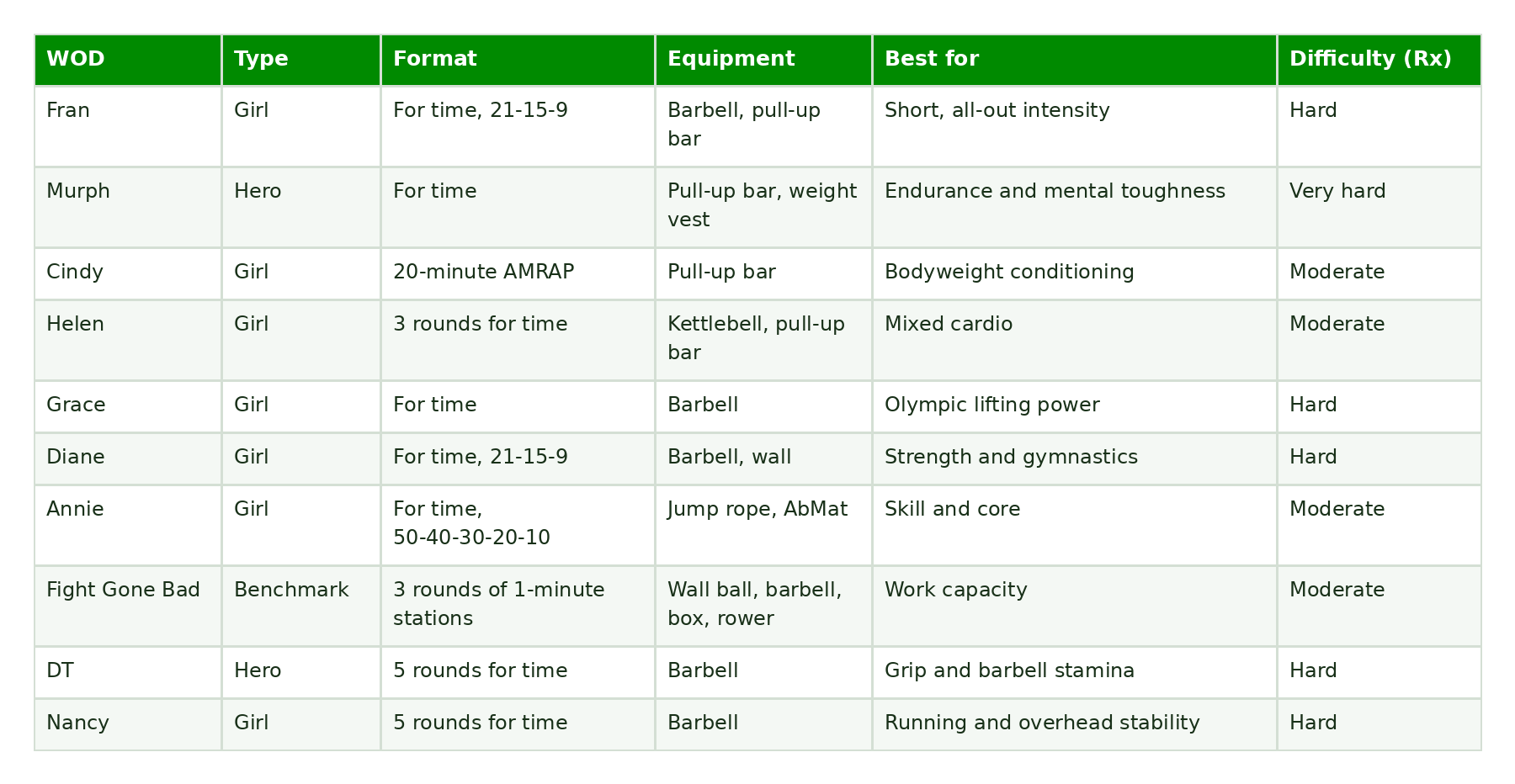
Loads are listed as women/men, in kg with the official lb standard in brackets. Benchmark times for the Girls come from WODprep, and times for Murph and DT come from CrossFit's own Hero workout pages.
1. Fran: best for short, all-out intensity
Fran is the benchmark most CrossFitters know by name, and a Fran time is often the first score people compare. It's short, so there's very little room to pace. The pairing of thrusters and pull-ups works your legs, shoulders and back at the same time, and your heart rate climbs within the first minute.
Type: Girl WOD
Format: for time, 21-15-9
Difficulty (Rx): hard
The workout (Rx)
21-15-9 reps for time of:
- Thrusters, 29/43 kg (65/95 lb)
- Pull-ups
Equipment: barbell, plates, pull-up bar
Muscles worked: quads, glutes, shoulders, triceps, lats, biceps and grip
Good Fran times
- Beginner: 7 to 9 minutes
- Intermediate: 6 to 7 minutes
- Advanced: 4 to 6 minutes
- Elite: under 3 minutes
Scaled version: do the same 21-15-9 with a lighter barbell, such as 20/30 kg (45/65 lb), and swap pull-ups for jumping pull-ups or ring rows.
Tips
- Decide how you'll break each set before the clock starts. Many athletes split the 21s into two or three sets and aim to go unbroken on the 9s.
- Drive the bar up with the momentum from the squat. Pressing with your arms alone tires your shoulders quickly and slows the pull-ups that follow.
2. Murph: best for endurance and mental toughness
Murph honours US Navy SEAL Lt. Michael Murphy, who was killed in Afghanistan on 28 June 2005. CrossFit introduced it as a Hero workout on 18 August 2005, and thousands of CrossFit gyms now programme it every year on US Memorial Day.
With 600 reps and two 1.6 km runs, it's the longest workout on this list, and for most people the middle section of pull-ups, push-ups and squats takes up most of the time.
Type: Hero WOD
Format: for time
Difficulty (Rx): very hard
The workout (Rx)
For time:
- 1.6 km (1 mile) run
- 100 pull-ups
- 200 push-ups
- 300 air squats
- 1.6 km (1 mile) run
Wear a 6/9 kg (14/20 lb) weight vest if you have one. You can split the pull-ups, push-ups and squats however you like.
Equipment: pull-up bar, weight vest (optional), somewhere to run
Muscles worked: lats, biceps, chest, shoulders, triceps, quads, glutes, core, plus your aerobic system
Good Murph times (from CrossFit, for each version of the workout)
- Beginner version: 25 to 30 minutes
- Intermediate version: 32 to 40 minutes
- Rx: 36 to 46 minutes
- Elite: Rx in under 35 minutes
CrossFit suggests choosing a scaled version if you expect the Rx workout to take you longer than 46 minutes.
Scaled versions
- Intermediate: 1.6 km run, 50 pull-ups, 100 push-ups, 150 air squats, 1.6 km run. Start the second run by the 25-minute mark.
- Beginner: 800 m run, then 10 rounds of 5 ring rows, 10 push-ups (from the knees or with hands on a box) and 15 air squats, then an 800 m run. Start the second run by the 20-minute mark.
Tips
- Split the middle section into 20 rounds of 5 pull-ups, 10 push-ups and 15 squats. This is the same structure as Cindy, and it keeps any single movement from failing early.
- Run the first 1.6 km at an easy, conversational pace. You'll need that energy for the push-ups, which usually slow people down the most.
- Murph is a big jump in volume if you're new to training. Build up with the scaled versions first, since high-volume work your body isn't used to raises the risk of severe muscle breakdown (rhabdomyolysis).
Running a box? Many gyms host Murph as a special event on US Memorial Day. Setting it up as a bookable class with heats and a capacity limit lets members reserve a slot early and helps you plan coaches, judges and equipment.
3. Cindy: best for bodyweight conditioning
Cindy uses three bodyweight movements and a pull-up bar, so you can do it in a garage or a park as easily as in a box. Each round takes well under a minute for most people. The challenge comes from repeating that round for 20 minutes while your shoulders and chest fatigue.
Type: Girl WOD
Format: 20-minute AMRAP
Difficulty (Rx): moderate
The workout (Rx)
As many rounds as possible (AMRAP) in 20 minutes of:
- 5 pull-ups
- 10 push-ups
- 15 air squats
Your score is the number of full rounds plus any extra reps.
Equipment: pull-up bar
Muscles worked: lats, biceps, chest, shoulders, triceps, quads, glutes and core
Good Cindy scores
- Beginner: 11 to 12 rounds
- Intermediate: 13 to 17 rounds
- Advanced: 19 to 22 rounds
- Elite: 24 rounds or more
Scaled version: reduce the reps to 3 pull-ups, 6 push-ups and 9 air squats, or keep the full reps and use band-assisted pull-ups and push-ups from the knees.
Tips
- Pick a target pace before you start, such as one round every minute, and check the clock every five rounds.
- Push-ups usually slow down first. Split them into sets of five from the opening rounds so you keep moving later on.
- Cindy is also the most common way to split up the middle section of Murph, so a good Cindy score is a sign you're ready to try Murph.
4. Helen: best for mixed cardio and functional strength
Helen was first programmed on CrossFit.com in August 2003 as "The CrossFit Challenge" and renamed Helen a few months later. It mixes running, hip power and pulling, so no single muscle group gives out first. Your lungs and grip decide your time.
It was also programmed for every individual, age group and adaptive athlete at the 2023 CrossFit Games, which shows how well it tests all-round fitness.
Type: Girl WOD
Format: 3 rounds for time
Difficulty (Rx): moderate
The workout (Rx)
3 rounds for time of:
- 400 m run
- 21 kettlebell swings, 16/24 kg (35/53 lb)
- 12 pull-ups
CrossFit's standard is the American kettlebell swing, which finishes with the kettlebell overhead.
Equipment: kettlebell, pull-up bar, somewhere to run
Muscles worked: hamstrings, glutes, lower back, lats, biceps, grip, plus your aerobic system
Good Helen times
- Beginner: 15 to 17 minutes
- Intermediate: 11 to 14 minutes
- Advanced: 9 to 10 minutes
- Elite: under 8 minutes
Scaled version: 3 rounds of a 400 m run, 15 kettlebell swings with a lighter kettlebell, and 9 jumping pull-ups or ring rows. If running isn't an option, a 500 m row is a common swap.
Tips
- Run at a pace that lets your breathing settle before you reach the kettlebell. Sprinting the first run usually costs more time on the swings than it saves.
- Keep the swings in one set if your grip allows, then shake out your hands on the walk to the pull-up bar.
5. Grace: best for Olympic lifting power
Grace has one movement and one number: 30 clean and jerks. That simplicity puts all the focus on how efficiently you can move a barbell from the floor to overhead, again and again. It has been programmed at the CrossFit Games at least twice.
Type: Girl WOD
Format: for time
Difficulty (Rx): hard
The workout (Rx)
For time:
- 30 clean and jerks, 43/61 kg (95/135 lb)
Equipment: barbell and bumper plates
Muscles worked: quads, glutes, hamstrings, back, shoulders, triceps and core
Good Grace times
- Beginner: 6 to 7 minutes
- Intermediate: 4 to 5 minutes
- Advanced: 3 to 4 minutes
- Elite: under 2 minutes
Scaled version: 30 clean and jerks at a lighter load, such as 29/43 kg (65/95 lb). Choose a weight you can lift with the same technique on rep 30 as on rep 1.
Tips
- Quick singles work well for most people: drop the bar, reset your feet and lift again straight away. Link reps together only if your technique holds.
- Use your legs to drive the bar overhead in the jerk. Pressing it with your arms will burn out your shoulders before rep 15.
If you like Grace, try its sibling Isabel: 30 snatches at the same loads, for time.
6. Diane: best for strength and gymnastics
Diane was first posted on CrossFit.com on 19 September 2003, as part of the original set of Girls. It uses the same 21-15-9 rep scheme as Fran, but swaps the thrusters for heavy deadlifts and the pull-ups for handstand push-ups. The result is a test of raw pulling strength followed by pressing your bodyweight upside down.
Type: Girl WOD
Format: for time, 21-15-9
Difficulty (Rx): hard
The workout (Rx)
21-15-9 reps for time of:
- Deadlifts, 70/102 kg (155/225 lb)
- Handstand push-ups
Equipment: barbell, plates, a clear wall, an AbMat or folded mat for your head
Muscles worked: hamstrings, glutes, lower back, grip, shoulders, triceps and core
Good Diane times
- Intermediate: 6 to 9 minutes
- Advanced: 5 to 6 minutes
- Elite: under 4 minutes
The Rx version isn't recommended for beginners. Start with the scaled version below.
Scaled version: 21-15-9 deadlifts at a lighter load, such as 43/61 kg (95/135 lb), with pike push-ups, box handstand push-ups, or push-ups with your hands elevated.
Tips
- Break the handstand push-ups into small sets from the first round, such as 5 or 6 at a time. Pushing to failure upside down costs a lot of rest.
- Keep your back flat on every deadlift, especially in the round of 21. Tired grip and lower back are where form slips first.
- Set your bar up a step or two from the wall so you lose no time moving between stations.
7. Annie: best for skill work and core strength
Annie is named after Annie Sakamoto, one of CrossFit's earliest athletes. It needs only a jump rope and a mat, which makes it one of the easiest benchmarks to do at home or while travelling. The reps should move quickly, so your score depends on how consistent your double-unders are.
Type: Girl WOD
Format: for time, 50-40-30-20-10
Difficulty (Rx): moderate
The workout (Rx)
50-40-30-20-10 reps for time of:
- Double-unders
- AbMat sit-ups
A double-under is a jump where the rope passes under your feet twice.
Equipment: jump rope (a speed rope helps), AbMat or folded towel
Muscles worked: calves, hip flexors, abdominals, plus coordination and your aerobic system
Good Annie times
- Beginner: 10 to 12 minutes
- Intermediate: 8 to 10 minutes
- Advanced: 7 to 8 minutes
- Elite: under 6 minutes
Scaled version: 50-40-30-20-10 single-unders with 25-20-15-10-5 sit-ups.
Tips
- Keep your jumps low and your arms close to your sides. Turn the rope with your wrists to save your shoulders.
- Stop a double-under set a few reps before you expect to trip. Restarting after a miss costs more time than a planned short break.
8. Fight Gone Bad: best for work capacity
Fight Gone Bad was created when MMA fighter BJ Penn asked CrossFit founder Greg Glassman for a workout that felt like a real fight. Glassman built three five-minute rounds with a minute of rest, matching the length of an MMA round.
When Penn finished, he said it was like a fight gone bad, and the name stuck. Your score is the total number of reps, which makes it easy to compare results across very different fitness levels.
Type: benchmark WOD
Format: 3 rounds of 1-minute stations, for total reps
Difficulty (Rx): moderate
The workout (Rx)
3 rounds, 1 minute at each station, for total reps:
- Wall-ball shots, 6/9 kg (14/20 lb) ball to a 2.7/3 m (9/10 ft) target
- Sumo deadlift high pulls, 25/34 kg (55/75 lb)
- Box jumps, 50 cm (20 in)
- Push presses, 25/34 kg (55/75 lb)
- Row, for calories
- Rest 1 minute
The clock keeps running as you move between stations. Each calorie on the rower counts as one rep. The whole workout takes 17 minutes.
Equipment: wall ball, barbell, plyo box, rowing machine
Muscles worked: legs, glutes, back, shoulders, arms and core, plus your aerobic and anaerobic systems
Good Fight Gone Bad scores
- Beginner: 150 to 250 reps
- Intermediate: 250 to 350 reps
- Advanced: 350 to 450 reps
- Elite: 500 reps or more
Scaled version: keep the same intervals with a lighter wall ball and barbell and a lower box, around 30 cm (12 in). Step-ups are a good swap for box jumps.
Tips
- Aim to keep moving for the full minute at every station. Stopping completely to rest costs more reps than slowing your pace.
- Push hardest on wall balls and push presses, where reps come quickly, and settle into a steady pace on the sumo deadlift high pulls and the rower.
Running a box? Fight Gone Bad has a long history as a charity event, with gyms running heats and judges for members and guests. It works well as a community class that brings in friends and first-timers.
9. DT: best for grip and barbell stamina
DT honours US Air Force Staff Sgt. Timothy P. Davis, 28, who was killed on 20 February 2009 while supporting operations in Afghanistan, when his vehicle was struck by an improvised explosive device. He was survived by his wife, Megan, and their one-year-old son, T.J.
CrossFit first posted the workout on 14 April 2009. It uses one barbell and three lifts, and because the bar stays in your hands for long stretches, your grip tends to give out before your legs do.
Type: Hero WOD
Format: 5 rounds for time
Difficulty (Rx): hard
The workout (Rx)
5 rounds for time of:
- 12 deadlifts
- 9 hang power cleans
- 6 push jerks
Use 48/70 kg (105/155 lb) for every lift. Finish all 12 deadlifts before moving on to the cleans.
Equipment: barbell and bumper plates
Muscles worked: hamstrings, glutes, back, traps, shoulders, triceps, grip and core
Good DT times (from CrossFit, for each version of the workout)
- Beginner version: 15 to 19 minutes
- Intermediate version: 10 to 14 minutes
- Rx: 6 to 9 minutes
- Elite: under 5 minutes
Scaled versions
- Intermediate: the same workout at 29/43 kg (65/95 lb)
- Beginner: the same workout at 16/20 kg (35/45 lb), which is an empty or light training barbell
Tips
- Break the hang power cleans early, in sets of three if needed. Holding on for all nine in round one often leaves your grip too tired for rounds four and five.
- Keep the bar close to your body on the deadlifts and cleans. A bar that drifts forward puts extra strain on your lower back.
- Hold a steady pace from round one. Going out too fast usually leads to long rests in the final two rounds.
10. Nancy: best for running and overhead stability
Nancy was part of the second set of Girls that CrossFit announced in November 2004. It alternates a 400 m run with overhead squats, one of the most demanding lifts in CrossFit for mobility and balance. Each run gives your shoulders a short break, but your legs and lungs keep working the whole time.
Type: Girl WOD
Format: 5 rounds for time
Difficulty (Rx): hard
The workout (Rx)
5 rounds for time of:
- 400 m run
- 15 overhead squats, 29/43 kg (65/95 lb)
Equipment: barbell, plates, somewhere to run
Muscles worked: quads, glutes, shoulders, upper back and core, plus your aerobic system
Good Nancy times
- Beginner: 17 to 20 minutes or more
- Intermediate: 13 to 16 minutes
- Advanced: 10 to 12 minutes
- Elite: under 9 minutes
Scaled version: 5 rounds of a 400 m run and 15 overhead squats with a lighter barbell, such as 20/29 kg (45/65 lb). If your shoulder or hip mobility limits the overhead position, use a PVC pipe or swap in front squats while you work on it.
Tips
- Take a wide grip and press your arms up into the bar at the bottom of each squat. Locked-out elbows keep the bar stable.
- Break the squats into sets before your shoulders fail. Dropping the bar means lifting it back overhead from the floor, which costs time and energy.
- Run at a pace that lets you start the squats with your breathing under control.
III. Best CrossFit workouts for beginners
Every workout in the list above can be scaled, so you can try Fran or Helen in your first month.
Beginners usually make faster progress, though, by spending the first few weeks learning the basic movements with light weights and short workouts.
Once those movements feel steady, the benchmarks become safer to attempt and easier to improve on.
This section covers the exercises to learn first, five simple WODs to start with, how to scale any workout, and the mistakes that most often hold new athletes back.
Beginner-friendly CrossFit exercises
CrossFit teaches new athletes nine foundational movements, grouped into three series. Most barbell movements in CrossFit build on these, so learning them first makes everything else easier. A thruster, for example, is a front squat followed by a push press.
- Squat series: air squat, front squat, overhead squat
- Press series: shoulder press, push press, push jerk
- Floor lift series: deadlift, sumo deadlift high pull, medicine ball clean
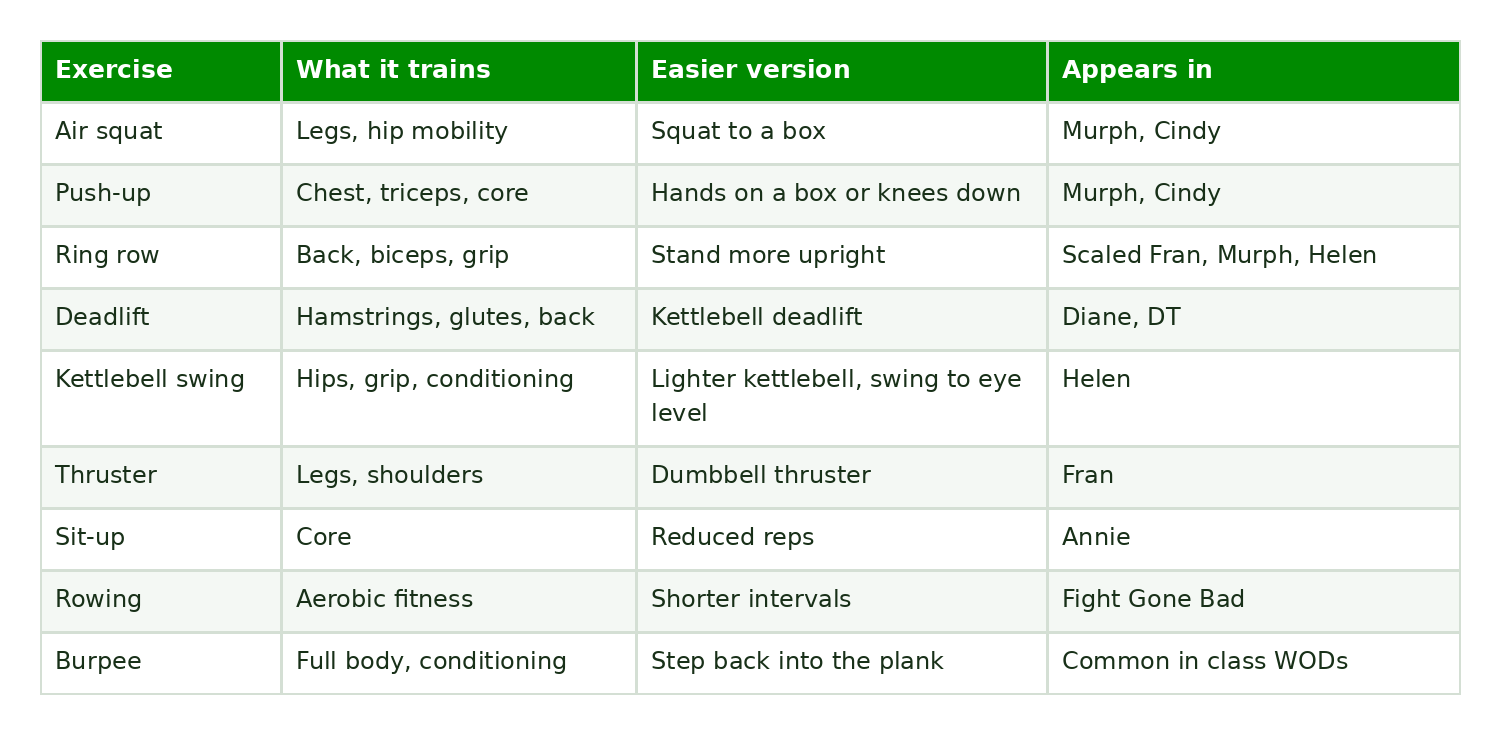
Alongside these, a handful of bodyweight and conditioning exercises show up in almost every beginner class. The table below shows what each one trains, an easier version to start with, and where it appears in the 10 WODs above.
5 simple CrossFit WODs for beginners
These five workouts use the movements above with light loads and short time frames. Each one is a smaller version of a benchmark from the list, so you can use them as stepping stones.
Write down your score each time and repeat a workout every three or four weeks to see your progress.
1. Bodyweight 21-15-9
21-15-9 reps for time of:
- Air squats
- Push-ups (hands on a box if needed)
- Sit-ups
Equipment: none
Builds towards: Cindy, Murph and Annie
2. Mini Cindy
AMRAP in 10 minutes of:
- 5 ring rows
- 10 push-ups (hands on a box if needed)
- 15 air squats
Equipment: gymnastic rings, a suspension trainer or a low bar
Builds towards: Cindy, then Murph
3. Beginner Fran
15-12-9 reps for time of:
- Dumbbell thrusters, with a light pair of dumbbells
- Ring rows
Equipment: dumbbells, rings or a low bar
Builds towards: Fran
4. Kettlebell EMOM
Every minute on the minute (EMOM) for 12 minutes, rotating through:
- Minute 1: 12 kettlebell swings to eye level
- Minute 2: 10 goblet squats
- Minute 3: 30 seconds of single-unders with a jump rope
Rest for whatever time is left in each minute.
Equipment: kettlebell, jump rope
Builds towards: Helen and Annie
5. Row and burpee intervals
5 rounds of:
- 250 m row
- 10 burpees
- Rest 1 minute
Record the time for each round and try to keep them within a few seconds of each other.
Equipment: rowing machine
Builds towards: Fight Gone Bad
How to scale CrossFit workouts to your fitness level
Scaling means adjusting a workout so it gives you the same effect it gives an Rx athlete. CrossFit coaches call this the intended stimulus.
Fran is meant to be a short, all-out effort, so a scaled Fran should still be finished in under 10 minutes.
Murph is meant to be long, and CrossFit suggests scaling it if the Rx version would take you longer than 46 minutes.
There are four main ways to scale:
- Reduce the load. Use a lighter barbell, dumbbell or kettlebell. This is usually the first change to make.
- Reduce the volume. Cut the reps or rounds, such as 15-12-9 instead of 21-15-9, or a half Murph.
- Swap the movement. Replace a skill you can't do yet with an easier version that trains the same muscles (see the table below).
- Set a time cap. Stop at a set time and record how far you got. Your coach will usually set this in class.
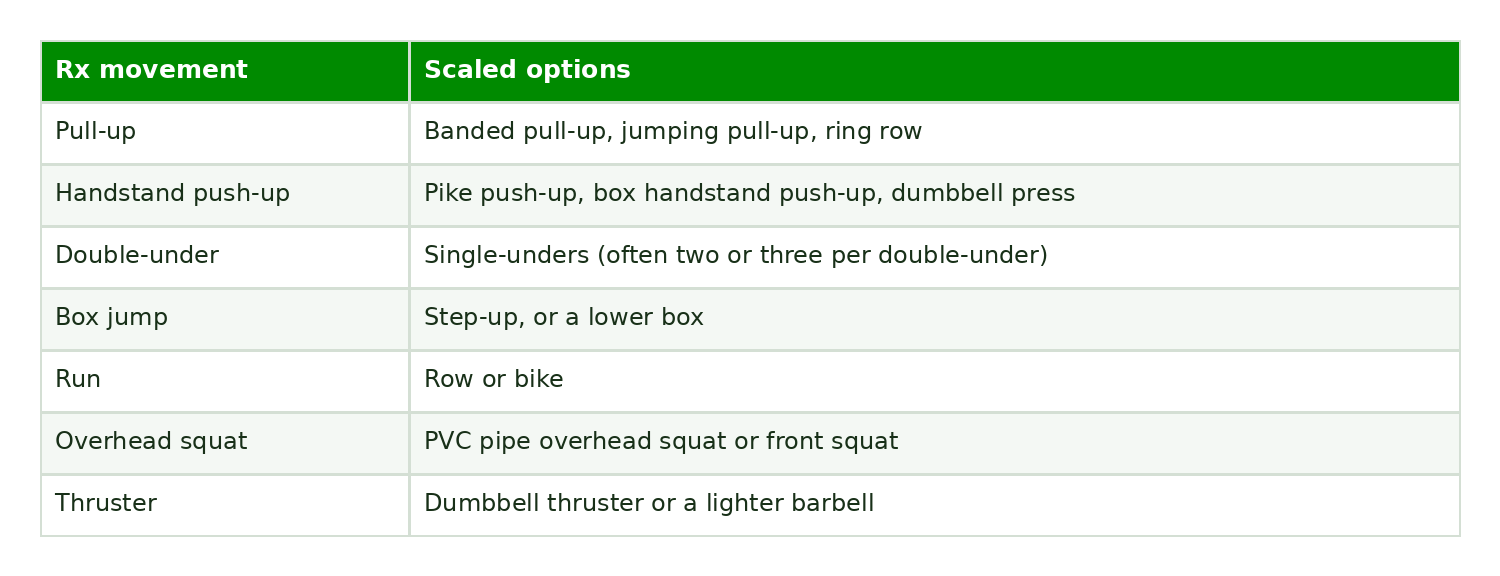
As your scores improve, bring back one Rx element at a time, such as the full load or one gymnastics movement, and keep the rest scaled until it feels steady.
Common mistakes beginners should avoid
1. Going Rx too soon
Finishing a workout at the prescribed weight with poor form teaches bad habits and raises your injury risk. Use the scaled version until you can move well on the last rep as well as the first.
2. Chasing the clock over form
A faster time with half-depth squats or a rounded back doesn't show real progress. Coaches count reps that meet the movement standard, and you should too.
3. Skipping the warm-up
Cold muscles and stiff joints make it harder to hit good positions, especially in overhead squats and handstand push-ups. Use the full warm-up your coach gives you.
4. Training hard every day
Your body gets fitter during recovery. Start with two or three sessions a week and build up from there.
3. Starting too fast
Sprinting the first round usually leads to long rests later. Aim for a pace you can hold, then push in the final minutes.
4. Not logging your scores
Without a record, you can't see what's improving or what needs work. Write down every benchmark score, the load you used and whether it was Rx or scaled.
5. Doing too much volume too early
High-rep workouts like a full Murph can cause rhabdomyolysis, a serious condition where damaged muscle breaks down and releases its contents into the blood.
It's more likely after intense exercise your body isn't used to. Build up gradually with scaled versions, and see a doctor straight away if you have severe muscle pain, weakness or dark urine after a workout.
IV. How to build an effective CrossFit workout routine
Benchmark WODs show where your fitness stands, and a consistent weekly routine is how you improve those scores. This section covers how often to train, how a session is put together, how to recover between hard days, and how to track and build on your results.
1. How many days a week should you do CrossFit?
Most beginners should do CrossFit two or three days a week, with a rest day between sessions. As your body adapts, you can build up to four or five days.
- Beginners (first three months): 2 to 3 sessions a week, on non-consecutive days such as Monday, Wednesday and Friday
- Intermediate athletes: 3 to 5 sessions a week, mixing short and long workouts
- Advanced athletes: 5 to 6 sessions a week, with at least one full rest day and lighter days built in
CrossFit's own programming has long used a pattern of three training days followed by one rest day. In a 2003 CrossFit Journal article, Greg Glassman explained that this pattern allows more high-intensity work with better recovery than training five days in a row.
He also noted that a five-days-on, two-days-off week is a fine choice if it fits your work schedule better. Today, CrossFit.com programmes three days on, one day off, then two days on.
Whichever pattern you follow, the rest days are part of the plan. Your body adapts to training while it recovers.
2. How to structure a CrossFit session
A typical CrossFit class lasts about 60 minutes and moves through four blocks. Timings vary from gym to gym, but most classes look something like this:
- Warm-up and mobility (10 to 15 minutes): raises your heart rate and prepares the joints for the day's movements
- Strength or skill (15 to 20 minutes): a heavier lift, such as back squats, or practice on a gymnastics skill, such as handstands
- WOD (10 to 20 minutes): the high-intensity conditioning piece
- Cool-down (5 to 10 minutes): stretching, easy breathing and logging your score
This structure is how CrossFit combines strength training and conditioning in the same hour.
CrossFit's programming rotates three types of training across the week: metabolic conditioning (running, rowing, jumping rope), gymnastics (bodyweight movements) and weightlifting. A good week touches all three.
If you're planning your own sessions, a few pairings help:
- On heavy strength days, keep the WOD short and lighter, such as a 7-minute AMRAP.
- On days with a long WOD like Murph, keep the strength block light or replace it with mobility work.
- Avoid stacking two grip-heavy pieces in one session, such as heavy deadlifts followed by DT.
3. How to balance training intensity and recovery
CrossFit works because of its intensity, and intensity only pays off when you recover from it.
A few habits keep that balance:
- Vary the length of your workouts. Mix short WODs under 7 minutes, medium ones of 8 to 15 minutes, and longer efforts over 20 minutes across the week. Two long, grinding workouts on back-to-back days leave little left for the next session.
- Plan easier days. Use one or two sessions a week for technique practice, mobility or easy cardio like a steady row or bike.
- Use your rest days well. A walk, light stretching or mobility work helps you feel fresher than a day spent sitting still.
- Look after the basics. Aim for at least seven hours of sleep, eat enough protein, and drink water throughout the day, especially before long WODs.
Watch for signs you need more rest: your scores are falling, you're sleeping badly, soreness lasts longer than two or three days, or you dread sessions you used to enjoy. When you notice two or more of these, take an extra rest day or cut the intensity for a week.
4. How to track WOD scores and measure progress
Benchmark workouts are only useful if you can compare one attempt with the next. For every benchmark, write down:
- the date and the workout
- your score (time, rounds and reps, or total reps)
- whether you did it Rx or scaled, and exactly what you changed
- the loads you used
- a short note on how it felt and where you slowed down
Compare like with like. A Fran done with ring rows and a 20 kg barbell can only be fairly compared with another attempt at the same scaling.
Retest two or three benchmarks every two to three months. Pick ones that test different things, such as Fran for short intensity, Cindy for bodyweight conditioning and Grace for barbell power, so you get a fuller picture of your fitness.
Any of these tools work for keeping a log:
- a training notebook
- a simple spreadsheet
- a workout logging app, such as the CrossFit app, which lets you log benchmarks and Hero WODs
- your gym's whiteboard or member app, if it records scores
Track your main lifts too. A heavier one-rep max in the deadlift or clean and jerk often shows up later as faster times in Diane, DT or Grace.
5. How to progress from beginner to advanced workouts
Most athletes move through the same stages, and how long each stage takes depends on your starting fitness, how often you train and how much coaching you get.
Use these stages to see where you are and what to work on next.
- Foundations. Learn the nine foundational movements with light loads and follow the beginner WODs above. Move on once your squat, press and deadlift look the same on the last rep as the first.
- Scaled benchmarks. Complete each Girl WOD in its scaled form and log your score. These become your starting points.
- Partial Rx. Do benchmarks at the Rx load or movement for the parts you've mastered, and scale the rest. For example, Fran with the Rx barbell and banded pull-ups.
- Full Rx. Complete benchmarks as prescribed, then work on beating your own times and scores.
- Longer and heavier work. Add Hero WODs like Murph and DT at Rx, and retest your benchmarks on a regular cycle.
Along the way, a few skill milestones mark real progress and unlock more Rx workouts:
- your first strict pull-up
- your first unbroken set of double-unders
- your first handstand push-up
- your first bodyweight overhead squat
- your first muscle-up
Celebrate each one. They take months of practice for most people, and they show up directly in your benchmark scores.
Frequently asked questions
1. What are the best CrossFit workouts?
The best CrossFit workouts are the classic benchmark WODs: Fran, Murph, Cindy, Helen, Grace, Diane, Annie, Fight Gone Bad, DT and Nancy. They've been used for over 20 years because they never change, so you can repeat them to measure your progress. Each one trains something different, from short, intense sprints to long endurance efforts and heavy barbell work.
2. What is the most effective CrossFit WOD?
The most effective WOD is the one that targets your weakest area and that you can repeat over time. If you struggle with conditioning, Helen or Fight Gone Bad will expose it. If strength is your limiter, Diane or DT will. Rotating a few benchmarks that test different things gives you better overall results than repeating one favourite.
3. What is the hardest CrossFit workout?
Murph is widely considered the hardest of the well-known benchmarks because of its volume: 600 reps plus two 1.6 km runs, often in a weight vest. Fran is often named the hardest for intensity, since it pushes your heart rate to its limit in just a few minutes. Which one feels harder depends on whether you struggle more with long efforts or short, all-out ones.
4. What are the most popular CrossFit benchmark workouts?
Fran, Murph, Cindy, Helen and Grace are among the most widely known. Fran was first posted on CrossFit.com in 2003 and is the benchmark most CrossFitters compare times on. Murph is done by thousands of gyms every year on US Memorial Day.
5. What is the best CrossFit workout for beginners?
Cindy is one of the best benchmarks for beginners, since it uses only pull-ups, push-ups and air squats and is easy to scale with ring rows and box push-ups. Before trying any benchmark, start with simple workouts like a bodyweight 21-15-9 of air squats, push-ups and sit-ups. The beginners section above lists five WODs that each build towards a benchmark.
6. What is the best CrossFit workout for building muscle?
Barbell-heavy WODs like DT, Diane and Grace put the most load on your muscles, especially your legs, back and shoulders. For muscle growth, pair these with a regular strength block of heavier, lower-rep lifts such as squats and deadlifts, and gradually increase the weight over time. Eating enough protein and getting enough sleep matter as much as the workouts.
7. What is the best CrossFit workout for fat loss?
Higher-volume conditioning WODs such as Helen, Fight Gone Bad, Cindy and Murph keep you moving for longer, which burns more energy in a session. Fat loss still depends mostly on your overall diet and daily activity, so the best approach is consistent training two to five times a week alongside a calorie intake that suits your goal.
8. Can CrossFit workouts build strength and endurance?
Yes. CrossFit trains both in the same programme: strength blocks and heavy WODs like DT and Diane build strength, while longer workouts like Murph and Nancy build endurance. Many WODs, such as Helen, train both at once by combining a lift or gymnastics movement with running or rowing.
9. Can you do CrossFit workouts at home?
Yes, several benchmarks need little or no equipment. Cindy needs only a pull-up bar, Annie needs a jump rope and a mat, and a scaled Murph can be done with a pull-up bar or a sturdy table for rows. Bodyweight workouts like a 21-15-9 of air squats, push-ups and sit-ups need nothing at all.
10. What equipment do you need for CrossFit workouts?
To start at home, a pull-up bar, a jump rope and a kettlebell or pair of dumbbells cover a large number of WODs. A CrossFit gym adds barbells and bumper plates, gymnastic rings, rowing machines, plyo boxes, wall balls and AbMats. For the 10 WODs in this guide, the equipment list in each entry shows exactly what you need.
11. How long should a CrossFit workout last?
A CrossFit class usually lasts about 60 minutes, including the warm-up, a strength or skill block, the WOD and a cool-down. The WOD itself is often between 5 and 20 minutes. Longer workouts like Murph can take 35 to 60 minutes or more.
12. How many times a week should you do CrossFit?
Beginners should start with two or three sessions a week on non-consecutive days. Intermediate athletes usually train three to five times a week, and advanced athletes five or six. CrossFit's classic pattern is three days of training followed by one rest day.
13. What does WOD mean in CrossFit?
WOD stands for "workout of the day". It's the main conditioning workout in a CrossFit class, with set movements, reps and a format such as "for time" or AMRAP. Our guide to WOD meaning in CrossFit explains it in full.
14. What is the difference between AMRAP and EMOM?
AMRAP stands for "as many rounds (or reps) as possible". You repeat a circuit for a fixed time, and your score is the number of rounds and reps you finish, as in Cindy. EMOM stands for "every minute on the minute". You start a set number of reps at the top of each minute and rest for whatever time is left before the next minute begins.
15. What does Rx mean in CrossFit?
Rx means "as prescribed". A workout done Rx uses the exact loads, reps and movements written in the WOD. If you change any of them, your score is recorded as scaled.
16. How do you scale a CrossFit workout?
You scale a workout by reducing the load, reducing the reps or rounds, or swapping a movement for an easier version, such as ring rows instead of pull-ups. The goal is to keep the workout's intended effect, so a scaled Fran should still be short and intense. The scaling section above lists common swaps for each movement.
17. Are CrossFit workouts suitable for beginners?
Yes, as long as they're scaled to your current level. Every CrossFit workout can be adjusted with lighter loads, fewer reps and simpler movements. Starting with a coach, or with a gym's beginner or foundations programme, helps you learn the movements safely before trying the benchmarks.
18. How do you track CrossFit workout progress?
Log every benchmark with the date, your score, whether it was Rx or scaled, the loads you used and how it felt. Retest two or three benchmarks every two to three months and compare each result with your last attempt at the same scaling. A notebook, spreadsheet or workout logging app all work.
19. Can you do CrossFit workouts every day?
Most people shouldn't do high-intensity CrossFit workouts every day. Your body needs rest to recover and adapt, and training hard without breaks raises your risk of injury and burnout. CrossFit's own programming includes regular rest days, and easier days of mobility or light cardio can fill the gaps if you want to stay active.
20. How do CrossFit coaches choose the right WOD for a class?
Coaches plan WODs to vary the type of training across the week, mixing conditioning, gymnastics and weightlifting, as well as short, medium and long workouts. They also consider the class's experience level, the equipment available, how many people will attend and how each movement can be scaled.
Many gyms follow a programme from CrossFit.com or a programming service and adapt it for their members, while others write their own.