Best payment systems for yoga studios: Memberships, packages & drop-ins
Learn how yoga studios manage payments for memberships, class packages, and drop-ins. Explore the best payment systems for smooth studio operations.
Running a yoga studio isn’t just about delivering great classes. Behind the scenes, how you handle payments plays a huge role in how smoothly your business operates and how predictable your revenue becomes.
Many studios start with a simple setup. Cash at the front desk, manual transfers, or a basic checkout link. It works at first. But as your studio grows, things get messy fast.
Tracking who still has sessions left, chasing unpaid memberships, handling refunds, or figuring out which classes are actually making money starts to eat up time.
And here’s the bigger issue: your payment system directly shapes your customer experience.
If booking and paying feel complicated, people drop off. If memberships don’t renew smoothly, you lose recurring revenue. If packages are hard to track, both you and your customers get frustrated.
A well-structured yoga studio payment system does more than collect money. It helps you:
- Build stable, recurring income through memberships
- Sell flexible options like class packages and drop-ins
- Reduce admin work for your team
- Give your customers a seamless booking and payment experience
- Clearly see what’s working in your business each month
In this guide, we’ll break down the most common payment models used by yoga studios, what features actually matter, and how to choose a system that supports your growth instead of slowing you down.

Source: prostooleh on Freepik
I. What are yoga studio payment systems?
A yoga studio payment system is the setup you use to collect, manage, and track customer payments across your business. That includes things like memberships, class packages, drop-ins, workshops, private sessions, and sometimes retail sales too.
In simple terms, it is not just a tool for taking money. It is the system that helps your studio handle how customers pay, how those payments connect to bookings, and how you keep track of what each customer has purchased.
A lot of studio owners mix up three related terms here:
Payment method
This is how the customer pays, such as credit card, bank transfer, digital wallet, or cash.
Payment gateway
This is the technology that processes the transaction online.
Yoga studio payment system
This is the bigger system that brings everything together, including payments, bookings, memberships, packages, and reporting.
That distinction matters because a payment gateway alone is not enough for most yoga studios. You might be able to accept a card payment, but that does not automatically mean the system can track remaining class credits, renew memberships every month, apply the right pricing option, or show you how much revenue came from drop-ins versus recurring plans.
A proper yoga studio payment system should support the way studios actually sell. Most yoga businesses do not rely on one single pricing model. They usually combine several, such as:
- recurring memberships for loyal students
- class packages for flexible buyers
- drop-ins for casual visitors or first-timers
- special payments for workshops, events, or private classes
When all of this is handled inside one system, your operations become much easier to manage. Your staff spends less time checking payments manually, and your customers get a smoother experience from booking to checkout.
That is why choosing the right system is not just an admin decision. It directly affects revenue, customer convenience, and how easy your studio is to run.

Source: Freepik
II. Common payment models used by yoga studios
Most yoga studios do not rely on just one way of charging customers. Instead, they usually combine a few payment models to match different buying habits.
Some students want full flexibility and only pay when they attend. Some prefer to commit to a package of classes. Others want the convenience of a recurring monthly membership. If your studio only offers one option, you may end up losing people who would have happily booked under a different pricing structure.
That is why offering multiple payment options matters. It helps you attract different types of students, including:
- first-timers who want to try one class
- casual students who come inconsistently
- regulars who want better value
- loyal members who are ready for an ongoing commitment
The three most common payment models used by yoga studios are drop-ins, class packages, and monthly memberships. Each one serves a different purpose, and each one affects your revenue in a different way.
1. Drop-in payments
Drop-in payments are the simplest model. A customer pays for one class at a time, with no long-term commitment.
This option is popular with:
- beginners trying your studio for the first time
- travelers or short-term visitors
- students with unpredictable schedules
- people who are not ready to commit to a package or membership
The biggest advantage of drop-ins is flexibility. Customers can join when they want, and the pricing is easy to understand. For studio owners, drop-ins can help reduce the barrier to entry and bring in new people who may later convert into package buyers or members.
But drop-ins also have limits. Revenue is less predictable because attendance depends on individual booking decisions each time. A studio that relies too heavily on drop-ins may see more fluctuation from month to month.
Drop-ins work best as:
- an easy entry point for new students
- a flexible option for occasional visitors
- part of a broader payment mix, not the only offer
2. Class packages
Class packages give customers a set number of sessions or credits that they can use over time. For example, a studio might sell a 5-class package, a 10-class package, or an intro pack for new students.
This model is common because it gives customers more flexibility than a membership while still encouraging a bigger upfront purchase.
Packages are often built around credits, which means each booking deducts one class credit from the customer’s balance until all credits are used. This makes packages easy to understand and practical for studios that want to sell sessions in bundles.
Class packages are a strong fit for:
- students who attend regularly but not enough for an unlimited plan
- customers who want commitment without monthly billing
- new clients who are not ready to become full members yet
The biggest benefits of class packages include:
- upfront revenue from multi-class purchases
- more flexibility for students
- easier upsell from drop-in buyers
- a good middle ground between casual and committed customers
Still, packages are not as predictable as memberships. Customers may use credits slowly, stop returning for a while, or wait a long time before buying another pack. That is why packages are useful, but they usually do not create the same stability as recurring monthly plans.
3. Memberships
Memberships are the most consistent payment model for many yoga studios. Customers pay on a recurring monthly basis in exchange for ongoing access to classes.
This can take different forms, such as:
- unlimited monthly classes
- limited memberships, like 4 or 8 classes per month
- memberships tied to specific perks or member pricing
For studio owners, memberships are usually the most stable and predictable revenue source. Instead of depending on one-off purchases, you build a recurring income base that makes planning much easier.
Memberships are valuable because they help with:
- more reliable monthly cash flow
- stronger customer retention
- better long-term forecasting
- deeper loyalty and routine among students
They also create a smoother customer experience when billing runs automatically each month. Students do not need to keep purchasing manually, and your team spends less time chasing payments.
Of course, memberships work best when the billing process is reliable and easy to manage. If renewals fail, rules are unclear, or members cannot easily track what they have access to, frustration builds quickly.
Which model is best?
There is no single best option for every yoga studio. It depends on your class style, customer behavior, pricing strategy, and growth stage.
In general:
- Memberships are best for predictable recurring revenue
- Packages are best for flexibility and upfront payments
- Drop-ins are best for accessibility and attracting new students
For many yoga studios, the most effective setup is a combination of all three. That gives you a way to serve loyal members, flexible regulars, and brand-new customers without forcing everyone into the same buying pattern.
That is also why your payment system matters so much. It needs to support all three models without making pricing, tracking, and booking harder to manage.

Source: Freepik
III. Features to look for in a yoga studio payment system
Not all payment systems are built for how yoga studios actually operate.
Some tools can take payments, but stop there. They don’t track class credits properly, don’t handle recurring memberships smoothly, or don’t connect payments with bookings. That’s where things start to break down.
If you want a system that actually supports your business as it grows, here are the key features to look for.
1. Recurring billing for memberships
If your studio offers monthly memberships, recurring billing is one of the most important features to have.
A strong payment system should let you:
- charge members automatically each month
- manage unlimited or limited memberships
- reduce manual follow-up for renewals
- keep member access connected to their active plan
This helps create more predictable revenue and saves your team from having to chase payments manually every month.
2. Package and credit tracking
For studios that sell class packs, the system should be able to track credits automatically.
This means customers should be able to:
- buy a package online
- use their credits when booking
- see how many credits they have left
And on the studio side, staff should be able to:
- view remaining credits easily
- track package usage
- set rules like package validity or expiry dates
Without this, class packages quickly turn into manual admin work.
3. Easy drop-in checkout
Drop-ins are often the first purchase a new student makes, so the payment process needs to feel simple and fast.
Look for a system that allows customers to:
- book and pay in one flow
- complete payment online without extra steps
- use the system easily on mobile
The easier it is to pay for a drop-in, the lower the chance that a potential customer leaves before finishing the booking.
4. Support for multiple payment methods
Customers do not all want to pay the same way. Some prefer cards, some use bank transfer, and some expect local digital payment options.
A good yoga studio payment system should support:
- card payments
- bank transfers
- digital wallets or local payment methods where relevant
- in-person and online payment collection
The more convenient the options, the easier it is for customers to complete a purchase.
5. Memberships, packages, and drop-ins in one system
This is one of the biggest things to look for. Your studio may sell several pricing models at the same time, so your payment system should be able to manage all of them together.
Instead of using separate tools, it is much easier when one platform can handle:
- recurring memberships
- class packages
- single-session drop-ins
- workshops or special events
- private sessions, if needed
This gives you more flexibility and keeps customer purchases, bookings, and payment history connected.
6. Wallet functionality
Some yoga studios also benefit from offering wallet or stored value payments.
This can be useful because it allows customers to:
- top up balance in advance
- pay faster during future bookings
- receive refunds back into wallet balance instead of waiting for bank processing
For the business, wallet features can also help encourage repeat bookings and reduce friction around future payments.
7. Clear payment and revenue reporting
A payment system should not only collect money. It should also help you understand your business.
Look for reporting features that show:
- total revenue
- membership sales
- package sales
- drop-in income
- refunds and discounts
- revenue by class or service type
This makes it much easier to see what is performing well and where your revenue is actually coming from.
8. Integration with booking and attendance
Payments work much better when they are directly connected to booking and attendance.
For example:
- if a customer buys a package, the system should apply it automatically during booking
- if a membership is inactive, access should update accordingly
- if someone checks into class, that information should connect to their booking and purchase history
When payments and bookings are disconnected, mistakes happen more easily. Staff may have to double-check records manually, and customers may run into avoidable confusion.
9. A simple experience for staff and customers
A payment system can have many features, but if it is frustrating to use, it still creates problems.
This matters more than many studio owners realize. A clean and easy system improves day-to-day operations just as much as the payment features themselves.
10. Room to grow with your studio
What works for a brand-new studio may not be enough a year later.
A strong yoga studio payment system should be able to grow with you, so you do not have to rebuild your setup too soon.
What this means in practice
For most yoga studios, the best payment system is not just the one that helps you take payments. It is the one that helps you manage different pricing models, reduce admin work, and keep the customer experience smooth from booking to checkout.
That is also why many studios prefer using an all-in-one platform instead of patching together separate tools. When payments, memberships, packages, bookings, and reporting all live in one place, the studio is much easier to run.
Software like Rezerv fit naturally into this kind of setup because they support the different ways studios sell, while also keeping payments connected to the rest of the business. It is a much more practical setup than using one tool for checkout, another for scheduling, and another for tracking customer purchases.
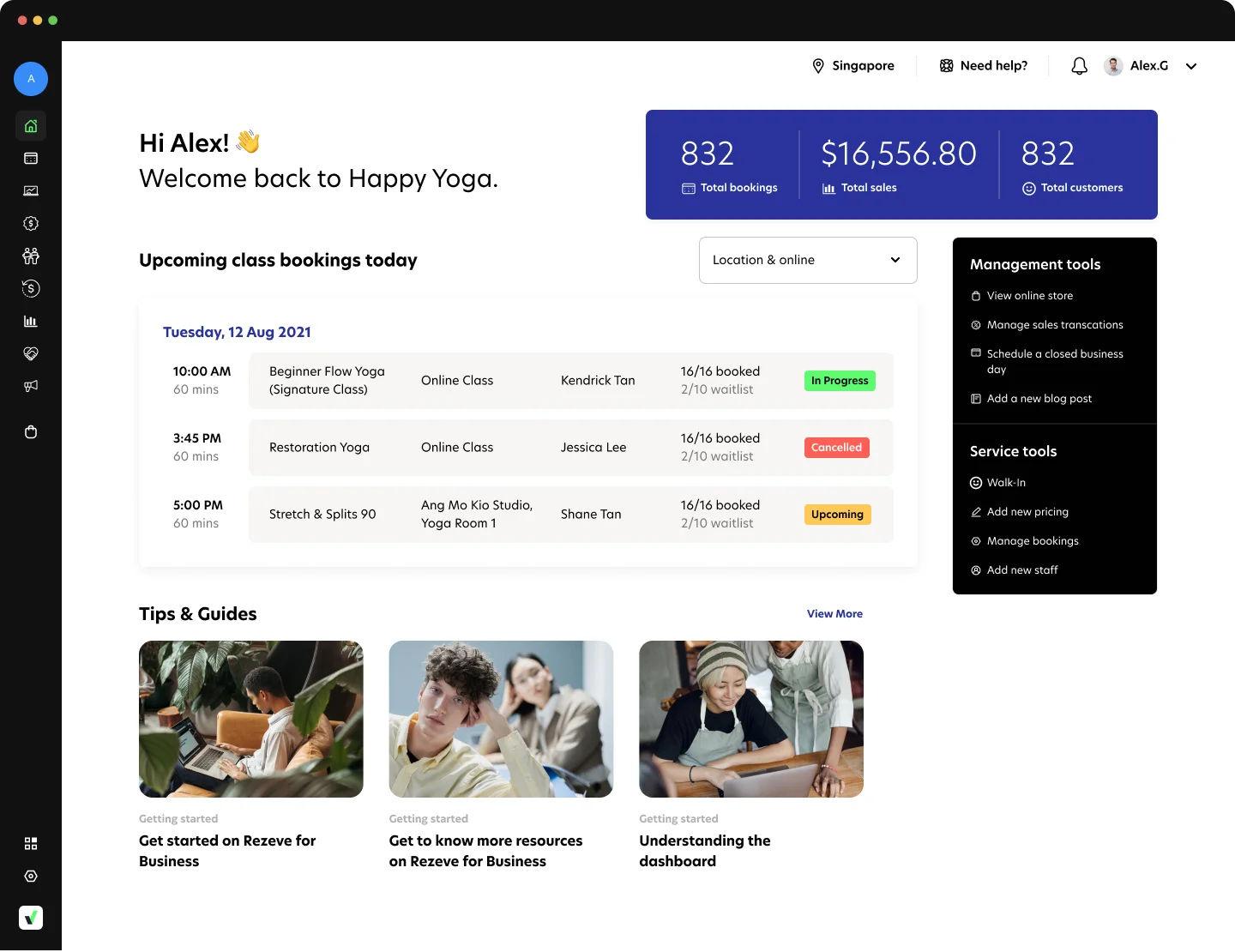
IV. Why many yoga studios prefer all-in-one payment and booking systems
As a yoga studio grows, using separate tools for bookings, payments, memberships, and reporting usually starts to create more work than it saves.
At first, it may seem manageable. One tool handles scheduling. Another collects payments. A spreadsheet tracks package usage. Staff manually check who has paid and who still has classes left.
Then the small cracks start showing.
A member’s payment goes through, but their access does not update properly. A customer buys a package, but the front desk still needs to confirm how many credits remain. Someone books a drop-in, but the payment record sits in a different system from the booking record. None of these issues sound huge on their own, but together they slow down operations and make the customer experience feel less polished.
That is why many yoga studios prefer all-in-one payment and booking systems. They keep the moving parts connected.
With an all-in-one setup, your studio can manage:
- recurring memberships
- class packages and credits
- drop-in payments
- bookings and attendance
- customer payment history
- revenue reporting
from one place.
That matters because yoga studios rarely sell just one thing. Most studios are juggling a mix of memberships, packages, drop-ins, workshops, and sometimes private sessions too. When all of that lives inside one system, your team spends less time fixing admin problems and more time focusing on the actual studio experience.
Here are a few reasons all-in-one systems tend to work so well for yoga businesses:
1. Fewer manual tasks for staff
Your team does not have to jump between platforms to verify payments, check package balances, or update member status. The system handles more of that automatically.
2. A smoother customer experience
Customers can book, pay, and manage their purchases in one flow. That makes the experience feel faster, simpler, and more professional.
3. Less room for errors
When bookings and payments are connected, there is less chance of mismatched records, missed renewals, or confusion around credits and active plans.
4. Better visibility into revenue
You can see how memberships, packages, and drop-ins are performing without piecing together data from different places.
5. Easier growth later
If you decide to add more pricing options, events, workshops, or new services, it is much easier to expand inside one system than rebuild your process across several disconnected tools.
Why Rezerv is the best all-in-one payment and booking systems for every yoga studio
Rezerv is designed to help yoga studios manage the full flow of the business in one platform, instead of forcing owners to patch together separate tools for bookings, payments, memberships, and reporting.
With Rezerv, you can run:
- monthly memberships with recurring billing
- class packages with credit tracking
- drop-in bookings with online payment
- different pricing options for different customer needs
- payment reporting that gives you a clearer view of sales and performance
And because payments are connected to bookings and customer records, the system feels much more operationally clean. Your staff can see what a customer bought, what they booked, and what they still have left without needing to double-check multiple places.
That is a big deal for busy yoga studios. It reduces friction at the front desk, cuts down on avoidable back-and-forth, and makes the business feel easier to run day to day.
Rezerv also makes sense for studios that want more flexibility in how they sell. You are not locked into one payment model. You can offer memberships for loyal students, packages for flexible buyers, and drop-ins for casual visitors, all within the same system. That gives you room to build a payment structure that matches how your studio actually operates.
For studios that care about both customer convenience and internal efficiency, that combination is hard to ignore.
The bigger advantage
The real value of an all-in-one system is not just convenience. It is clarity.
When your payment system, booking flow, and customer records are all connected, you get a much better grip on how the business is performing. You can spot what is selling, where revenue is coming from, and which offers are worth pushing harder.
That is the kind of setup that supports growth.
And for yoga studios looking for a practical system that can handle memberships, packages, drop-ins, and bookings in one place, Rezerv gives you that without turning daily operations into a mess.
Cheers,
Friska
FAQs
1. What payment options should a yoga studio offer?
A yoga studio should offer a mix of payment options to make booking easy for different customers. The most common options include credit or debit cards, bank transfers, digital wallets, and online payments through the studio’s booking system.
Some studios also accept in-person payments, but online payment options are important for convenience and faster checkout.
2. Are memberships better than class packages?
Memberships are usually better for predictable monthly revenue and stronger customer retention. Class packages give students more flexibility and can work well for casual attendees or beginners. For many studios, the best setup is offering both memberships and class packages so customers can choose what fits their routine and budget.
3. How do studios handle recurring billing?
Studios usually handle recurring billing through a yoga studio payment system that supports automatic membership renewals. This allows the system to charge members on a set schedule, such as monthly, without staff needing to process each payment manually.
4. Can students pay for classes online?
Yes, most modern yoga studios allow students to pay for classes online. This usually happens through the studio’s website or booking platform, where students can buy drop-ins, memberships, or class packages before attending. Online payment makes booking faster and reduces manual work for the studio team.
5. How do studios track package credits and payments?
Studios track package credits and payments through booking and payment software that records each purchase and automatically deducts credits when a class is booked.
This helps owners see how many sessions each student has left, which packages are active, and which payments have been completed. It also reduces errors that often happen with manual tracking.
.jpg)