Expanding your wellness business into mobile health services
Incorporating mobile health services into your existing wellness business isn’t as difficult as it sounds and may be just what your growth strategy needs.
Your clients really like what you have to offer. Sometimes they just can't get through to you. This is because people are busy and have so many things to do.
That is a problem because they have to travel the way to get to you. Even the people who really like your business may not show up for appointments because it is too much trouble.
At the same time, competitors who provide services directly to clients are taking market share you didn’t even know existed.
The good news is, incorporating mobile health services into your existing wellness business isn’t as difficult as it sounds and may be just what your growth strategy needs.

Source: Pexels
Why mobile wellness services are worth your attention
The mobile health market is not just growing; it’s exploding. The global mobile clinics market is expected to grow at a CAGR of 11.63% from $5.25 billion in 2024 to $15.76 billion by 2034. It’s not a niche trend. "It is a fundamental change in how people want to be cared for.
And the wellness industry at large? Research says it was $6.3 trillion in 2023 and is still growing at about 7-8% per year. This sweet spot of two growth areas is a perfect place for wellness business owners who are willing to adapt.
What’s behind this change:
- Clients want convenience above all else more and more.
- Companies with wellness programs look for service providers on-site
- Underserved communities desperately need wellness options they can access
- Norms after the pandemic have made house calls and mobile services mainstream
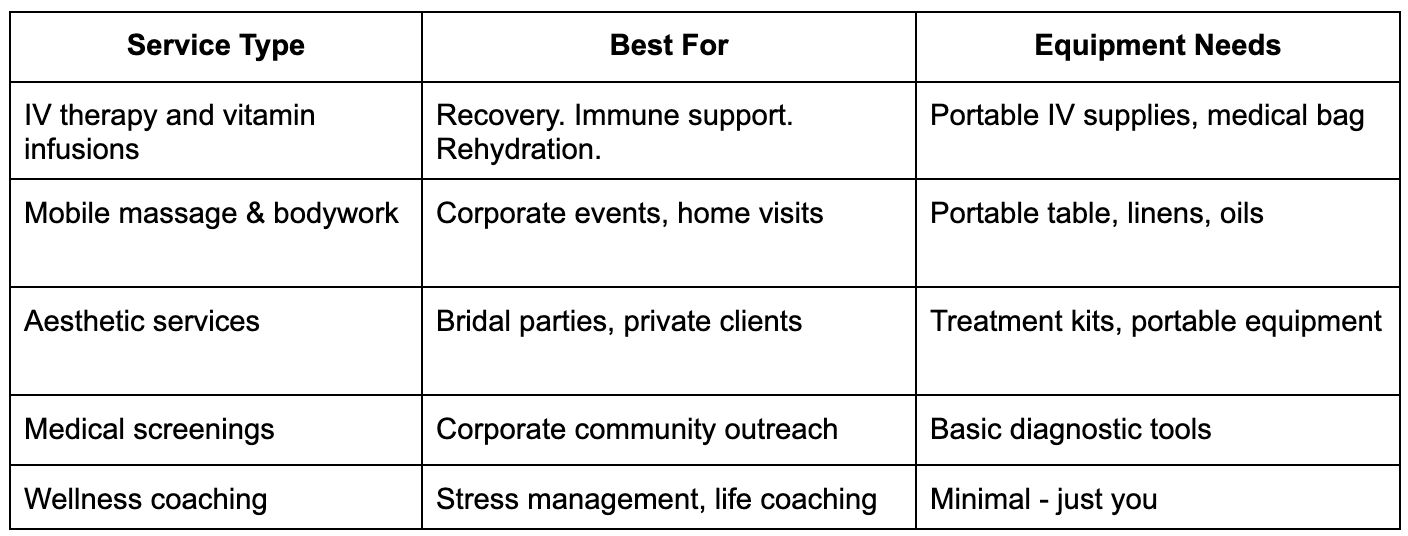
Types of mobile wellness services that actually work
Not every wellness service translates well to a mobile format. The key is matching your existing expertise with services that travel efficiently.
Planning your mobile expansion
Before ordering a vehicle wrap, you need a solid operational foundation. If you’re still in the early stages of building your wellness business, nailing this part first will make mobile expansion so much smoother. With careful planning now, you save time and energy later.
Start with your vehicle decision. This doesn't have to mean purchasing a fully outfitted medical van immediately. Many wellness businesses begin with simple mobile services where practitioners travel to client locations with portable equipment. When you're ready to scale, you can explore dedicated vehicles.
If you’re thinking about a dedicated mobile unit, knowing your mobile clinic setup costs upfront can help prevent budget surprises. The price varies a lot depending on the kind of vehicle, degree of personalization, and equipment needs. A retrofitted Sprinter with a few basic wellness amenities is much less expensive than a full-on mobile medical clinic with multiple treatment rooms.
Define your service radius carefully. Travel time is unbillable time. Most successful mobile wellness operations limit their service area to a 30-45 minute radius from their home base or create zone-based pricing that accounts for distance.
Price for profitability, not just competitiveness. Mobile services typically command premium pricing - and clients expect that. Factor in travel time, fuel costs, vehicle maintenance, and setup time when calculating your rates. Many mobile wellness providers charge 20-40% more than their in-clinic rates.
Considerations for licensing and compliance
Here's where things get serious. Mobile wellness services may not operate out of a traditional clinic setting, but that doesn’t mean they get to escape regulation.
What to check before you go live:
- State licensing requirements for mobile health operations
- Professional credentials covering mobile practice settings
- Insurance coverage specifically for mobile services and vehicle incidents
- HIPAA compliance for mobile documentation and record storage
Some states require separate permits for mobile health operations, and some treat them the same as fixed-location practices. “Do your due diligence on your state’s requirements before you launch, not after.
Marketing your new mobile services
Having mobile capabilities means nothing if potential clients don't know about them.
Update your online presence immediately. Ensure your website clearly states you now offer services. Your Google Business Profile and social media should also have this information. It's time to refresh your content strategy. You need to add information about the areas you serve. Also, list the services you offer and how people can book them. This way the customers know what you offer and how to get it.
Go after corporate clients aggressively. “We’re seeing more and more companies investing in employee wellness, and they love the convenience of having services brought to their campus.” Corporate wellness event packages, lunch break services, or recurring monthly visits.
Create strategic partnerships. Referrals are from hotels, event venues, fitness centers, and real estate agents dealing with luxury properties. A hotel concierge recommending your mobile massage services creates a steady client pipeline.
Technology that makes mobile work
A cumbersome booking process is one of the fastest ways to sink your mobile wellness business. The good news is that mobile health technology is becoming cheaper and easier to use.
Essential mobile wellness technology stack:
- Geologistics and travel time scheduling software
- Payment processing like Stripe, Square, etc.
- Intake and Consent Forms Online
- Automated text reminders with preparation instructions
Your scheduler needs to factor in travel time between appointments and mobile-specific service categories. You need a system to send reminders to people about their appointments and how they should prepare.
Wellness booking software like Rezerv enables you to manage scheduling, appointment bookings, automated reminders, customers, payments, forms, and marketing campaigns via email, SMS, and WhatsApp.
Common questions
1. How much does it cost to start a mobile wellness service?
The cost of starting a mobile wellness service can vary. It depends on things like mobile wellness technology. The cost of starting a mobile wellness service can be low for people who travel with equipment, but the cost of starting a mobile wellness service can range from $50,000 to $150,000 for fully equipped mobile wellness units. Most mobile wellness companies begin with a base and then expand as demand for mobile wellness services rises.
2. Do I need special insurance for mobile wellness?
Yes, most standard professional liability policies require additional coverage for mobile operations. Contact your insurance provider before launching to add mobile service coverage.
3. How much should I charge for mobile wellness services?
Mobile services typically have 20-40% premiums to in-clinic pricing. Don't forget travel, fuel, vehicle, and setup time. Zone-based pricing works well for larger areas of service.
4. Can I offer mobile services with my business license?
Perhaps. That depends on the state and the type of service. In some states, mobile permits are separate. Check with your state’s licensing board for requirements before you begin.
5. How to get corporate clients for mobile wellness services?
Network with HR directors and workplace wellness consultants. “Make packages that are specific to the corporation, and call local businesses directly. It is an idea to start by looking at LinkedIn and joining local business groups.
Key Takeaways
- Mobile wellness market to reach $15.76 billion by 2034, mobile clinics booming
- Start by converting your current services to mobile-friendly formats such as IV Therapy, Massage, Aesthetics, and Coaching
- Research mobile format options and setup costs before committing to a particular mobile format
- Licensing, insurance, and compliance requirements don’t disappear just because you’re mobile
- Charge a premium for mobile services that matches the convenience you are offering
- Target corporate clients for consistent revenue and update all marketing channels