Fitness advertisements: 15 Examples and ideas for better ads
15 fitness advertisement examples from gyms, studios and coaches, sorted by business type and campaign type. Each one shows what the ad did, why it worked and how to borrow it for your own gym on a smaller budget, plus platform tips and the numbers to track
Source: senivpetro on Magnific
You put a few hundred dollars behind an Instagram ad for your studio. The reel gets thousands of views, a stack of likes, and a comment from your cousin. Then you open your booking calendar and find two new trial sign-ups.
Most fitness ads lose people at the same three points:
- The offer is vague. “Join now” gives nobody a reason to act today.
- The audience is too broad. An ad written for everyone in the city speaks to no one in particular.
- The click goes nowhere useful. People land on a homepage and have to hunt for the timetable.
Each of these has a fix you can copy from gyms, studios and fitness brands that already get it right.
In this guide, you’ll find 15 fitness advertisement examples sorted by business type and campaign type, so you can jump straight to the ones that match what you sell.
For each example, you’ll see:
- What the ad did
- Why it worked
- How to borrow the idea for your own gym or studio on a smaller budget
After the examples, we’ll cover platform tips for Meta, Google and TikTok, the ad policies that trip up fitness businesses, and the numbers worth tracking once your ads go live.
I. What makes a fitness advertisement work
The ads in this guide come from very different businesses, from global gym chains to single-room Pilates studios. Almost all of them get the same four things right.
1. One audience, one offer, one action
Each strong ad speaks to a specific person, makes one offer, and asks for one next step.
- Audience: office workers near Raffles Place, new mums in Kemang, first-timers who have never tried reformer Pilates
- Offer: first class free, a two-week intro pass, 30% off the first month
- Action: book a class, claim the pass, message the studio on WhatsApp
When one ad tries to reach beginners and athletes at the same time while promoting three membership tiers, nobody reading it feels it was written for them.
2. A reason to act this week
People scroll past offers they can claim any time.
Give them a deadline or a limit:
- "Founding member rate ends 30 November"
- "Only 12 spots left in the 6am beginner class"
- "Intro price for the first 50 sign-ups"
Keep the limit real. If the same "last chance" offer comes back every month, your regular followers will notice and stop trusting your deadlines.
3. Proof people can picture themselves in
Stock photos of models look the same across every gym's feed, so they rarely stop anyone mid-scroll. Footage from your own business gives prospects something specific to picture:
- Real members mid-class, filmed with their permission
- Your coaches introducing themselves on camera
- A short quote from a member who started as a complete beginner
- Your actual space, including reception and the changing rooms
Using real people and real results also keeps you clear of most ad platform rules on fitness claims, which we'll cover in section D.
4. A booking path that takes under a minute
The ad's job ends at the click. From there, your booking flow decides whether you get a new member.
- Link straight to the class or offer the ad promises
- Let people book and pay on the same page
- Send an instant confirmation with the address, what to bring and where to park
Quick test: click your own ad on your phone and time how long it takes to book. If it takes longer than a minute or asks you to create an account first, fix that before you spend another dollar on ads.
Pre-launch checklist
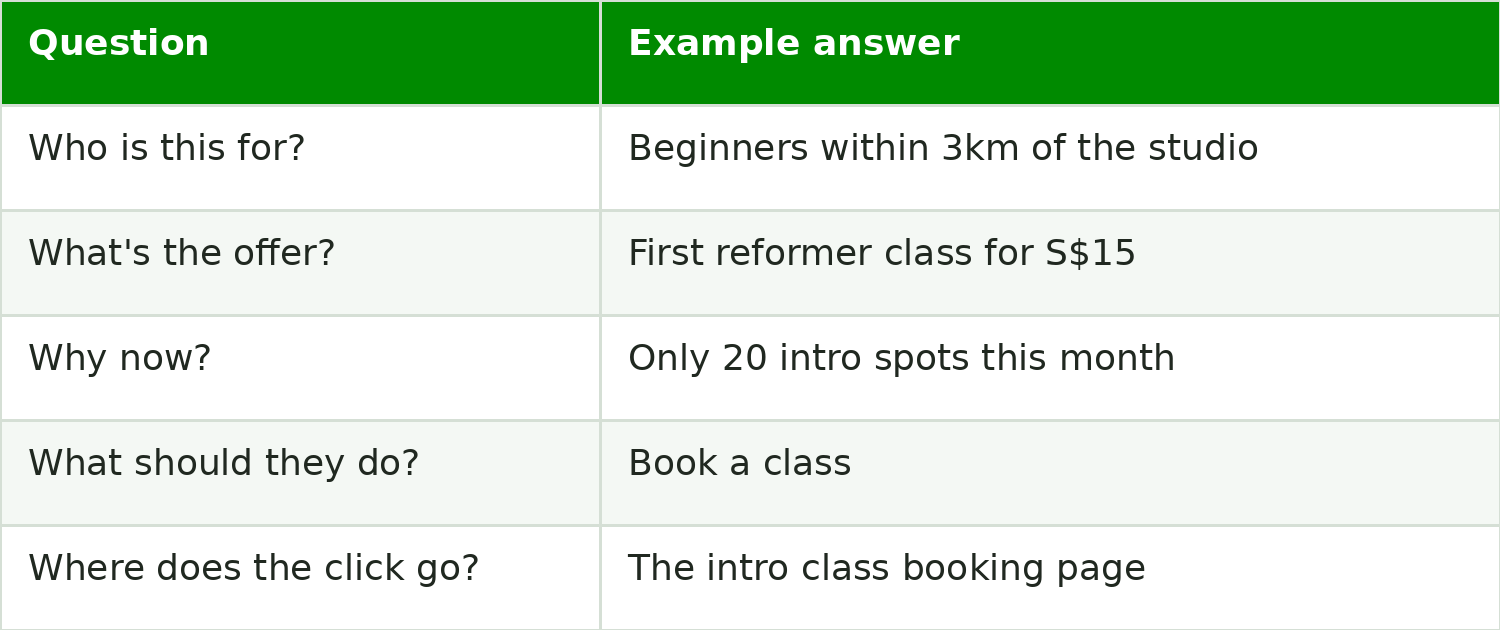
Run every ad through these five questions before it goes live:
II. Fitness advertisement examples by business type
These six examples cover the most common fitness business models. Find the one closest to yours and use its format for your next ad.
1. Gym membership advertisements: lead with the joining offer
Source: PRNewswire
The ad
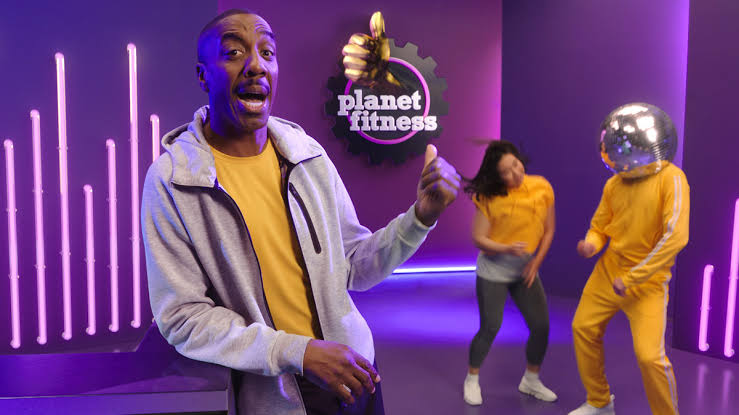
Actor and comedian J.B. Smoove headlined Planet Fitness’s “Get Down With Your Judgement Free Self” campaign, which launched on New Year’s Eve and invited people to join for $1 down and then $10 a month from 1 to 15 January.
The campaign builds on the chain’s “Judgement Free Zone”, which Planet Fitness introduced in 1997 to make first-time gym users feel comfortable joining. The New Year approach has worked before: during an earlier January push, the brand’s Ad Awareness score rose from an average of 11% in December 2017 to 16% in January 2018.
Why this type of ad works
A gym membership is a monthly commitment, so the biggest barrier is the fear of paying for months you won’t use.
Strong gym ads remove that fear early:
- They lead with the joining offer: no joining fee, a cheap first month, or no lock-in contract
- They set a short deadline, so people act this week
- They name the worry that keeps people away, such as feeling judged or out of place
Borrow it for your gym
- Run a “no joining fee” offer with a clear end date
- Pick the one worry your prospects mention most and answer it in the headline
- Film a 15-second walkthrough from the entrance to the free weights area on a normal evening
2. Personal training advertisements: sell the coach, then the result
Source: Fitness First Asia (YouTube)
Watch here: Fitness First Let's Get Personal - Wen - YouTube
The ad
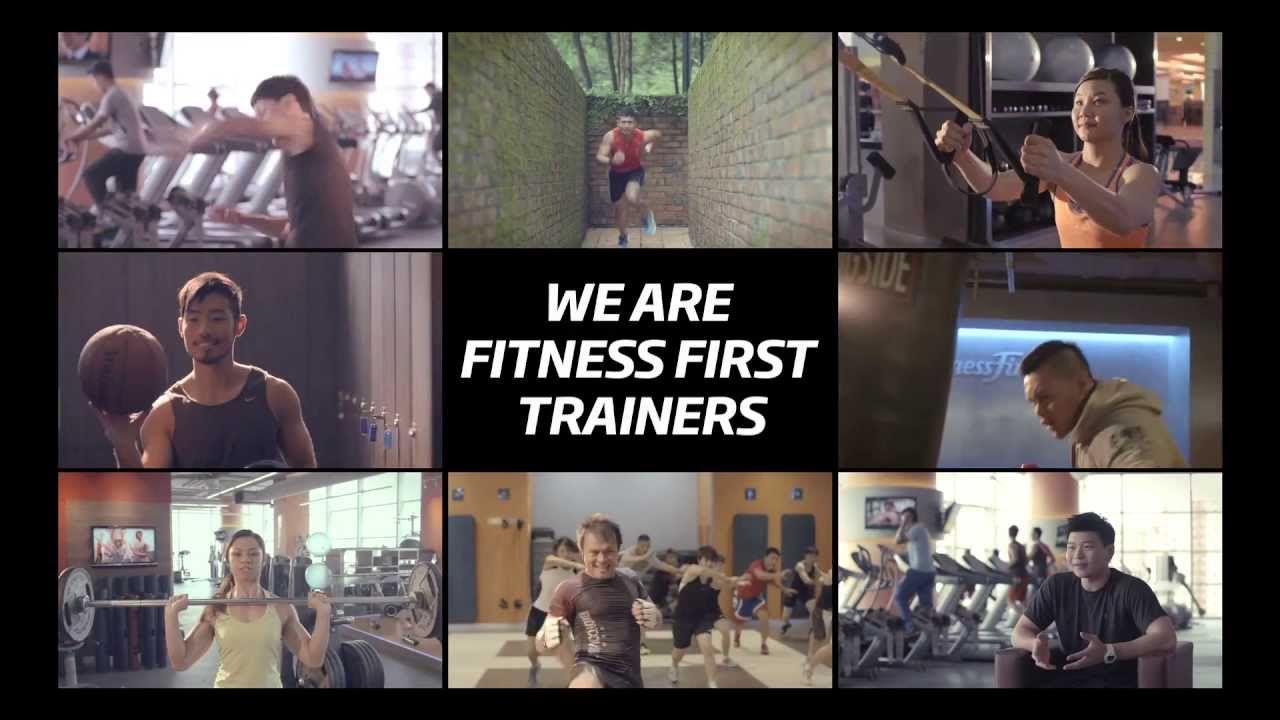
Fitness First Asia’s “Let’s Get Personal” campaign ran across Malaysia, Singapore, Hong Kong, Thailand, Indonesia and the Philippines, inviting people to take a “match-making” test to discover their most compatible personal trainers.
Alongside the quiz, the brand released a series of short videos featuring its trainers, to show the expert faces behind its personal training.
Why this type of ad works
People buying personal training are choosing a person to spend several hours a week with.
The best PT ads build trust in that person first:
- The coach appears on camera, speaking in their own words
- The ad shows who the coach trains, such as busy parents, runners or people returning after a long break
- A quiz or match turns a big decision into a quick, personal one
Borrow it for your studio
- Build a three-question “which coach suits you?” quiz with an Instagram story poll or a short form
- Record a 30-second intro for each coach covering who they train and what a first session looks like
- Offer a single assessment session as the entry point, with packages coming after
3. Boutique fitness studio advertisements: show the experience inside the room

Source: Wonderful Machine
Watch here: This is Pure • AHHH GRRR - YouTube
The ad
PURE Group, which operates yoga and fitness studios, ran “This is Pure” in Hong Kong, Singapore, Shanghai and Taipei, paired with a share-to-win promotion for a one-year pass and a prize for the best photo of a “Grrr” or “Ahhh” moment.
The “Grrr” stood for the raw energy of a workout, and the campaign featured PURE’s own yoga teachers, instructors, personal trainers and boxing coaches across cinemas, video walls, MTR stations, print, outdoor and social media.
Why this type of ad works
Boutique studios charge more per class than a standard gym, so the ad has to show what the extra money buys.
The strongest ones capture the full experience:
- The sound, lighting and instructor energy during a class
- Real instructors instead of models, so prospects meet the people who’ll teach them
- A reason for current members to share the campaign, which puts your studio in front of their friends
Borrow it for your studio
- Film a point-of-view reel from check-in to the final stretch, keeping the real class audio
- Run a photo contest for members with a free month as the prize
- Put your class size cap in the copy so prospects know they’ll get attention
4. Pilates and yoga studio advertisements: reassure first-timers
Source: Businesswire
Watch here: Every Body Club Pilates - :30 - YouTube
The ad
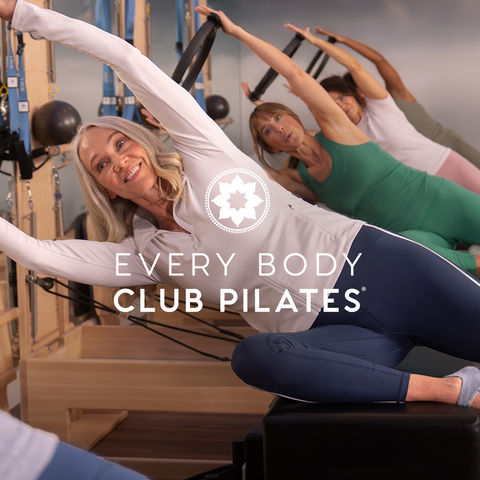
Club Pilates launched “Every Body Club Pilates”, its first national brand campaign, with the message that Pilates is for everybody regardless of age, body type or activity level. The campaign features one of its own Master Instructors.
Everyday Club Pilates members appear in the campaign video. Its CMO described the goal as removing the intimidation factor and showing that Pilates is for every person.
Why this type of ad works
Beginners hold back from Pilates and yoga for a handful of predictable reasons. They worry about flexibility, about the reformer looking complicated, and about not knowing the class etiquette. Ads that answer these worries give first-timers the confidence to book:
- They show beginners, mixed ages and different body types in class
- They feature real instructors, so the teacher feels familiar before the first visit
- They point to a dedicated beginner class or time slot
Borrow it for your studio
- Make a “your first reformer class” explainer covering what to wear, grip socks and how the machine works
- Feature three or four real members of different ages in one ad
- Run a separate ad set for a beginners-only class
5. Group fitness class advertisements: give every member a reason to join

Source: OrangeTheory Facebook
Watch here: Every Reason Is the Right Reason | 60-Second Cut - YouTube
The ad
Orangetheory’s “Every Reason is the Right Reason” centres on an upbeat 60-second spot celebrating the different reasons people work out there, from shedding a few pounds before a wedding to regaining strength after pregnancy. The campaign also kicked off a renewed brand strategy, including refreshed branding inside studios and across digital channels.
Why this type of ad works
People choose group classes for the shared energy, and each person arrives with a different goal. Showing many reasons in one ad lets a wider range of viewers picture themselves in the room:
- Each person on screen represents a different type of prospect
- Real class footage shows the energy of training together
- The message works for beginners and regulars at the same time
Borrow it for your studio
- Ask five members why they started, then cut their answers into a short video series
- Add your two most popular class times as on-screen text
- Open each clip on the most intense moment of the class, with real audio
6. Online fitness coaching advertisements: prove you can coach through a screen

Source: The One Club for Creativity
Watch here: Here We Go - Video | 2023 San Diego Awards - The One Club
The ad
Future’s “Here We Go” campaign celebrates the partnership between members and coaches on the journey to fitness consistency, and launched in August 2023 across its paid, earned and owned digital channels. It follows individual people, including new mums, athletes recovering from injury and older fitness fans, alongside their real Future coaches.
Why this type of ad works
The main doubt about online coaching is accountability. Prospects wonder whether anyone will check their form or notice when they skip a week.
The best online coaching ads put the coach in every frame:
- The coach and client appear together, so the relationship is visible
- Each story matches a specific type of client
- The ad shows how support happens, through check-ins, messages and feedback
Borrow it for your business
- Record a real form-check reply, with your client’s permission
- Show what a client receives each week: plan, check-in and feedback
- Offer a two-week trial at a low entry price
III. Fitness ad ideas by campaign type
The next nine examples are organised by campaign type, so each one works for any gym or studio. Pick based on your goal this month: more trial bookings, more referrals, or members who stay longer.
7. Free trial and first-class offer advertisements: make the first step easy to take
The ad
In October 2014, Fitness First Australia ran five free trial offers on Facebook at the same time: a three-day club pass, a free Hot Yoga class, a one-week club pass, a 10-visit pass for AU$10 and a free personal training session. Each offer had its own message and call to action, and the gym measured success by completed registration forms.
The results showed which audiences to target. People aged 18 to 34 clicked less often but cost less per lead, and targeting people by activity, such as yoga, beat targeting fans of other brands. The social ads also cost less per sign-up than signing people up on the street.
Why this type of ad works
A first visit is the biggest hurdle in fitness marketing. Once someone has tried a class and met a coach, the membership conversation gets much easier. Trial ads work when they make that first step feel free of risk:
- The offer costs nothing or close to nothing
- Claiming it takes seconds
- A limited number of passes gives people a reason to act now
Borrow it for your gym
- Run a “first class free” ad that links straight to a bookable class, with no account creation needed
- Cap the offer at a set number of passes and show the count in the ad
- Test two or three trial offers side by side, such as a free class, a one-week pass and a free personal training session, and keep the one with the lowest cost per sign-up
- Target people by the activity they already do, such as yoga or running
- Follow up with every trial booker within 24 hours of their class
8. Referral and bring-a-friend advertisements: give both sides a reward
Source: Swipefile
The ad
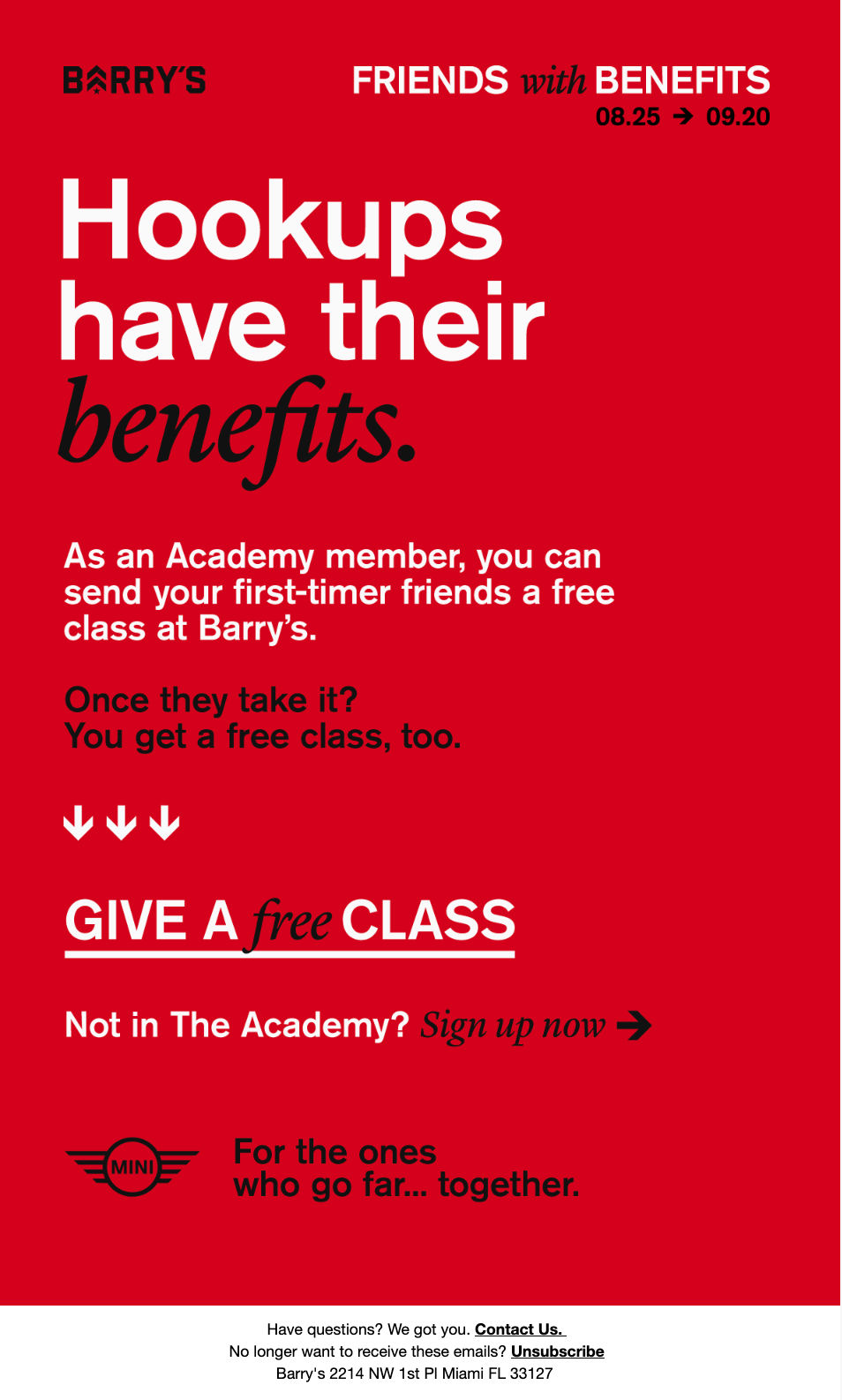
In 2025, Barry’s framed a standard referral promo like a flirty hookup. The bright red ad headline “Hookups have their benefits” asked members to give a friend a free class and get one back, with a limited-time offer to drive urgency.
Why this type of ad works
People trust a friend’s recommendation more than any ad, and they’re more likely to stick with a gym where they already know someone.
Referral ads work best when:
- Both the member and the friend get something, so asking feels like a favour to both
- The copy matches the brand’s personality, which makes members happy to share it
- The offer has an end date
Borrow it for your studio
- Run a give-one-get-one offer: a free class for the friend and a free class for the member
- Show the ad to your current members using a customer list audience on Meta
- Write the headline in your studio’s own voice, even if that means a little cheeky
- Give every member a unique referral code or link so you can track who brought whom
9. Fitness challenge advertisements: give people a start date and a finish line

Source: Gymshark (YouTube)
Watch here: HOW TO CHANGE YOUR LIFE IN 66 DAYS | Gymshark66 - YouTube
The ad
Gymshark built “66 Days | Change Your Life” around one idea: if it takes 66 days to form a habit, it takes 66 days to change your life. The first edition ran from 1 January to 7 March and let people choose any goal they liked. It was Gymshark’s first major push into TikTok, using six fitness and dance creators to promote the challenge. The hashtag was viewed 45.5 million times, and the influencer videos received nearly 2 million likes.
The challenge now runs every year as a free programme in the Gymshark Training app, where participants pick three daily habits across mind, movement and nutrition and tick them off each day.
Why this type of ad works
Gymshark is an apparel brand, but the format transfers straight to gyms and studios. A challenge gives people a clear reason to start on a specific date and stay until a specific end point:
- A fixed start date creates urgency
- Small daily goals feel achievable for beginners
- Participants post their progress, which turns them into your advertisers
- Finishers have built a habit around your gym, which helps retention
Borrow it for your gym
- Launch a 30-day challenge with a set start date and a simple daily or weekly target, such as 12 classes in 30 days
- Ask participants to post their progress with your studio’s hashtag
- Offer a prize people actually want, such as a free month or a branded kit bag
- Use finishers’ stories and photos, with permission, as your next round of ads
10. Seasonal fitness campaigns: plan around the full calendar

Source: Merahputih.com
The ad
To celebrate its third anniversary and Indonesian Independence Day, FIT HUB launched “Gym-nya Indonesia” (Indonesia’s gym), positioning itself as the country’s largest gym brand and an easy route to a healthier lifestyle. The campaign set out to change three common beliefs about quality gyms: that membership is expensive, that they’re unfriendly to beginners, and that they’re hard to reach.
Why this type of ad works
People already pay attention to national holidays and big shopping dates, so a campaign tied to one gets noticed without having to create its own moment.
The strongest seasonal ads:
- Link the offer to an occasion people feel good about, such as a national day or a brand anniversary
- Use the occasion to deliver a bigger message, like FIT HUB’s push against the “gyms are expensive” belief
- Run for a fixed window, which builds urgency on its own
Borrow it for your gym
Most gyms only plan for January.
Here’s a fuller calendar for Southeast Asia:
- January: New Year resolutions (start promoting in mid-December)
- Lunar New Year: a “reset after the feasting” offer
- Ramadan: adjusted timetables, such as pre-iftar and late-night classes
- After Lebaran or Hari Raya: a back-to-routine offer for members returning from the holidays
- National days: 17 August in Indonesia, 9 August in Singapore and 31 August in Malaysia, with pricing tied to the date (for example, 17% off on 17 August)
- Mid-year: a halfway check-in for anyone whose resolutions have slipped
- 11.11 and 12.12: shoppers are already looking for deals, so run your best pack offer here
- Your studio’s anniversary: a reason to thank members and reward referrals
11. New facility and equipment launch advertisements: make the upgrade the headline

Source: MediaPost
Watch here: Planet Fitness TV Spot, 'We're All Strong: $15' Song by When in Rome - iSpot
The ad
Planet Fitness launched its “Strong” campaign on Christmas Day, during an NFL game streamed on Netflix, with shorter spots airing during the New Year’s Eve broadcast. The work centred on its new plate-loaded strength machines, including a supine bench press, hack squat and seated calf machine. The equipment had already reached more than 1,700 clubs, and the ads ran alongside a limited-time join offer for the New Year.
The brand backed it up on social media too, comparing its dumbbells to those at an “overpriced competitor gym” to show they weigh the same and get the same results for a lower membership price. The campaign worked well enough that Planet Fitness extended it into 2026.
Why this type of ad works
New equipment or a new space gives lapsed members a reason to come back and gives prospects something concrete to look at. It also answers a common reason people leave a gym: they think it’s outdated or doesn’t have what they want to train with.
- The new equipment is named and shown, so the upgrade is specific
- The launch is paired with a join offer, which turns interest into sign-ups
- The timing matches a moment when people are already deciding where to train
Borrow it for your gym
- Film the new kit or space being unboxed and set up, then post a first-session clip with a coach
- Send a “come back and try it” offer to former members with the launch ad
- For a new location, run a founding member presale with a capped number of discounted spots
- Host an open day where people can try the equipment with a coach before buying
12. On-demand and hybrid membership advertisements: keep members training when they can’t come in
Source: BrandinginAsia
Watch here: Gold's Gym Indonesia - Gym It Yourself - YouTube
The ad
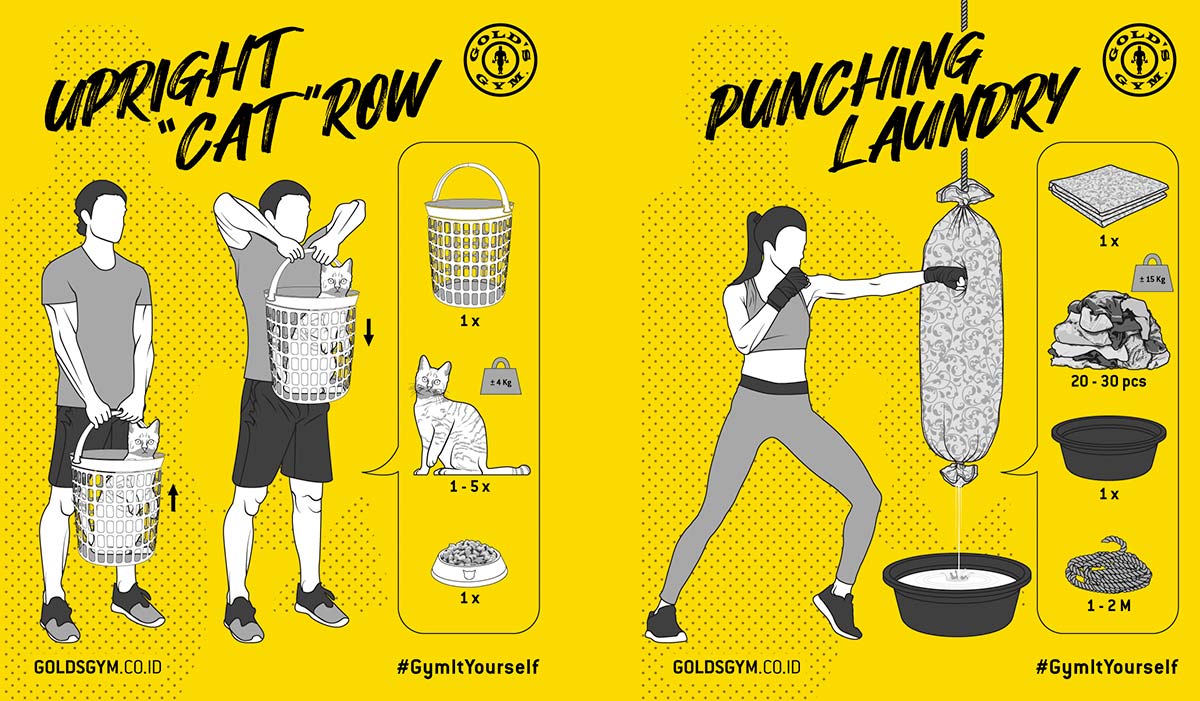
When pandemic restrictions kept Indonesians away from gyms in June 2020, Gold’s Gym Indonesia and LUP Jakarta released “Gym It Yourself”. The digital campaign was a series of step-by-step tutorials showing people how to train like they were at the gym using everyday household items.
Why this type of ad works
Members don’t stop training because they lose motivation alone. Travel, holidays, busy weeks and bad weather all keep people away from the gym. On-demand and hybrid ads show that your coaching goes with them:
- They keep your brand in front of members on the days they can’t visit
- Household-item workouts make the content useful to anyone, without special equipment
- A hybrid plan can be sold as a lower-priced tier to people who aren’t ready for a full membership
Borrow it for your gym
- Film a short series of home workouts using household items, led by your own coaches
- Promote the series before long holidays like Lebaran mudik or year-end travel, when members miss the most sessions
- Offer an on-demand add-on or a hybrid plan that mixes studio classes with at-home sessions
- Use the content as a free taste of your coaching for people who haven’t visited yet
13. Member app and online booking advertisements: put the booking button in their pocket
Source: PureGym on the App Store
The ad
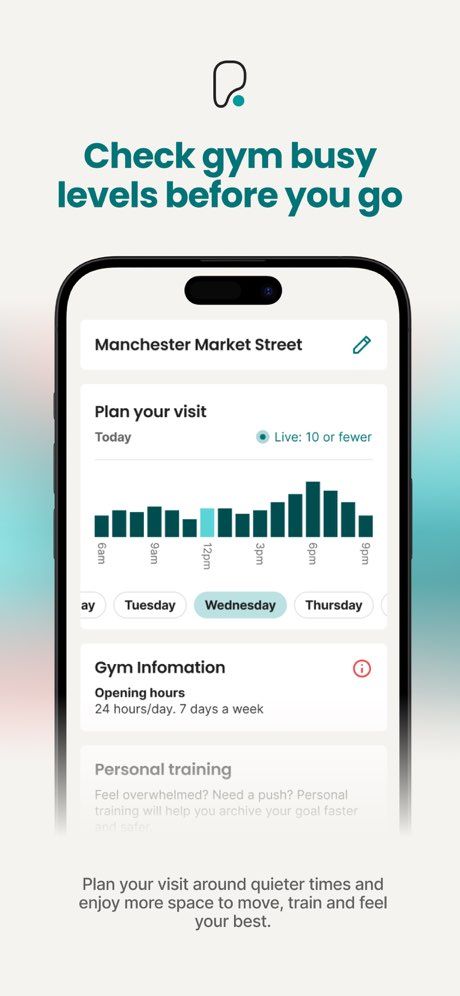
PureGym’s myPureGym app was the first in the industry to let users book, manage and cancel classes in real time, and it won a DMA Bronze award for Best Use of Mobile. Its four main features were weekly class times that people could book straight into their phone calendar, GymScan (a QR code on every piece of equipment linking to how-to videos), and a gym finder with full local information for non-members.
Why this type of ad works
Every extra step between “I want to go” and “I’m booked” loses people. App and booking ads remove those steps and give members a reason to open your app instead of a competitor’s:
- They show the booking in action, usually in two or three taps
- They highlight one useful feature beyond booking, like PureGym’s equipment videos
- They speak to members and prospects at the same time
Borrow it for your studio
- Record a 10-second screen capture of a member booking a class in your app, and use it as the ad
- Put QR codes on your equipment or studio walls that open how-to videos or the class timetable in your app
- Run an “app-only” perk, such as early access to popular class slots, to drive downloads
- If you run on Rezerv, promote your own branded member app, so every ad sends people to a booking flow with your studio’s name on it
14. Studio merchandise and activewear advertisements: turn members into your best billboard
Source: London On The Inside
The ad
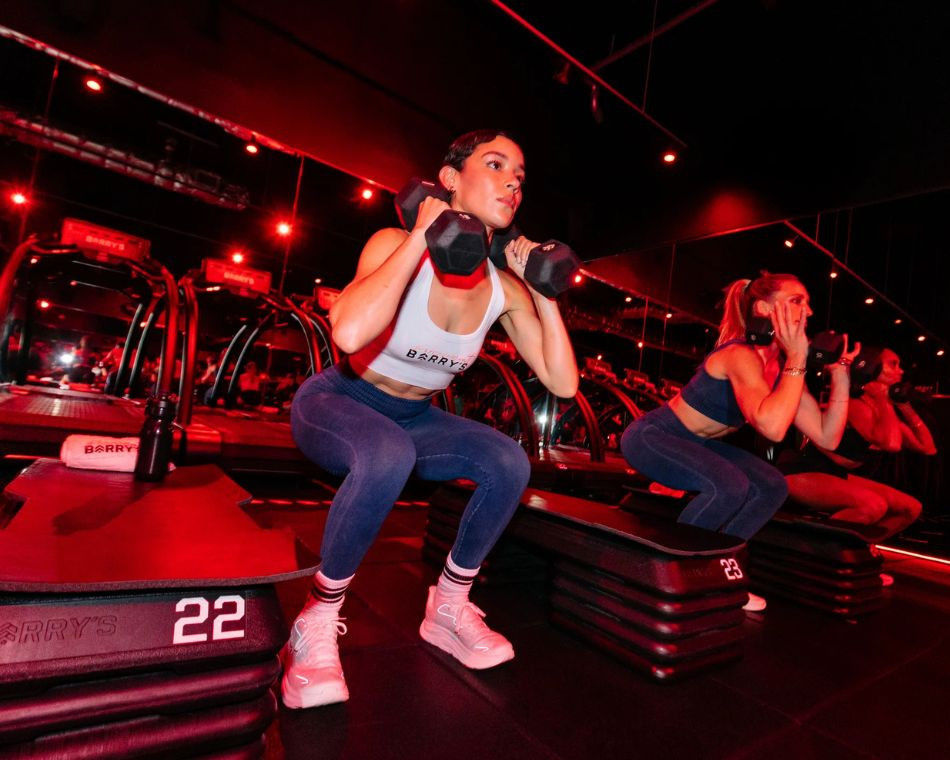
Barry’s partnered with FP Movement, Free People’s activewear brand, on a co-branded collection. The UK launch included a limited-edition smoothie and a six-week pop-up at Selfridges with weekly classes, with the clothes sold at Selfridges and over 60 Barry’s locations.
The partnership returned in July 2026 with a second drop of 10 co-branded styles, sold only at select Barry’s studios. Studios marked the launch with a special themed class, and every attendee received a free post-workout shake.
Why this type of ad works
Merchandise keeps advertising long after the ad stops running. Every member who wears your logo to the supermarket or the office is showing your brand to people nearby.
A partnership adds even more:
- The partner brand promotes the collection to its own audience, which brings in new prospects
- A limited drop gives members a reason to buy now
- A launch class or event gives people a reason to visit the studio, including non-members
Borrow it for your studio
- Start small with grip socks, tote bags or tees that members actually want to wear
- Partner with a local activewear brand for a small capsule, and split the promotion across both brands’ channels
- Launch the drop with a themed class open to non-members
- Use merch as a prize for your challenge or referral campaigns
15. Fitness retargeting advertisements: follow up with people who almost booked
Source: Custom Creatives
The ad
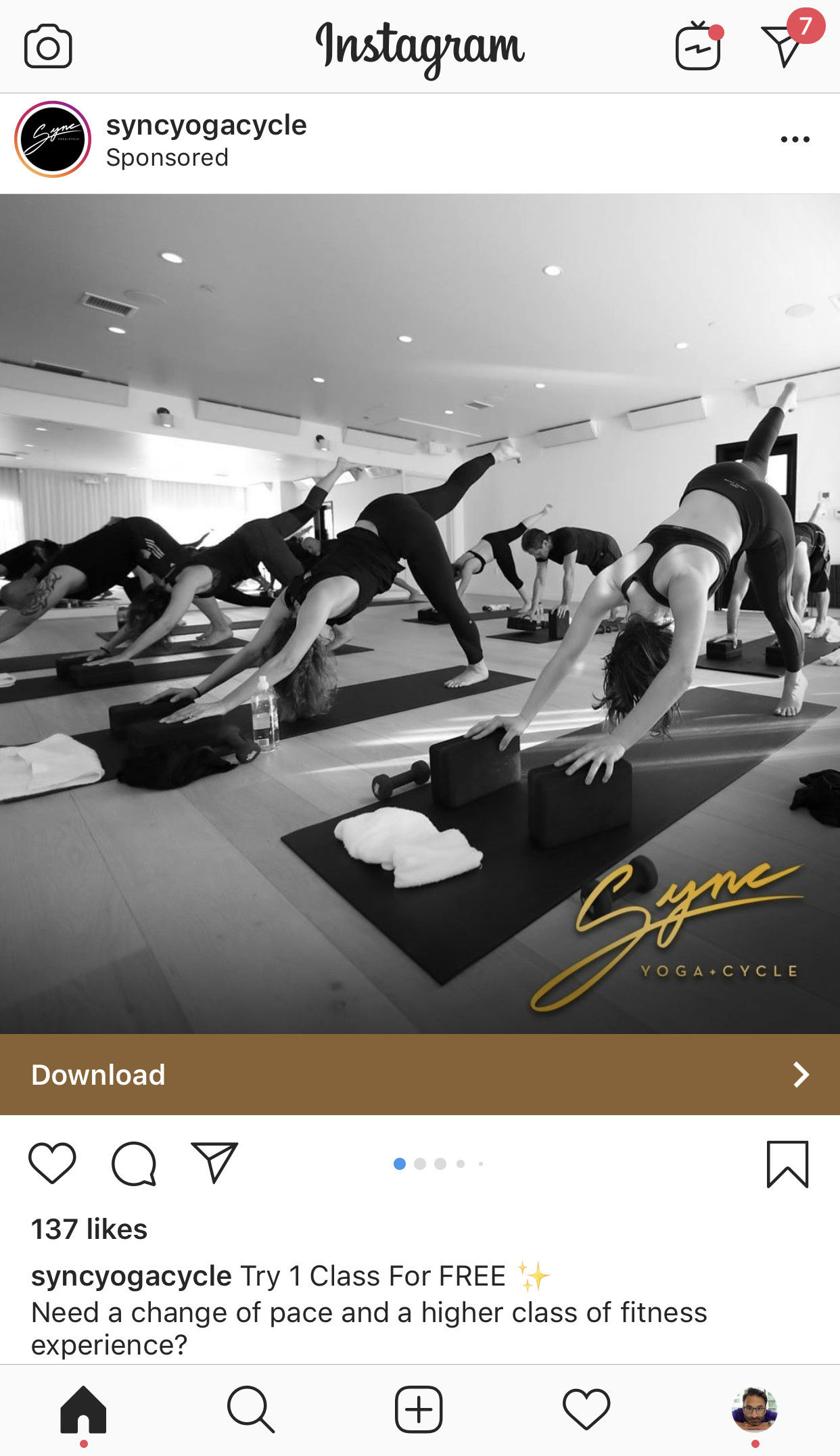
A fitness studio in Glendale, California ran Facebook ads offering a free class worth $25. On top of the main campaign, the agency ran retargeting ads to people who had visited the studio’s website without signing up. Retargeting brought in 13 extra leads at a cost of $1.63 each, leads the studio would have missed without it.
Why this type of ad works
Most people don’t book the first time they see your ad or visit your website. They get distracted, compare options or wait for payday. Retargeting reaches people who already showed interest, which makes it one of the cheapest ways to get bookings:
- The audience already knows your studio, so the ad has less convincing to do
- The message can pick up where they left off, such as “your free class is still waiting”
- Small audiences mean small budgets, which suits studios spending a few hundred dollars a month
Borrow it for your gym
Set up separate retargeting audiences, each with its own message:
- Timetable or pricing page visitors who didn’t book: remind them of your intro offer
- People who watched most of your video ads: show a member testimonial or coach intro
- Trial bookers who didn’t join: offer a membership discount that expires within a week
- Lapsed members: show what’s new, such as new classes, coaches or equipment
- Exclude current members from all of these, so you’re not paying to show offers to people who already pay you
IV. Tips for better fitness ads by platform
Each platform rewards a slightly different approach. Here’s what to get right on the four places most gyms and studios advertise.
A. Meta (Facebook and Instagram)
Meta is where most fitness ads run, and it’s also where most fitness ads get rejected. Get the policy right first, since a rejected ad costs you days of momentum.
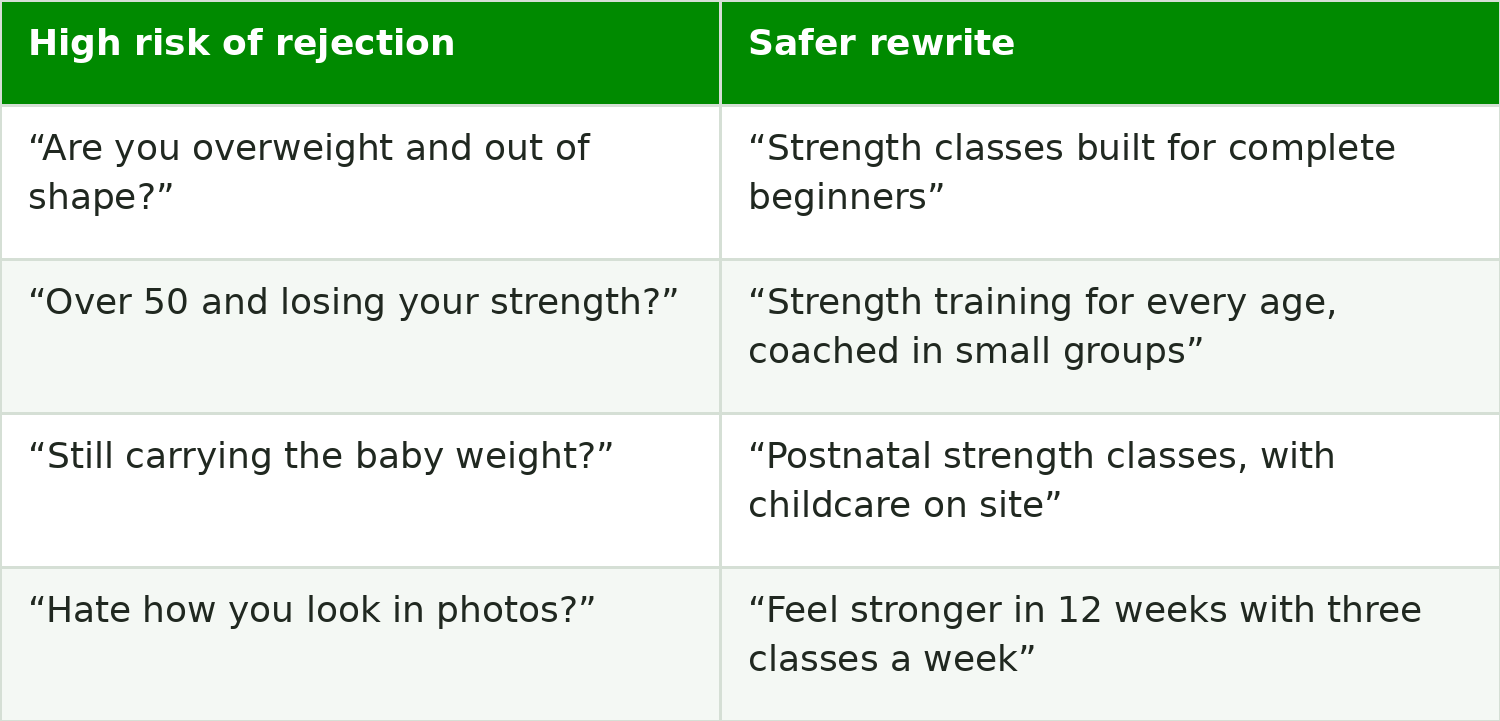
1. Describe the class, and leave the viewer’s body out of it
Meta’s Personal Attributes policy bars ads that assert or imply a viewer’s personal attributes, such as age, religion, health or vulnerable financial status.
The test is whether the ad talks about the product or about the viewer. In fitness, this usually catches copy that opens with “you” followed by something about weight, age or health.
2. Skip anything that shames how people look
Meta’s Health and Wellness standards don’t allow ads that make people feel negatively about the way they look, exploit insecurities, reinforce unhealthy body images or feature body-shaming. Lead with what people gain, such as strength, energy or confidence, instead of what they dislike about themselves.
3. Check the current rules before using before-and-after photos
The rules here changed recently. Meta rewrote its Health and Wellness Advertising Standards on 22 July 2026, replacing rejection by product category with claim-by-claim review. Under the current wording, before-and-after transformations are allowed in some categories when the ad targets people aged 18 and over.
For most gyms, progress stories built on performance and habits are still the safer choice, such as a member’s first pull-up or a 5km run without stopping. If you do use before-and-after photos, use a real member who has agreed to it, target adults only, and read Meta’s current policy page before launching.
4. Know whether your account has data restrictions
Since early 2025, Meta has limited mid and lower-funnel events such as Add to Cart and Purchase for advertisers it classifies as health and wellness, affecting advertisers in the US, EU and UK. Gyms aren’t a Meta Special Ad Category, but some fitness businesses have been flagged anyway. You can check how your account is classified in Events Manager, under Settings, then Manage Data Source Categories. If you’re restricted, track bookings in your own booking system so you still know which ads bring in members (more on this in section E).
5. Refresh your creative often
Fitness is a crowded category on social media, so ads wear out quickly. One estimate puts the lifespan of a fitness ad on Instagram at around two to three weeks before frequency drags down click-through rates. Plan a new batch of footage every month.
B. Google Search
People searching on Google already want a gym. Your job is to show up for the right searches, in the right area.
- Target local searches: “gym near me”, “reformer pilates [neighbourhood]”, “personal trainer [area]”
- Limit your radius: One agency cut a fitness centre’s cost per conversion by 67%, from $60 to $19, mainly by restricting ads to people near the gyms and using exact match keywords such as “gym near me” and “CrossFit membership”.
- Add negative keywords like “jobs”, “home workout” and “equipment for sale” to stop paying for irrelevant clicks
- Match the ad to the search: if someone searches “pilates intro offer”, the headline should show your intro price
- Keep your Google Business Profile updated with opening hours, photos and recent reviews, since it appears in Maps results next to your ads
C. TikTok and Instagram Reels
Short-form video works best when it looks like content people already watch, filmed on a phone by people who actually work at your gym.
- Hook in the first two seconds: open on the hardest rep, a coach’s direct question or a surprising moment
- Shoot vertical and add captions: many people scroll with the sound off
- Use formats that repeat well: “POV: your first reformer class”, “3 moves our coaches use every warm-up”, “What 6am at our studio looks like”
- Boost posts that already perform: put budget behind organic videos with strong watch time, using Spark Ads on TikTok or boosted posts on Instagram
- Apply the same copy rules as Meta: TikTok has its own restrictions on body image and weight-loss claims
Landing pages
Every platform sends people somewhere. Section A covered the one-minute booking test.
On top of that:
- Build one page per offer: the intro offer ad goes to the intro offer page
- Show the price: hidden pricing sends people back to the scroll
- Embed the timetable so people can pick a class without clicking away
- Add a WhatsApp button: across Southeast Asia, many prospects would rather message than fill in a form
- Put a member quote or rating near the booking button
V. Measure what matters
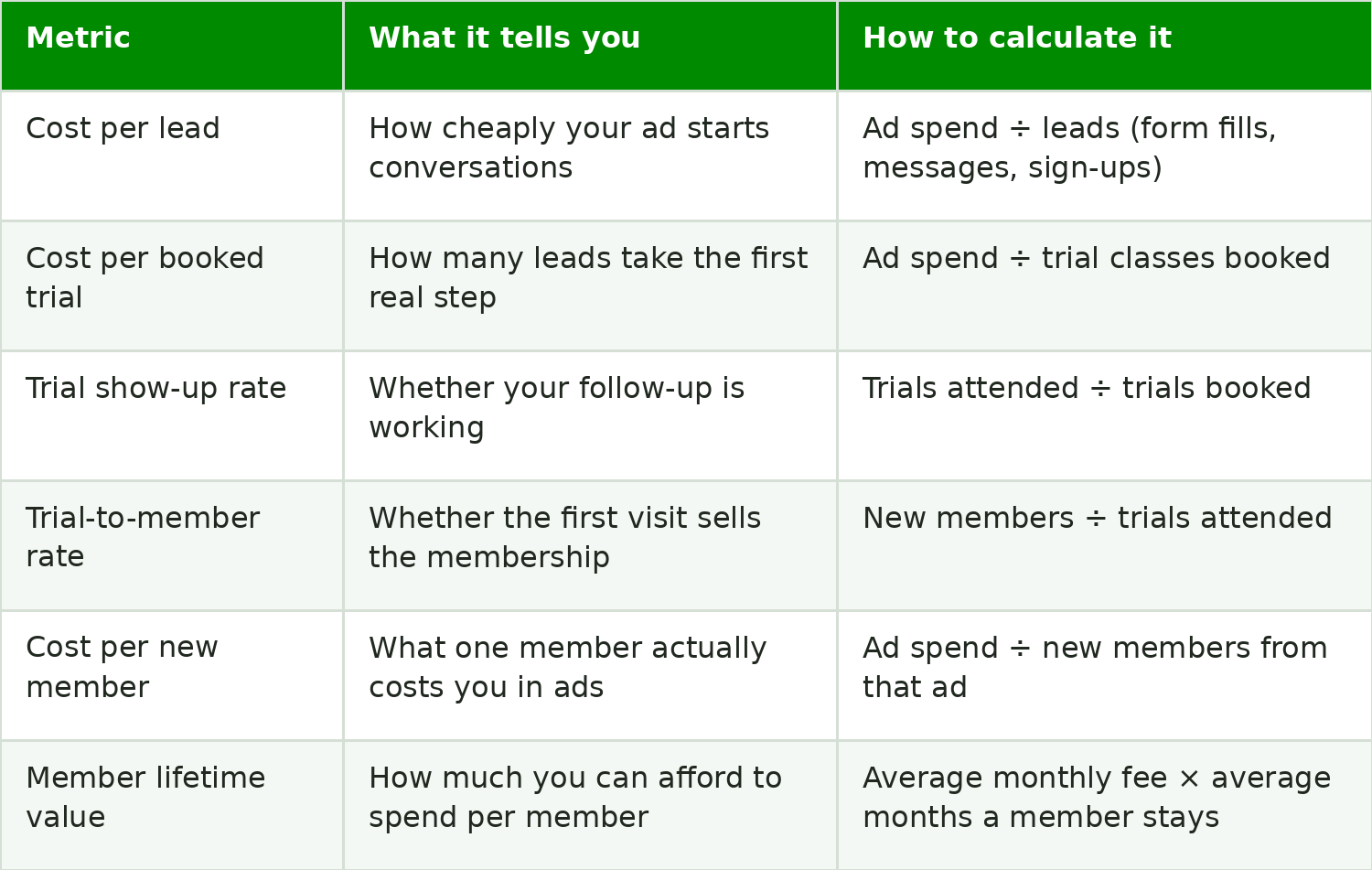
Likes, views and clicks tell you whether people noticed your ad. They don’t tell you whether it paid for itself. To know that, follow each lead all the way to a paying member.
The numbers worth tracking
Why cost per lead alone can mislead you
A cheap lead is only cheap if it turns into a member. Take a median Health and Fitness cost per lead of $52.98 and change only the share of leads who join: at 10%, each new member costs $530 in ads, while at 45%, it drops to $118.
The ad is identical in both cases. The difference comes from what happens after the click: how fast you reply, how good the first class is and how clearly you present the membership offer.
How to track where your members come from
- Tag every ad link with a UTM code so your booking system shows which ad each booking came from
- Use a different offer or promo code per channel, such as one code for Instagram and another for Google
- Ask new members how they found you at sign-up, as a short dropdown question
- Review weekly: pause ads with a high cost per new member, even if their cost per lead looks good
Follow up fast
A lead who books a trial and hears nothing until the day of the class is far more likely to forget or book somewhere else.
Set up three touchpoints:
- Straight after booking: a confirmation with the address, what to bring and where to park
- The day before: a reminder with the coach’s name and photo
- Within 24 hours after the class: a thank-you with a membership offer that expires within a week
Keep the members your ads bring in
Every month a new member stays raises their lifetime value, which means you can afford to pay more to win the next one. Retention is part of your ad budget.
This is where your software does a lot of the work. Rezerv runs classes, appointments, courses and events on one booking engine, with your own branded member app, so every ad can link straight to a booking page with your studio’s name on it. Its AI features flag members who are at risk of churning, trigger re-engagement messages, and retry failed payments automatically, so fewer of the members you paid to acquire slip away.
You can also create intro offers and trial passes, see which source each booking came from, send automated follow-ups after a trial class, and report on trial-to-member conversion, all in the same system.
VI. Turn your next fitness ad into new members
The 15 examples in this guide come from global chains, Southeast Asian gyms and single-location studios.
The ones that worked share five habits:
- They speak to one audience with one offer
- They show real coaches, members and spaces
- They give people a reason to act this week
- They send the click to a page where booking takes under a minute
- They track every ad through to cost per new member
Start small. Pick the example closest to your business, adapt its “Borrow it” tips, and run it for two to three weeks. Then compare its cost per new member against your current ads and keep whichever wins.
Where Rezerv fits
Rezerv is built for gyms, studios and multi-location operators that want bookings, payments, a branded member app and retention tools in one system. Your ads send people to a booking flow with your studio’s name on it, and Rezerv flags new members early if they start to drift, so more of the people you paid to win stay on.
If you run a solo practice with a handful of regular clients, a simple booking link may be all you need for now. Once you’re managing multiple classes, coaches or locations, keeping bookings, payments and member data in one place makes it much easier to see which ads actually bring in members.
Book a Rezerv demo to see how it works for your studio.
FAQs
What are fitness advertisements?
Fitness advertisements are paid promotions for gyms, studios, personal trainers, fitness apps and related products. They run on social media, search engines, video platforms, print and outdoor spaces, and usually aim to win new members, fill classes, or bring back lapsed clients.
What are the best examples of fitness advertisements?
Strong examples include Planet Fitness’s “Judgement Free Zone” campaigns, Club Pilates’ “Every Body Club Pilates”, PURE Group’s “This is Pure” and Gymshark’s 66-day challenge. Each one speaks to a specific audience with a clear reason to act. See section B and section C for all 15 examples.
How do you write an effective fitness advertisement?
- Pick one audience, such as beginners, busy professionals or new mums
- Make one offer, such as a free first class or an intro pass
- Show real members, coaches and your actual space
- Add a deadline or a limit
- Ask for one action, such as “Book a class”
What should a fitness advertisement include?
- A headline that names the offer or the audience
- Real footage or photos of your gym or studio
- The price or offer, stated clearly
- Your location or area
- A single call to action
- A link to a page where people can book in under a minute
What are the best fitness ad headlines?
The best headlines are specific about the offer, the class or the audience.
A few formats that work:
- Offer and deadline: “No joining fee until 30 November”
- Beginner reassurance: “Never tried reformer? Start here”
- Time slot: “HIIT at 6:30am and 7pm, every weekday”
- Coach-led: “Your first session with Coach Dimas, on us”
- Limited spots: “Only 12 spots left in the beginner class”
Keep the headline about your class or offer. Headlines that comment on the reader’s body or weight are likely to be rejected on Meta.
What’s the best call to action for a fitness ad?
One that matches the offer and asks for a single step, such as “Book a free class”, “Claim your intro pass” or “Message us on WhatsApp”. Save “Learn more” for awareness ads, since it slows down people who are ready to book.
What are the best platforms for fitness advertising?
- Facebook and Instagram: intro offers aimed at people in your area
- Google Search: people already searching for a gym or class nearby
- TikTok and Instagram Reels: awareness through short videos of classes and coaches
- Local channels: flyers, posters with QR codes and partnerships with nearby businesses
Most studios start with Meta and Google, then add short-form video once those are working.
Are Facebook or Instagram ads better for gyms?
You don’t have to choose. Both run from the same Meta Ads Manager, so you can run one campaign across both and let Meta show your ads where they perform best. Instagram suits visual content like Reels and class footage.
Facebook works well for local events, community groups and slightly older audiences. Check your results by placement after a couple of weeks and shift budget towards the stronger one.
Do fitness video ads perform better than image ads?
It depends on the job. Video is better at showing what a class feels like, introducing coaches and building trust with people who haven’t heard of you. Images work well for simple, clear offers and for retargeting people who already know your studio. Test both with the same offer and compare cost per booked trial.
How much do fitness advertisements cost?
Costs vary by city, platform and offer. As a benchmark, the median cost per lead for Health and Fitness ads on Facebook is around $52.98, but the number that matters is your cost per new member.
Work backwards: if a member pays $100 a month and stays for 10 months, they’re worth $1,000 to you. If you’re comfortable spending 20% of that, your target is $200 in ads per new member.
How can small gyms advertise with a limited budget?
- Run one offer at a time, aimed at people within a few kilometres of your gym
- Film ads on a phone with your own coaches and members
- Put budget behind organic posts that already perform well
- Start a referral offer, since your members’ friends cost far less to reach
- Keep your Google Business Profile updated with photos and reviews
- Use retargeting, which reaches small, warm audiences for very little
How long should a fitness ad run before I judge it?
Give a new ad at least a week to collect enough bookings to judge fairly. Measure it on cost per booked trial and cost per new member, and plan to refresh the creative every two to three weeks.
How do you advertise a personal training business?
Put the coach at the centre of the ad. Film each trainer introducing themselves and describing who they train, then offer a single assessment session as the entry point. A short quiz that matches people with the right coach, like Fitness First Asia’s “Let’s Get Personal”, turns a big decision into an easy first step.
How do you advertise Pilates and yoga classes?
Focus on first-timers. Show beginners of different ages in class, explain what happens in a first session, and promote a dedicated beginners’ class or time slot. A short explainer on what to wear and how the reformer works answers the questions that stop people from booking.
What fitness advertising claims should businesses avoid?
- Comments on the viewer’s body: “Are you overweight?” or “Still carrying the baby weight?”
- Body-shaming: anything that makes people feel bad about how they look
- Guaranteed results: “Lose 10kg in 30 days”
- Medical claims: promising to cure or treat a health condition
- Misleading before-and-after photos: Meta now reviews these claim by claim, so only use real, consenting members, truthful timeframes and an adult audience
Describe what your class or coaching offers, and let real member progress, such as a first pull-up or a 5km run, do the persuading.
How can fitness businesses measure advertising success?
Track each ad through to new members. The key numbers are cost per lead, cost per booked trial, trial show-up rate, trial-to-member rate and cost per new member. Tag every ad link with a UTM code, use a separate offer code per channel, and ask new members how they found you. Section E covers each metric.
How can gyms convert ad leads into memberships?
- Reply to every new lead within minutes, by WhatsApp or phone
- Send a reminder the day before their trial, with the coach’s name and photo
- Make the first class welcoming, with a coach who learns their name
- Follow up within 24 hours with a membership offer that expires within a week
- Retarget trial attendees who haven’t joined yet
