Home fitness trends 2026: 10 Trends to watch
Explore 10 home fitness trends shaping 2026, from AI-powered workouts and smart gym equipment to wearable technology, strength training, and recovery.
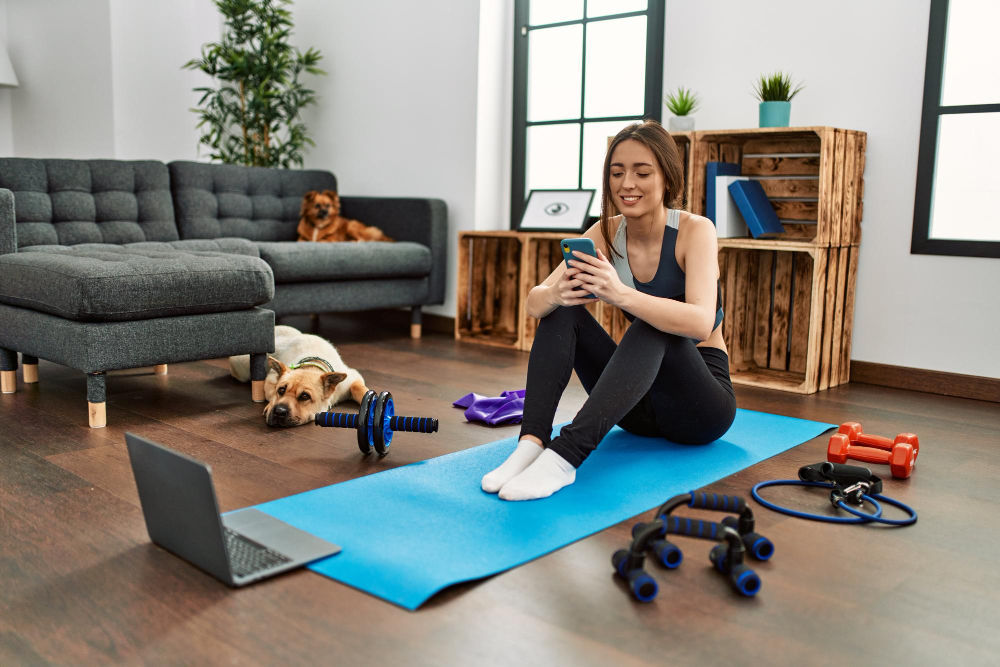
Source: krakenimages.com on Magnific
Remember when a home workout meant shoving the coffee table into a corner, balancing your laptop on a stack of books and hoping the neighbours downstairs could tolerate a few rounds of burpees?
Home fitness has had a serious upgrade since then. Today's living room might hold a smart cable machine that picks your weights for you, a walking pad that slides under your desk for afternoon calls, or a Pilates reformer that folds flat behind the sofa when friends come over.
Gyms are having a great run as well. A record 81 million Americans belonged to a gym, studio or other fitness facility in 2025, according to the Health & Fitness Association.
Meanwhile, people keep buying kit for home. Fortune Business Insights expects the global home fitness equipment market to grow from USD 13.57 billion in 2026 to USD 22.99 billion by 2034.
That's why so many people now split their week between the two: a strength class at the studio on Tuesday, a 20-minute app workout in the living room on Thursday, and a few thousand steps on the walking pad while clearing emails on Friday.
So which home fitness trends are worth your attention this year? We dug through research from the American College of Sports Medicine (ACSM), Les Mills, Strava and other industry sources to find the 10 shaping 2026.
We'll also weigh up home and gym workouts side by side, and share what these trends mean if you run a fitness studio or gym.
I. What are home fitness trends?
Home fitness trends are the equipment, technology and workout styles that shape how people exercise outside a gym or studio.
In 2026, that includes wearables, AI coaching, fitness apps, compact strength machines, Pilates reformers and walking pads, along with goals such as building strength, managing weight and looking after mental health.
Some trends stick around for years (hello, smartwatches). Others disappear by spring. We’ve focused on the ones backed by solid data.
How home workouts have evolved
In 2020, home fitness went from hobby to necessity almost overnight. With gyms shut, people cleared online shops of dumbbells, resistance bands and exercise bikes. Demand for Peloton got so intense that customers waited ten weeks from order to delivery.
Then gyms reopened, and plenty of that kit became a very expensive clothes rack. By February 2022, US gym visits were already 7.1% above 2019 levels. Peloton felt it hardest: sales of its connected fitness products fell 31% in 2022, then another 48% in 2023.
Home workouts stayed, and found a new role in people’s weeks. McKinsey research showed the share of fitness consumers with a hybrid routine grew from 46% in 2020 to 65% in 2022.
The equipment changed too. Bulky machines gave way to gear built for flats and spare rooms: adjustable dumbbells, foldable reformers, walking pads and wall-mounted cable machines.
The tech got smarter as well. Peloton IQ, launched in October 2025, uses a built-in camera to count your reps and correct your form in real time.
Is home fitness still popular in 2026?
Short answer: yes, usually alongside a gym or studio membership. Here’s what keeps people training at home this year.
Convenience. No commute, no queue for the squat rack, and a 20-minute session fits neatly between school drop-off and a 9am meeting.
Wearables and apps. Nearly half of US adults now own a fitness tracker or smartwatch, and more than 345 million people used fitness apps in 2024. In ACSM’s 2027 rankings, mobile exercise apps climb from No. 4 to No. 2.
Strength and weight goals. Exercise for weight management reached its highest ACSM ranking yet in 2026, partly driven by the rise of GLP-1 weight loss medications. People on these medications need strength training to protect their muscle, and a set of dumbbells at home makes that habit easier to keep.
Small-space equipment. Compact gear now dominates some categories. At Swiss retailer Galaxus, desk treadmills now make up 90% of all treadmill sales.
Better results from mixing it up. In the same McKinsey research, 55% of hybrid exercisers said their wellness had improved over the past year, against 41% of all respondents.
10 Home fitness trends to watch in 2026
Now for the good bit. We picked these 10 trends using ACSM’s annual rankings, large consumer surveys from Les Mills, Strava and the Health & Fitness Association, peer-reviewed research, and the product launches that got the fitness industry talking over the past year.
Some of these trends are about technology, like AI coaching and smart strength machines. Others are about how people train, such as short exercise snacks spread through the day or reformer Pilates in the spare room.
Here are 10 home fitness trends shaping how people work out in 2026:
1. Wearable technology and real-time fitness tracking
Your smartwatch has quietly become a training log, sleep tracker and slightly nagging coach rolled into one. It counts your heart rate during a living-room HIIT session, scores your sleep, and buzzes when you’ve been glued to the sofa for an hour.
Wearable technology sits at No. 1 in the ACSM’s 2026 fitness trends for the third year running, and it keeps the top spot in the 2027 report, making it the tenth time it has ranked first. Nearly half of US adults now own a fitness tracker or smartwatch.
The interesting part for home exercisers is what people do with all that data. According to ACSM, more than 70% of wearable users say they use their data to shape their exercise or recovery.
From step counts to recovery scores
A few years ago, most people checked their watch for steps and calories. Today, the numbers that get the most attention are heart rate variability (HRV), resting heart rate, sleep quality and daily readiness scores.
Strava’s 2025 Year in Sport report shows the shift clearly. The Apple Watch is still the most popular device for logging workouts, while screen-free wearables such as the Oura Ring 4 and Whoop 5.0 are growing fast as users pay closer attention to recovery and sleep.
The sensors keep getting more advanced too. ACSM notes that newer devices can capture fall detection, heart rhythm, blood pressure, blood glucose and skin temperature.
How to get more from your wearable at home
1. Check your readiness before a hard session. If your HRV has dropped and you slept badly, swap the burpees for a mobility flow or an easy walk. ACSM points to a 2023 study where athletes who followed HRV-guided training improved their performance and had fewer injuries than those on fixed programmes.
2. Train by heart rate zones. For steady cardio on a bike or walking pad, keep your heart rate at a pace where you can still hold a conversation. For intervals, use your zones to make sure the hard efforts are actually hard.
3. Look at weekly patterns. One poor sleep score tells you very little. A week of falling HRV and rising resting heart rate is a clear sign to ease off.
4. Connect it to your workout apps. Many home fitness platforms now pull in wearable data automatically. Peloton IQ, for example, uses data from Garmin Connect, Fitbit and Apple Health to tailor its workout recommendations.
A quick reality check
Wearables are brilliant for spotting trends, and some of their numbers are still best guesses. ACSM experts note that while some data is accurate, other metrics may be experimental or unreliable. Treat calorie burn figures as rough estimates, and if your watch says you’re fully recovered while your legs say otherwise, listen to your legs.
2. AI-powered personal training and workout recommendations
For years, the biggest gap in home training was simple: nobody was around to tell you your knees were caving in during squats. AI coaching is starting to fill that spot.
The best-known example is Peloton IQ, launched in October 2025 and rolled out across all of Peloton’s connected equipment, including older models via a software update. On the newer “Plus” machines, a built-in camera tracks your reps, gives feedback on your form, and suggests weights for each exercise. The system also builds an adaptive, personalised plan you can edit.
Other brands are heading in the same direction. Smart strength machines such as the Speediance Gym Monster 2 now recommend your next weight after every set.
What AI coaching can do at home
Form feedback. Computer vision spots common mistakes as you move, so you can correct them mid-set.
Adaptive programming. Your plan adjusts when you miss a session, hit a new personal best or change your goal.
Weight suggestions. The system tracks how each set went and tells you whether to go heavier or lighter next time.
On-the-spot workouts. Short on time? Peloton IQ includes an AI-powered workout generator that builds a session around what you have.
People still want a human in the room
Les Mills’ 2026 Global Fitness Report, based on more than 10,000 consumers across five continents, found that just 10% of exercisers prefer AI workouts over a human-led experience. Les Mills Head of Research Bryce Hastings put it down to people staying social animals when they work out.
That makes AI a strong support act. It handles the counting, tracking and planning, and leaves motivation, encouragement and community to real instructors and classes.
Tips for using AI coaching well
Use form feedback first. Get your technique right before you let the system push your weights up.
Check what you’re paying for. Peloton keeps its most advanced IQ features for the Plus line, and in the UK the All-Access membership rose from £39 to £45 a month around the launch.
Book a real coach now and then. A session with a trainer or a studio class every few weeks helps catch issues a camera might miss and keeps your goals on track.
Review your privacy settings. AI coaches rely on cameras and health data, so check what’s being stored and shared.
3. Fitness apps and on-demand workout classes
Your phone is probably the most-used piece of home gym equipment you own. It plays the class, times your intervals, logs your sets and sends a reminder when you’ve skipped two sessions in a row.
According to ACSM, more than 345 million people used fitness apps in 2024, generating over 850 million downloads. Mobile exercise apps ranked No. 4 in ACSM’s 2026 trends and climb to No. 2 for 2027, where ACSM highlights on-demand workouts and virtual instruction that fit around busy schedules.
What people use fitness apps for
On-demand classes. Yoga, HIIT, strength or Pilates sessions you can start whenever you have 20 spare minutes.
Live-streamed classes. A real instructor at a set time, which adds a bit of accountability to working out in your pyjamas.
Programme tracking. Logging sets, reps and progress across weeks so you can see yourself getting stronger.
Social motivation. Challenges, leaderboards and kudos from friends. Strava users gave 14 billion kudos in 2025, a 20% jump on the year before.
Gyms and studios are getting in on it
Many fitness brands now offer their own digital classes so members can keep training between visits. Crunch, for example, launched Crunch+ to deliver on-demand and live-stream classes, and Les Mills streams its workouts through the LES MILLS+ platform. For members, it means following the same instructors at home and in the studio.
Creator-led workouts are back
Programmes built by fitness influencers return to ACSM’s top 10 for 2027, after falling out of the top 20 in 2026. ACSM adds a useful reminder: a high trend ranking reflects how popular something is, and it doesn’t prove that a particular product or programme works. Check who’s behind the plan and what qualifications they hold before following it.
How to choose an app you’ll actually keep using
Look for habit-building features. ACSM notes that apps with reminders, rewards or social features may help people stick with them longer.
Check the instructors. Qualified coaches and clear technique cues matter more than slick editing.
Mix live and recorded sessions. Recorded classes give you flexibility, and live ones give you a reason to show up on time.
Use the free trial properly. Try at least three or four workouts across different formats before you commit to a subscription.
4. Smart strength training equipment
Lifting at home used to mean a rack of dumbbells taking over the spare room. Smart strength machines squeeze a full cable gym into something closer to the size of a wardrobe door, and they handle the weight changes for you.
Strength training has plenty of room to grow. ACSM reports that fewer than 30% of US adults meet the recommended guidelines for muscle-strengthening activity. Traditional strength training sits at No. 7 in the 2026 trends and rises to No. 5 for 2027, with ACSM’s latest guidance putting consistency ahead of complexity.
The barriers are often about confidence. In Les Mills’ 2026 Global Fitness Report, 54% of aspiring lifters said they don’t know where to start, and 23% had injury concerns. Guided programmes and digital resistance take a lot of that guesswork out.
How smart strength machines work
Instead of iron plates, these machines use motors to create resistance through cables. You pick a weight on the screen, and the machine adjusts it instantly. Many also offer modes that change the load mid-rep, such as extra resistance on the lowering phase, which creates a strong muscle-building stimulus.
Most come with guided classes, rep tracking and progress charts, and some add AI coaching that recommends your next weight after each set.
Popular smart strength machines in 2026
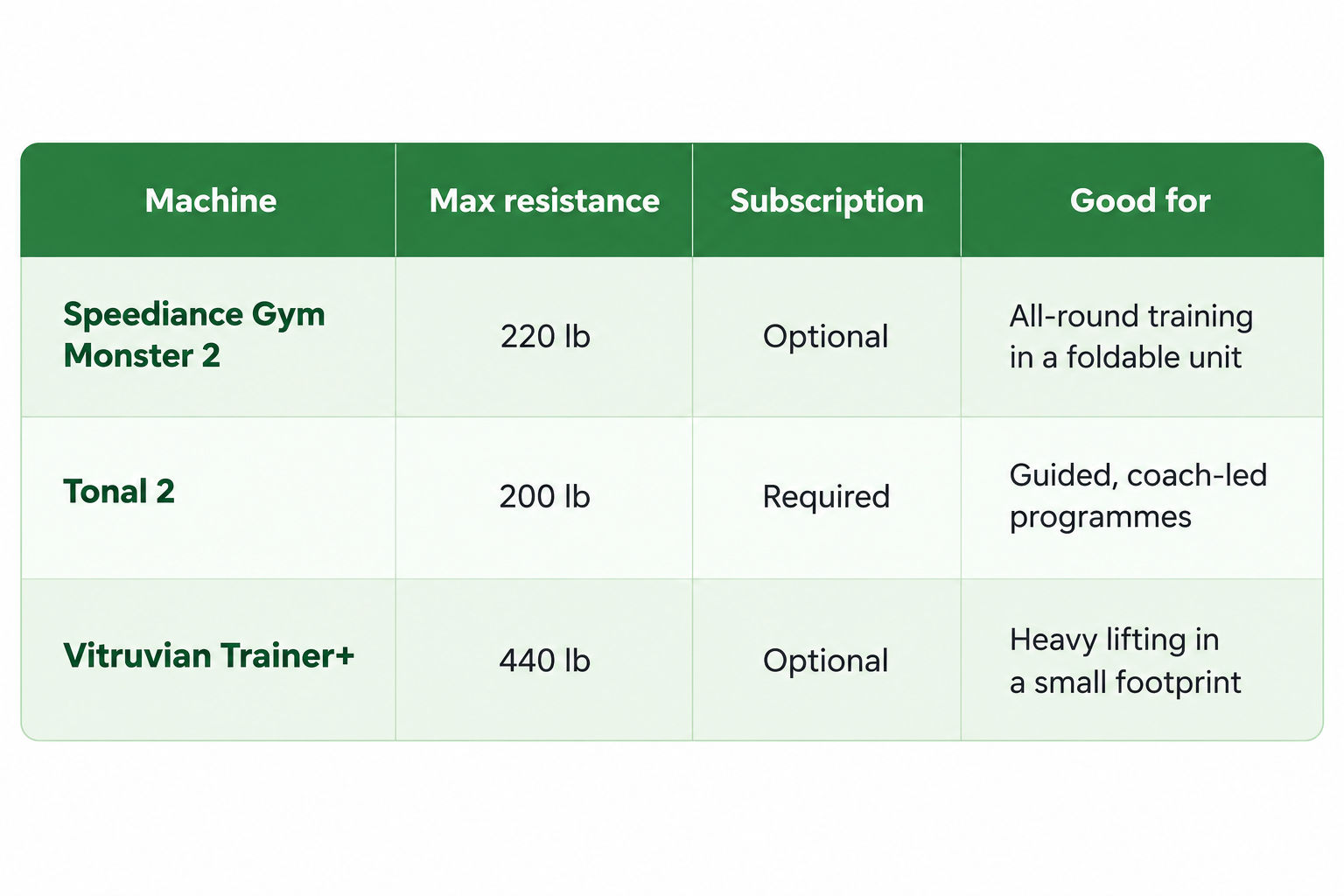
Specs from The Body Blueprint and Cleveland Heart.
The Speediance Gym Monster 2 folds down to 2.69 square feet, which makes it a realistic option for flats. Tonal mounts on the wall and uses electromagnetic resistance controlled by smart software.
Budget-friendly ways to lift at home
Smart machines are a big investment, and you can build serious strength with much simpler kit:
Adjustable dumbbells. One compact set replaces a full rack and covers most upper and lower body exercises.
Kettlebells. Great for swings, goblet squats and carries, and easy to store under a bed.
Resistance bands. Cheap, portable and handy for warm-ups and accessory work. Free weights still make it easier to keep adding load over time, so bands work best as a supplement.
Is smart strength equipment worth it?
It suits people who train at home most days, want structured programmes, and value having data on every rep. If you lift a couple of times a week and enjoy the energy of a gym floor, a set of adjustable dumbbells at home plus a strength class at your local studio may give you more for your money.
5. Strength training for weight management
Weight loss conversations used to revolve around cardio and calorie counting. In 2026, more people are asking a different question: how do I lose fat while keeping the muscle?
Exercise for weight management reached its highest-ever position in ACSM’s 2026 trends, at No. 3. ACSM also renamed the trend from “Exercise for Weight Loss” to cover a wider range of goals, including losing, maintaining and gaining weight. A big driver is the growing use of GLP-1 medications such as semaglutide and tirzepatide, and the 2027 report keeps the focus on preserving muscle and physical function as these medications become more common.
Why muscle matters during weight loss
When weight drops quickly, the body often breaks down muscle along with fat. A report from ukactive and Les Mills found that for GLP-1 users, lean mass loss can be comparable to what people experience after bariatric surgery, cancer treatment or ten years of ageing. The same report found that combining exercise, especially strength training, with a healthy diet helps people keep their muscle and reduces weight regain after treatment ends.
ACSM points to similar research: people who keep exercising during medication treatment hold on to more fat loss and more lean mass after they stop, compared with those who rely on medication alone.
There’s a motivation challenge too. A study using Fitbit data found that daily movement declined after people started GLP-1s. That makes an easy, low-barrier routine at home especially valuable.
What a simple home routine can look like
You don’t need a full home gym to protect your muscle. Two or three full-body sessions a week, built around a handful of basic movements, gives you a solid starting point:
Squats or sit-to-stands for your legs and glutes
Push-ups against a wall, kitchen counter or the floor
Rows with a resistance band or dumbbells
Hip hinges such as Romanian deadlifts with a kettlebell or dumbbells
Carries with a pair of heavy bags or dumbbells, walking up and down the hallway
Start with a weight you can lift with good form for 10 to 12 reps, then add reps or load as it gets easier.
Tips for training during weight loss
- Speak to your doctor first. If you’re taking weight loss medication, check with your healthcare provider before starting a new exercise plan.
- Prioritise protein. Strength training works best alongside enough protein to support muscle repair. A dietitian can help you set the right amount.
- Track strength along with the scale. Lifting heavier or doing more reps over time is a good sign you’re holding on to muscle.
- Get some guidance. A few sessions with a qualified trainer or a beginner strength class can help you learn the movements safely before training solo at home.
6. At-home Pilates and reformer workouts
Reformer Pilates used to be something you booked weeks in advance at a boutique studio. Now plenty of people have a reformer in the spare room, folded against the wall until the next session.
Balance, flow and core strength, the ACSM category that covers Pilates, yoga, barre and mobility work, ranked No. 5 in 2026 and jumps to No. 3 for 2027. ACSM’s experts link the rise to the growing popularity of Pilates and barre, and to a wider shift towards longevity and mind-body training that appeals across generations. Les Mills found a similar appetite: 88% of gym members want yoga, breathwork or meditation on their timetables.
Home reformers are getting smaller and smarter
Equipment makers have noticed. Technavio expects the Pilates equipment market to grow at 14.2% a year between 2025 and 2030, with rising demand for compact, foldable reformers designed for flats.
At the premium end, iFIT entered the market in May 2026 with the NordicTrack Ultra 1 Reformer. It has a 24-inch touchscreen that tilts and pivots, and launched with around 300 on-demand classes from 10 instructors.
Ways to do Pilates at home
- Mat Pilates. All you need is a mat and a bit of floor space. It’s the easiest way to learn the core principles before investing in equipment.
- Wall Pilates. Uses a wall for support and extra resistance during leg work, bridges and roll-downs. A popular starting point for beginners on social media and apps.
- Small equipment. Resistance rings, mini balls and light ankle weights add variety without taking up much room.
- Foldable reformers. Give you the spring-loaded resistance of a studio machine and fold away after use.
- Connected reformers. Built-in screens and guided classes for people who want a full studio experience at home.
Tips before you buy a reformer
Learn the basics with an instructor. A few studio classes help you understand spring settings, alignment and safe transitions before you train alone.
Measure your space. Check the reformer’s length when open and folded, plus room to move around it.
Check the specs. Look at the weight limit, spring options and how easy it is to adjust between exercises.
Keep a studio class in your week. Many people use a home reformer for quick sessions and book studio classes for coaching and progression.
7. Walking pads and under-desk treadmills
Remote work gave people more flexibility and a lot more sitting. The walking pad is the fix many have landed on: a slim, motorised belt that slides under a standing desk and lets you clock up steps while answering emails.
The numbers back it up. At Swiss retailer Galaxus, desk treadmill sales more than tripled compared with the same period in 2024, and they now account for 90% of all treadmill sales on the site. Most top out at around 7 km/h, so they’re built for walking, and people tend to set them up under height-adjustable desks or in front of the TV.
Walking has also become a workout in its own right. Strava’s 2025 data shows that while running is still the most-logged activity, walking continued its rapid rise on the platform.
Why walking pads are catching on
They fit small spaces. Most models fold or slide under a sofa or bed when you’re done.
They turn dead time into movement. Calls, emails and TV episodes become an easy way to add steps without blocking out workout time.
They’re beginner-friendly. Walking is low-impact and easy to start, which makes it a good entry point for people who don’t enjoy traditional workouts.
They work in any weather. A rainy week no longer means a week without a walk.
Tips for walking while you work
Start slow. A gentle pace of 2 to 3 km/h is usually comfortable for typing. Save faster walks for calls and listening tasks.
Match the task to the pace. Walk during meetings, inbox clearing and reading, and stand still for detailed writing or design work.
Set your desk at the right height. Your elbows should sit at around 90 degrees with your shoulders relaxed.
Wear proper shoes. Socks or slippers might feel fine for ten minutes, but supportive trainers make longer sessions more comfortable.
Check the specs. Look at the weight limit, motor noise, incline options and whether a fold-up handlebar is included for faster walks.
8. Exercise snacks and micro workouts
No time for an hour-long workout? Good news: your body still counts the small stuff. Exercise snacks are short bursts of activity, usually a few minutes long, scattered through the day. Think a quick sprint up the stairs, 20 squats while the kettle boils, or a minute of brisk skipping between meetings.
What the research says
The evidence for short bursts keeps growing. A systematic review in the British Journal of Sports Medicine looked at 11 randomised trials with 414 participants aged 14 to 80. It defined an exercise snack as two to five minutes of moderate to vigorous activity, and found these snacks improved cardio fitness in inactive people and muscular endurance in older adults. Better still, 82.8% of participants stuck with them.
Another study tracked 3,293 US adults who did no structured exercise, using wrist-worn activity monitors. Those who fitted in around five one-minute bursts of vigorous activity a day had a 44% lower risk of death from any cause over the study period. It shows an association rather than direct cause and effect, but it’s a strong case for turning up the intensity for a minute at a time.
Short bursts won’t replace every long session. A wearable-based study summarised by FoundMyFitness found that brief bouts of activity bring substantial health benefits, though they may not fully match the effects of longer, sustained exercise. If you’re training for a half marathon, you’ll still need the long runs.
Easy exercise snacks to try at home
- Stair sprints. Walk or jog up a flight of stairs briskly two or three times.
- Kettle squats. Do bodyweight squats while you wait for the kettle to boil.
- Counter push-ups. Use the kitchen counter for 10 to 15 incline push-ups.
- Skipping. One minute with a rope, or without one if your ceiling is low.
- Pre-meal walk. A brisk few minutes before eating. Trinity Health notes that exercise snacks before a meal may help with blood sugar control.
10. Home workouts for older adults
Some of the most committed home exercisers are over 65. They’re doing sit-to-stands in the kitchen, balance drills while brushing their teeth, and following low-impact classes on the living room TV.
Fitness programmes for older adults ranked No. 2 in ACSM’s 2026 trends and stay in the top five for 2027, for the fifth year in a row. The demand is easy to explain. The baby boomer generation includes 73 million Americans, and all of them will be over 65 by 2030. ACSM also notes that programmes described as “low intensity”, “functional” or “active ageing” consistently attract more participants than those labelled “senior fitness”.
Why strength and balance matter most
Falls are a big reason this trend matters. According to the CDC, more than 14 million adults aged 65 and older in the US, or one in four, report falling each year. The CDC points to poor strength and balance as risk factors that can be addressed.
That’s why ACSM recommends three priorities for older adults: resistance training to preserve strength, balance and mobility exercises to reduce fall risk, and low-impact cardio to support heart health. All three are easy to do at home with very little equipment.
A simple home routine for older adults
- Sit-to-stands. Stand up from a sturdy chair and sit back down slowly, without using your hands if you can.
- Wall push-ups. Push away from the wall to build upper body strength without getting down on the floor.
- Heel raises. Hold the kitchen counter and rise up onto your toes to strengthen your calves and ankles.
- Single-leg stands. Balance on one foot while holding the counter, then gradually reduce how much you hold on.
- Heel-to-toe walking. Walk along a hallway placing one foot directly in front of the other.
- Low-impact cardio. A walk around the block, a session on a stationary bike or a seated 6. cardio class.
Short bursts count too. The exercise snacks review we covered earlier found that brief activity sessions improved muscular endurance in older adults.
Home fitness vs. gym workouts: which is better?
It’s the question that starts friendly arguments in group chats. The honest answer depends on your goals, budget and personality, so let’s look at what each option does well.
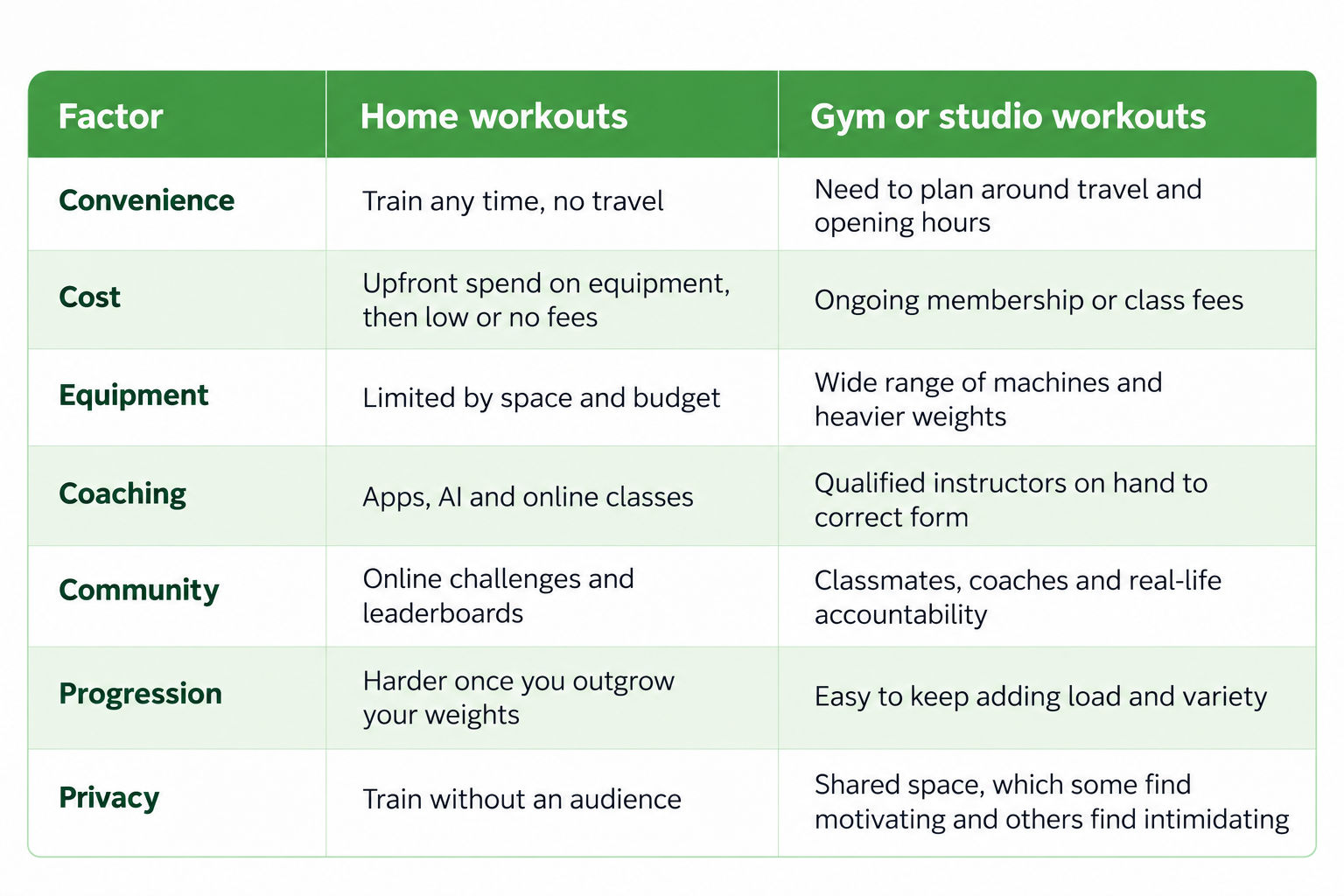
Benefits of working out at home
You’re more likely to show up. Convenience is one of the strongest predictors of sticking with exercise. BOXROX points to research by Rhodes et al. (2017) that ranks convenience and accessibility among the top factors behind exercise adherence.
It can work just as well for fitness. A 12-week study in The Journal of Physiology followed 32 adults with obesity. It found that home-based high-intensity interval training was as effective as a supervised lab programme for improving fitness, while cutting out barriers such as travel time and cost.
It saves time. No commute and no waiting for equipment means a 30-minute workout takes 30 minutes.
It feels comfortable. For anyone dealing with gym anxiety or just starting out, home is a low-pressure place to learn.
Benefits of working out at a gym or studio
Heavier weights for bigger strength gains. Gyms make it easier to keep increasing the load, which matters for building maximal strength over time.
Expert coaching. Instructors spot form issues, adjust exercises for injuries and keep your programme moving forward.
Community and accountability. Group fitness classes jump six places to No. 7 in ACSM’s 2027 trends, with ACSM highlighting the mix of expert instruction and social connection that helps people stick with exercise.
A more active lifestyle overall. The Health & Fitness Association found that gym members are seven times less likely than non-users to report no physical activity in a typical week (4.7% vs. 33.1%).
The best of both: a hybrid routine
Most people get the best results by combining the two. The McKinsey research we mentioned earlier found that hybrid exercisers were more likely to say their wellness had improved over the past year.
A balanced hybrid week could look like this:
- Monday: Strength class at the gym or studio
- Tuesday: 20-minute app workout at home
- Wednesday: Walking pad during afternoon calls, plus a couple of exercise snacks
- Thursday: Reformer Pilates or yoga class at the studio
- Friday: Home strength session with dumbbells or a smart machine
- Weekend: A long walk, a run with friends, and some recovery time with a foam roller
Use home workouts for convenience and consistency, and the studio for coaching, heavier lifting and the energy of training with other people.
What these trends mean for studio and gym owners
If you run a studio or gym, your members are almost certainly training at home between visits. They’re logging walks on their smartwatch, following app workouts on busy days and maybe eyeing up a foldable reformer. The good news: the trends in this article point to plenty of reasons for them to keep booking your classes too.
Here’s how to make the most of them.
1. Build offers that suit hybrid members
Many members no longer come in five days a week. They might take two classes at your studio and train at home the rest of the time. Flexible class packs and memberships make it easier for them to keep you in their routine.
With Rezerv, members can buy packages and memberships online and book classes from their phone. You can also let customers choose their own membership start date within a limit you set, which works well for new-month promotions and early-bird offers.
2. Add classes that match what people want
Pilates, strength training and programmes for older adults are all climbing ACSM’s rankings. Beginner reformer sessions, strength foundations classes and low-impact functional classes give home exercisers something they can’t easily get on their own: expert coaching and proper technique.
Take a tip from ACSM’s research when naming them. Classes described as “functional” or “low intensity” tend to attract more older participants than ones labelled “senior fitness”.
For classes that need extra care, such as reformer or active ageing sessions, Rezerv lets you require a signed waiver before anyone can be added to the class.
3. Catch members before they drift away
A member who discovers home workouts might quietly stop booking classes. Rezerv’s automations can send a promo code when a customer’s package credits drop below a set number or their package is about to expire, through email, or SMS and WhatsApp if your Twilio account is connected.
Rezerv’s AI Business Insights can also flag churn risk from inactive customers and highlight underperforming classes or quiet time slots, so you can spot problems early.
4. Reward your most loyal members
With Auto-Tagging, Rezerv can automatically add customers to a pricing group or tag them when they buy a selected package or membership. You can use that to unlock member-only prices, then send targeted email campaigns to specific groups, such as a reformer intro offer for everyone who bought your Pilates pack.
5. Give members a reason to come back in person
Home workouts are great for convenience, and your studio offers what a living room can’t: qualified instructors, heavier equipment and a room full of people cheering each other on. Lean into that in your marketing, your class descriptions and your timetable.
Frequently asked questions
What are the biggest home fitness trends in 2026?
Wearable technology leads the way, ranking No. 1 in ACSM’s 2026 fitness trends for the third year in a row. Other major trends include AI-powered coaching, fitness apps, smart strength equipment, strength training for weight management, home Pilates, walking pads, exercise snacks, recovery tools and home workouts for older adults.
Is home fitness becoming more popular?
Home fitness is growing steadily as part of hybrid routines. Fortune Business Insights expects the home fitness equipment market to grow from USD 13.57 billion in 2026 to USD 22.99 billion by 2034. At the same time, gym membership hit a record in 2025, which shows most people are adding home workouts to their week alongside the gym.
What is the most popular home fitness equipment?
Dumbbells, kettlebells, resistance bands and exercise mats remain the everyday staples. Walking pads have taken off in recent years: at Swiss retailer Galaxus, they now make up 90% of all treadmill sales. Exercise bikes, Pilates reformers and smart strength machines are popular with people who want a more complete setup.
What is the best home workout equipment for beginners?
A mat, a set of resistance bands, and a pair of light adjustable dumbbells or one kettlebell. Together they cover strength, mobility and core work. A sturdy chair and a step are useful extras for squats, step-ups and balance drills.
What is the best smart home gym equipment?
It depends on how you train. The Speediance Gym Monster 2 is a strong all-rounder with 220 lb of digital resistance and a foldable frame. Tonal 2 suits people who want guided, coach-led programmes. Vitruvian Trainer+ offers up to 440 lb of resistance in a small footprint. For cardio, Peloton’s Cross Training Series comes with AI coaching built in.
How is AI changing home fitness?
AI brings personal trainer features into the living room. Systems like Peloton IQ use cameras to count reps, correct form in real time, suggest weights and build adaptive training plans. Most people still value human instructors, though: Les Mills found only 10% of exercisers prefer AI workouts over human-led ones.
What are the benefits of wearable technology for home workouts?
Wearables help you train at the right intensity and recover properly. They track heart rate, sleep, heart rate variability and readiness, so you can decide when to push and when to ease off. According to ACSM, more than 70% of wearable users apply their data to shape their exercise or recovery. Many also include fall detection, which is useful for older adults training alone.
Are home workout apps worth paying for?
They’re worth it if you use them regularly. Look for apps with qualified instructors, a mix of live and on-demand classes, and habit-building features such as reminders, rewards or social challenges, which ACSM says may help people stick with them. Use the free trial to test several workouts before committing.
Can you build muscle with home workouts?
Yes. Your muscles respond to effort and progressive overload, wherever you train. Research has found that lighter loads can build similar amounts of muscle to heavier loads when sets are taken close to failure. The challenge at home is progression, so adjustable dumbbells, kettlebells or a smart strength machine help you keep adding resistance over time.
Is home fitness as effective as going to the gym?
For general fitness, it can be. A study in The Journal of Physiology found home-based interval training was as effective as a supervised programme for improving fitness in adults with obesity. Gyms make it easier to lift heavier weights and get expert coaching, which helps with building maximal strength. Many people combine both.
What are the best home workouts for weight loss?
A mix of strength training and cardio. Research summarised by Fit-Pro shows that combining the two is more effective for weight loss than either one alone. Try two or three full-body strength sessions a week, plus brisk walks, bike sessions or short interval workouts. Strength work also helps protect muscle while you lose weight.
What are the best home workouts for building strength?
Full-body sessions built around squats, push-ups, rows, hip hinges such as Romanian deadlifts, and loaded carries. Choose a weight you can lift with good form for 8 to 12 reps, and add reps or load as it gets easier. Two or three sessions a week is a solid starting point.
How much does it cost to build a home gym?
It ranges from very little to several thousand. A mat, resistance bands and a kettlebell keep costs low. Connected equipment sits at the higher end: in the UK, Peloton’s Cross Training Bike costs £1,599 and the Cross Training Tread £3,499, plus a £45 monthly membership. iFIT’s NordicTrack Ultra 1 Reformer costs around USD 10,000.
What equipment do you need for a home gym?
The essentials are a mat, adjustable dumbbells, a kettlebell and resistance bands. From there, add equipment based on your goals: a walking pad or bike for cardio, a reformer for Pilates, or a smart strength machine for guided lifting. A foam roller or massage gun covers basic recovery.
How much space do I need for a home workout area?
Less than you might think. Bodyweight workouts, mat Pilates and dumbbell sessions only need enough room to lie down and stretch your arms out. Check the length of larger equipment when it’s open and folded, and leave space to move around it safely.
What home fitness trends are best for small spaces?
Walking pads, foldable reformers, adjustable dumbbells, resistance bands and fitness apps all suit small homes. Some smart strength machines are compact too: the Speediance Gym Monster 2 folds down to 2.69 square feet. Exercise snacks need no equipment at all.
How can you stay motivated when working out at home?
Schedule your workouts like meetings, and link them to habits you already have, such as morning coffee. Join live-streamed classes for a fixed start time, use social features like challenges and kudos, and track your progress with a wearable. Booking a studio class once or twice a week also adds coaching and accountability.
How often should you exercise at home?
Aim for at least 150 to 300 minutes of moderate activity, or 75 to 150 minutes of vigorous activity, each week, plus muscle-strengthening work on two or more days. You can spread this across short home sessions, walks and exercise snacks.
Are short workouts at home worth doing?
Yes. A British Journal of Sports Medicine review found that exercise snacks of two to five minutes improved cardio fitness in inactive people and muscular endurance in older adults. Several short bursts spread through the day add up quickly.
What is hybrid fitness training?
The term has two common meanings. The first is mixing home workouts with gym or studio sessions. McKinsey found the share of fitness consumers with this kind of routine grew from 46% in 2020 to 65% in 2022. The second is a training style that combines strength, cardio and mobility in one programme, popular with people who want all-round fitness.
Are Pilates and mobility workouts growing in popularity?
Yes. Balance, flow and core strength, the ACSM category covering Pilates, yoga, barre and mobility, ranked No. 5 in 2026 and rises to No. 3 for 2027. Les Mills found 88% of gym members want yoga, breathwork or meditation on their timetables, and Technavio expects the Pilates equipment market to grow 14.2% a year to 2030.
What is the future of home fitness technology?
Expect smarter coaching, better sensors and more connected equipment. AI systems with computer vision already correct form in real time, and wearables are adding sensors for heart rhythm, blood pressure, blood glucose and skin temperature. Connected reformers are entering homes, and VR fitness is getting another push, with Meta planning a relaunch of its Supernatural app in autumn 2026. Fitness apps also climb to No. 2 in ACSM’s 2027 trends.
How can fitness studios benefit from home fitness trends?
By supporting members’ hybrid routines. Flexible packages and memberships, coaching-focused classes such as reformer Pilates and strength foundations, and automated reminders that bring members back all help. Gym and studio management software like Rezerv handles online bookings, packages, memberships and member automations in one place.
