How to run a multi-location wellness business efficiently
Successfully running a multi-location wellness business involves much more than just opening new branches.
Operating a single wellness center is already quite a challenge. Going on to open multiple studios, salons, spas, or wellness clinics, however, raises the level of difficulty significantly. Owners of such companies have to control staff at different locations, keep the level of service high, and coordinate timetables, among a handful of other things.
Fortunately, development doesn't have to lead to disorder. In fact, with the help of appropriate systems, technology, and operational procedures, multi-location wellness businesses can function efficiently even while providing fantastic experiences to clients and employees.
Following are some ways in which successful wellness brands manage their multiple locations so that they do not have to compromise on quality or profitability.

Source: Pexels
Prepare standard operating procedures for each location
One of the major errors that wellness businesses make when they decide to expand is to expect that every branch manager or staff member will spontaneously comprehend the way in which things are supposed to be done.
Instead, each location may soon develop its own processes which, ultimately, will bring about inconsistencies confusing customers and resulting in operational inefficiency.
Standard Operating Procedures (SOPs) are the tools that your business needs to have in place in order to work properly. You should write down:
- Customer check-in and check-out procedures
- Appointment management
- Staff roles
- Standards of client correspondence
- Cleaning and sanitation methods
- Handling of cancellations and no-shows
- Payment procedures and reporting requirements
When these processes are documented, it means that a branch can run according to set standards even if the manager happens to be a different person.
Purchase centralized business management software
Innovation is probably one of the biggest reasons why companies working out of several wellness locations can be run successfully. Attaching benevolent spreadsheets or disconnected tools is frequently the reason for scheduling conflicts, communication problems, and inaccurate reporting.
As you grow, you will no doubt end up giving appointments to your clients via the internet and maintaining the appointments' and clients' data together with your staff across various locations through booking and scheduling software.
A management system centralizes the stream of business operations in many locations. Owners and managers who use it can:
- Oversee appointments of all the branches
- Accept payments online
- Store customer data
- Measure performance
- Carry out transactions and reporting from a single location
Especially helpful for those owners who go from one business location to another or travel frequently is cloud-based wellness management software that provides business information access in real time from anywhere.
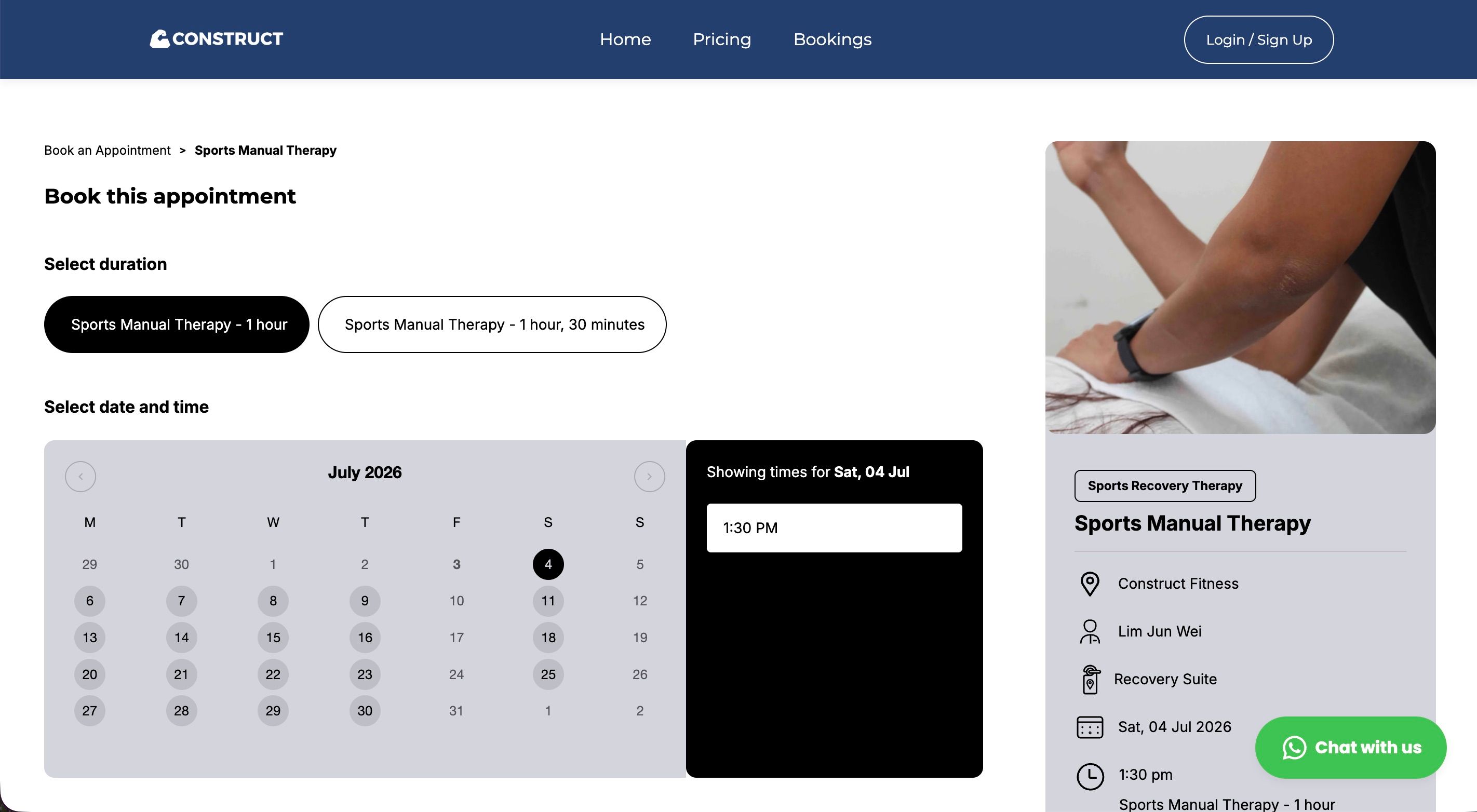
Appointment booking system - Construct Fitness Singapore
Provide customers with a consistent experience
Regardless of the location, customers expect an equal level of service. While one branch can be delivering superior service, if another is facing problems with communication and organization, your brand can be negatively affected.
Consistency depends largely on how you train your employees. Therefore, all members of your team need to be aware of:
- The company's values and mission
- Customer service expectations
- Communication standards
- Service procedures and quality benchmarks
You can at least maintain high standards across all locations with regular training sessions and staff evaluations.
Your brand's identity is equally important. From your website and social media pages to in-person interactions, every point has to be consistent and professional.
Develop robust communication systems
When businesses grow, communication issues arise physically. When employees are located in different places, it is very easy for them not to be in touch with each other, which leads to a decrease in effectiveness and increased confusion.
Effective wellness businesses with multiple locations:
- Hold weekly meetings for the management
- Have internal messaging platforms
- Make use of shared calendars
- Send out company-wide news and announcements
- Use standardized reporting procedures
Sharing a spirit of cooperation and collaborating between locations are also great ways to get teams talking and helping each other more efficiently.
Make use of data to support business choices
At the same time, having several premises brings a lot of relevant data. Successful proprietors consider analytics and thus-, instead of guessing work-, they take advantage of opportunities and fix the issues.
Being able to track what happens financially at the level of each location separately can certainly provide additional assistance in making decisions related to business operations. On the other hand, analyzing the data also helps to uncover which methods yield the best results.
Usually, data-informed choices result in good staffing, effective marketing campaigns, and satisfied customers.
Give local managers authority
It is necessary to give your location managers enough power to make decisions for the day-to-day activities in the business as you keep building your company. A manager with good leadership skills should be entrusted with the task of:
- Fixing customers' problems
- Checking employees' work
- Making sure that everything runs smoothly
- Applying regulations
- Giving feedback and advice
In most cases, staff management tools for personnel that show employee schedules, attendance, and even performance measurement at multiple premises are used by many companies in order to empower local leaders.
Yet, empowerment is not about the absence of accountability. Setting up definite operating goals and reporting systems help make sure that every location continues to follow the company's objectives.
Focus on cybersecurity and data protection
Wellness businesses keep a great deal of personal and confidential information such as customer contact details, payment information, and appointment history. The more locations you have, the bigger is the role and importance of cybersecurity.
If you travel and get to work from different places, the remote access to your management system without the right protective measures can put you in danger of cyber threats. Besides, it is relatively common for multi-location businesses to use cloud-based software and have remote access to management platforms. For this reason, cybersecurity has become one of the major operational factors.
A Virtual Private Network (VPN) is among the simplest solutions for adding a layer of security. To be sure, a VPN encrypts your internet traffic and protects confidential business data from potential cyber threats. This is especially important if you happen to be accessing the company systems outside the office.
Some operators go a step further and route connections through a residential proxy, which assigns traffic a standard ISP-issued address so remote logins to branch systems look consistent rather than flagging as unfamiliar.
As a matter of fact, a lot of expanding companies are seriously considering various security solutions. For instance, a very affordable option for protecting remote connections and the valuable customer data while managing the operations of multiple locations is to get current Proton VPN discounts.
Besides protecting your business, incorporating security features into your daily activities will give you another reason to establish a great relationship with clients who, after all, trust you not to disclose their personal information to anyone else.
Design a hiring system that can grow
Taking your business to more than one location implies that you will always be on the lookout for new employees and that you will have to train them. Without a managed hiring process, it is becoming more and more difficult to deliver a high level of service.
Besides the standard job descriptions, your hiring system will also include;
- Interview guidelines
- Training programs
- Performance expectations
- Onboarding checklists
Employing an expandable hiring process also enables a new location to achieve operational efficiency in a shorter time and it is also going to lessen the chances of staff inconsistencies.
Invite customer input
Customer feedback is a good source of information regarding the performance of each location.
Taking reviews and feedback can help locate:
- Issues with the quality of service
- Staff training needs
- Areas where the operation is not running efficiently
- Ways in which things can be improved
Surveys, online reviews, and direct customer communication should be regular features of your business operation.
Most importantly, the feedback should be made use of. Clients favor businesses that genuinely listen and keep on trying to better themselves.
Think about your next stage of growth
Keeping multiple locations well-managed and running smoothly entails more than thinking just about present operations. Continuous self-evaluation by business owners as to whether their systems can accommodate further expansion is an integral part of the process.
Among the questions that you could ask yourself are:
- Does the technology that I have now allow for expansion?
- Are my workflows documented accurately?
- Is my hierarchy scalable?
- Have I prepared leadership talent for expansion?
If you lay the groundwork for strong operations now, you will make your future growth much easier and more sustainable.
Conclusion
Successfully running a multi-location wellness business involves much more than just opening new branches. It implies standardizing processes, efficient communication, quality leadership, dependable technology, and a dedication to providing a continuous customer experience.
The most successful wellness brands realize that efficiency results from developing systems able to scale without getting service quality compromised. Wellness businesses can confidently grow and still maintain operational excellence by adopting centralized management tools, empowering local teams, effectively utilizing data, and securing sensitive information through safe digital practices.
What separates a struggling multi-location business from a thriving one is quite often merely the systems. Those that standardize their operations, invest in appropriate technology, and give top priority to both customer experience and data security will be better positioned to scale sustainably and create long-term success.