Rezerv vs Glofox comparison (2026)
Compare Rezerv vs Glofox pricing, features, memberships, branded apps, booking tools, fees, and support. Find the best gym software for studios and fitness businesses.
Glofox is a well-known name in fitness software. It has a strong global presence, a polished brand, and serves thousands of studios across the US, UK, Europe, and Australia.
But once you look at how it actually fits Southeast Asian studios, the gaps start to show.
From regional payment methods and pricing to multi-member bookings, support hours, and how the platform has shifted since being acquired by ABC Fitness Solutions in 2022, there are real reasons why a growing number of SEA studios are choosing Rezerv instead.
This is not about whether Glofox works. It clearly does, for the markets it was built around. The real question is whether a global platform built for Western franchises is the right fit for how your business actually runs in Southeast Asia.
This article breaks down the key differences so you can see which platform is the stronger choice for studios in this region.
I. Key differences at a glance
Here is a quick breakdown of how Rezerv and Glofox stack up against each other across core features, pricing, and capabilities.
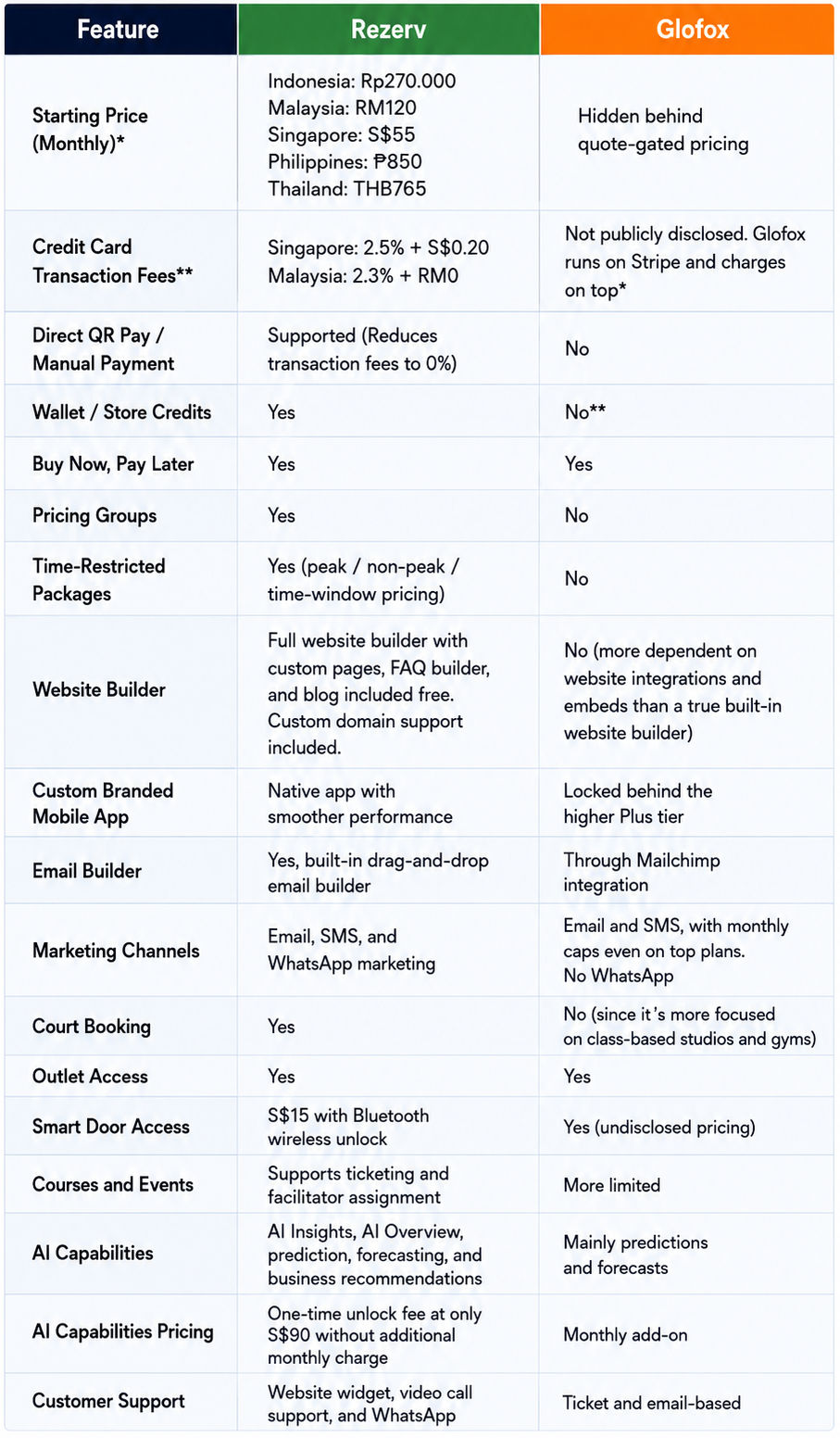
Notes:
*Stripe's standard US rate is 2.9% + 30¢ and Glofox adds their own platform charge on top
**Glofox’s Account Balance sounds like a wallet, but only staff can use it as a payment method and clients cannot see it as a payment option
II. Regional fit and market focus
There is a difference between a platform that operates in Southeast Asia and a platform that is built for Southeast Asia.
Glofox operates here. It will technically work if you sign up from Jakarta, Kuala Lumpur, or Singapore. But operating somewhere and being built for somewhere are two completely different things.
Glofox was built in Dublin, scaled across the US, UK, EU, and Australia, and acquired by an American fitness conglomerate (ABC Fitness Solutions) in 2022. Its product roadmap, payment partnerships, support structure, and pricing logic are all shaped around those Western markets.
Then it gets shipped over here and expected to work the same way.
It does not.
1. Local payment methods
Here is the simplest test you can run.
Walk into any cafe, gym, or retail store in Jakarta, Kuala Lumpur, Bangkok, Manila, or Singapore. Watch how people pay.
Most of them pull out a phone and scan a QR code.
That QR code is QRIS in Indonesia. DuitNow in Malaysia. PayNow in Singapore. PromptPay in Thailand. Some pay through wallets like GrabPay, Touch 'n Go, or GCash. Across the region, digital wallets and QR rails have become the default way people transact.
Credit card ownership in this region tells the story:
- Indonesia: around 6%
- Vietnam: around 11%
- Thailand: around 30%
- Philippines: around 8%
So when a platform forces you onto credit card payments as the default, it is actively cutting off the majority of your potential customers from being able to pay you smoothly.
Rezerv natively supports:
- QRIS, DuitNow, PayNow, PromptPay
- Direct QR Pay and manual payments at 0% transaction fees
- Local digital wallets
- Credit cards at lower-than-Stripe rates through FIUU
Glofox runs payments through Stripe only.
That means no native local payment methods for each South East Asian country.
You and your customers are pushed onto the most expensive payment rail available in the region, while the cheapest, fastest, most familiar options sit untouched.
This is the entire payment culture of Southeast Asia, and Glofox does not speak it.
2. Local currency pricing
Glofox does not publish localized pricing for Southeast Asia.
Whatever quote you receive will come in USD, EUR, or GBP. That number then gets converted to your local currency every single month, based on whatever the exchange rate is at the time your card is charged.
That means your real cost is moving up and down constantly, and you have zero control over it.
When the rupiah weakens, you pay more.
When the ringgit drops, you pay more.
When the peso slides, you pay more.
You are carrying the foreign exchange risk for a software subscription. Every month.
Forever.
Rezerv prices in your local currency from day one.
- Indonesia: Rp270.000
- Malaysia: RM120
- Singapore: S$55
- Philippines: ₱850
- Thailand: THB765
No conversion. No FX (foreign exchange) surprises. No invoices that quietly creep up because the dollar moved.
That is what local pricing actually means. Pricing built around your market, in your currency, at a rate that makes sense for studios operating here.
3. Support coverage and time zones
Glofox's support team operates primarily out of Dublin and the US.
When you need help during your peak operating hours, their team is asleep.
When your members are trying to book a class on Sunday morning and the payment system glitches, the response you get is a ticket number and a "we will get back to you" auto-reply.
Rezerv's support is built around Southeast Asian business hours.
You get:
- A website widget for instant help
- Video call support when you need real-time problem solving
- WhatsApp support, because that is how studios in this region actually communicate
A real person, in your time zone, on the channel you already use every day.
4. Operational models common in this region
Glofox was designed for a specific type of business: the Western boutique studio with class-based memberships, single-adult clients, and one location.
That model exists in Southeast Asia too. But it is not the only model. And in many cases, it is not even the most common one.
In this region, studios run very differently:
- Multi-outlet operations where one membership needs to work across multiple physical locations
- Family bookings where parents bring kids, sometimes with shared accounts, sometimes with separate ones
- Court and facility rentals for pickleball, padel, badminton, futsal, entire categories of business that do not fit a class-based model at all
- Mixed pricing structures where the same studio might offer membership, drop-in, packages, and walk-in pricing all at once
- Peak and non-peak demand patterns where weekend mornings sell out while Tuesday afternoons sit empty
Rezerv was built around all of these realities and more.
Glofox handles a few of these awkwardly and most of them not at all. Because the studios it was built for did not need them.
III. Pricing comparison – Is Rezerv cheaper than Glofox?
Pricing is usually the first thing studio owners look at when comparing software. Monthly subscription numbers get compared, a winner gets picked, and the conversation moves on.
That is exactly the wrong way to compare these two platforms.
Because the monthly subscription is the smallest part of the cost. The bigger numbers are sitting in the transaction fees, the add-ons, and the payment markup that nobody talks about until you are already locked in.
Once you put real numbers behind it, the gap between Rezerv and Glofox becomes very hard to ignore.
1. Pricing transparency
On Glofox’s own pricing page, the first thing you see is not a clean comparison table with clear public pricing.
It is a “Request Pricing” flow.
That already says a lot about how the platform positions itself.
Instead of making it easy for businesses to compare costs upfront, the process immediately pushes you into a sales conversation.
For some enterprise businesses, that may be normal. But for many gym owners and studio operators, it creates unnecessary friction just to understand what they may end up paying.
Rezerv takes a more practical approach. Businesses can understand pricing faster, compare costs more easily, and make decisions without needing to go through a lengthy sales process first.
2. Base subscription pricing
Glofox does not publish localized pricing for Southeast Asia. Quotes come in USD, EUR, or GBP, and they start at around US$110/month for the Base plan before any add-ons (Glofox does not publicly disclose official pricing, so the figures here are estimates based on user reviews and other publicly available feedback.)
Rezerv's starting price across SEA markets:
- Indonesia: Rp270.000
- Malaysia: RM120
- Singapore: S$55
- Philippines: ₱850
- Thailand: THB765
- For pricing outside Southeast Asia, please refer to our pricing page* or contact our customer support team directly.
That means businesses are already paying significantly less with Rezerv before even looking at transaction fees, add-ons, or other extra costs.
The starting price gap on the subscription alone is substantial. Once you account for the FX risk on Glofox's USD pricing, the gap widens further.
*Our pricing page will display different pricing depending on the region you access it from.
3. Transaction fees
Glofox processes payments through Stripe. That is publicly stated on their own documentation.
Now check Stripe's public pricing page.
Stripe's standard card transaction fee is listed as 2.9% + 50¢.
That is the rate Stripe charges merchants directly. Anyone with a Stripe account can sign up tomorrow and pay that rate.
Glofox sits on top of Stripe and quotes you a higher rate.
Whatever transaction fee Glofox gives you, it is Stripe's baseline plus a Glofox markup layered on top. Every booking, every package purchase, every membership renewal, every retail sale through your studio carries that markup.
You are paying Stripe to process the payment, and then paying Glofox a second cut on top, just for sitting in the middle.
Rezerv works differently.
Through our partnership with FIUU, we negotiate lower-than-standard rates that come in below Stripe's public pricing. We do not add a platform markup on top.
What that means for your studio:
- The transaction fee you pay is the actual processing cost
- No hidden cut taken by the platform on every customer payment
- More of your revenue stays in your business
Across a year of bookings and memberships, that gap between "rate plus markup" and "rate minus markup" becomes a serious amount of money.
4. Add-on costs
Glofox does not publish a transparent add-on price list. The features most modern studios need (a custom branded mobile app, smart door access, AI capabilities, multi-location support, SMS marketing) are either locked behind higher tiers or quoted on a case-by-case basis by their sales team.
That alone is worth pausing on.
The lack of transparent pricing means you cannot calculate your real monthly cost until you have already spoken to a salesperson, sat through a demo, and asked for a custom quote.
By that point, you are deep in their funnel, and the number you are given will depend on how the conversation went and how much they think you are willing to pay.
Rezerv takes the opposite approach. Every add-on price is published, transparent, and available without forcing you into a higher tier:
- Custom branded mobile app: flat add-on, native build
- Smart door access: S$15 with Bluetooth wireless unlock
- AI Insights and AI Overview: one-time unlock fee at S$90
- SMS, email, and WhatsApp marketing: included
- Outlet Access for multi-location operations: included
The difference is structural. On Rezerv, you can calculate your exact monthly cost before you ever speak to anyone. On Glofox, you cannot.
How much could you save per month with Rezerv?
The pricing gap may sound abstract until you put real numbers behind it. Let's walk through a scenario.
Scenario: S$45,000 monthly revenue (credit card payments)
Assume your business has 300 members and your average monthly membership price is S$150, processed through credit card payments.
That gives you:
- 300 monthly transactions
- S$45,000 in monthly card revenue
For this comparison, we use a representative Glofox effective rate of 3.1% + S$0.80 per transaction (Stripe baseline of 2.9% + 50¢ plus typical platform markup) and Rezerv's Singapore rate of 2.5% + S$0.20. Glofox's actual quoted rate may vary.
Glofox cost per month:
- 3.1% of S$150 = S$4.65
- Plus S$0.80 fixed fee = S$5.45 per transaction
- 300 × S$5.45 = S$1,635/month
Rezerv cost per month:
- 2.5% of S$150 = S$3.75
- Plus S$0.20 fixed fee = S$3.95 per transaction
- 300 × S$3.95 = S$1,185/month
Monthly savings with Rezerv (cards only): S$450
With Rezerv you can save S$5,400 saved per year!
Now factor in Direct QR Pay
Rezerv supports Direct QR Pay and manual payment at 0% transaction fees. In Southeast Asia, QR-based payment adoption is high, so a portion of your customers will likely shift to QR Pay once it is offered.
Here is how your savings scale based on how many of your members switch to QR Pay:

At 50% adoption, savings exceed S$12,000 per year.
At 75% adoption, savings approach…
With Rezerv + manual payment you can save S$16,000 saved per year!
And this is just from card processing fees and QR Pay.
It does not include savings from:
- Lower base subscription pricing
- Lower add-on costs (smart door, branded app, AI features)
- No FX risk on monthly invoices
The total annual cost difference between running your studio on Glofox versus Rezerv stretches well past the table above once everything is added up.

IV. Contract terms and commercial practices
There is one more dimension of cost that does not show up in any comparison table: what happens after you sign up.
How flexible are the contract terms? What happens if the price goes up mid-contract? How hard is it to leave? And if you do leave, can you take your own data with you?
For Glofox, these questions have generated some of the most consistent and specific complaints across public review platforms. The pattern is documented, repeated, and worth reading closely before committing to any long-term relationship with the platform.
1. Contracts
Glofox's standard model is an annual contract. This is not a month-to-month arrangement where you can reassess based on how the platform is actually working for your business. You are committing upfront, before you have fully experienced the product in a live environment.
Several reviewers describe being pushed into longer commitments than they initially intended, with high-pressure sales tactics used to close the deal quickly.
One Trustpilot reviewer described the experience directly: "High-pressure sales (instant discounts for subscribing straight-away). No cool-off period. Sold completely inappropriate package for the size of my business."
Another Capterra reviewer who was charged S$1,500 before being fully onboarded wrote: "It appears that the contract primarily serves to protect GloFox from customer dissatisfaction and the implications of its practices."
The contract structure matters because it shapes the entire support relationship that follows. Once you are locked in, the platform's incentive to resolve your issues quickly is reduced. You cannot leave anyway.
2. Hidden costs and price increases
Glofox does not publish its pricing publicly. You have to go through a sales demo to get a quote. That alone makes it difficult to know what you are actually committing to before you are already deep in their sales process.
What multiple reviewers describe is a gap between what was communicated during the sales process and what appeared on later invoices.
A Trustpilot reviewer described their monthly payment doubling after one year with no corresponding improvement in service or features. Another Trustpilot reviewer wrote: "I have been charged 3 months at 300% the price I agreed to and have requested multiple times to cancel."
A multi-studio Trustpilot reviewer described negotiating a Stripe fee reduction directly with Glofox, only to find the change was never applied, costing the business over £1,000. Glofox was aware of the discrepancy for months without notifying the customer.
One Capterra reviewer listed the pattern explicitly:
- Price increases that do not correlate with improved functionality or support
- Reporting inaccuracies that added significant unplanned admin hours
- Clients being billed randomly following the completion of their payment periods
A Software Advice reviewer described the cumulative experience as "recurring subscription traps", their words, not ours.
Several reviewers also describe discovering costs they were not told about at the time of signing.
A Capterra reviewer wrote: "My bill jumped by 70% mid-contract, something that wasn't mentioned upfront."
A Trustpilot reviewer described their monthly payment doubling after one year, with no corresponding improvement in features or service.
3. Cancellation process
Getting out of Glofox is, by multiple accounts, significantly harder than getting in.
The same sales team that was responsive and accommodating during the signup process tends to disappear once you raise cancellation. What replaces it is a slow, friction-heavy process that several reviewers describe lasting weeks or months.
Direct quotes from verified reviews:
- "Tried to cancel 3 times, was persuaded not to, when finally cancelled was charged for a further month" (Trustpilot)
- "I've been trying to cancel my subscription as a gym and studio owner, and it took a month before I received a confirmation" (Capterra)
- "They couldn't help me migrate data for months and have the audacity to keep charging me even though I don't use their system" (Trustpilot)
- "The customer service stopped as soon as the sign up process was over" (Trustpilot)
One Trustpilot reviewer summarized the dynamic bluntly: "They have a huge sales team but once signed up they do not let you leave."
Capterra even summarizes cancellation-related complaints around Glofox, including subscription management problems and cancellation difficulties. One reviewer said they canceled their Glofox service but were still charged $1,300 after cancellation on a card they said was not authorized for that charge.
G2 also shows a review where the user complained about a major price increase without enough notice to find a replacement and cancel properly.
That is a serious concern.
A business should not feel trapped just because switching software is inconvenient. And cancellation should not become a drawn-out process that creates more billing stress after the customer has already decided to leave.
4. Exit fees
This is the part that tends to surprise studio owners the most.
When a business decides to leave Glofox and migrate to a different platform, they need to take their customer data with them: member profiles, attendance history, payment records, contact details. That data was collected by your studio, from your own members, through your own operations.
On Glofox, accessing that data to migrate elsewhere can come with a fee.
One Trustpilot reviewer described being charged $700 to export their own client details after cancelling their subscription.
A platform charging you to leave with your own data is a structural decision about where the power sits in the relationship. It is worth knowing about before you sign.
How Rezerv handles this
Rezerv takes a fundamentally different approach to the commercial relationship:
- Choose monthly or annual billing. No mandatory annual contract. If you want monthly, you pay monthly. If annual works better for your cash flow, that option is available too and annual billing comes with a discount if you want it.
- No lock-in. You can cancel any time. The next billing cycle simply does not run. If you want to cancel, you cancel. No negotiation, no month-long confirmation process
- Transparent pricing. Every add-on, every feature tier, every regional price is published on the Rezerv pricing page. No "talk to sales for a custom quote" wall on the basics. No hidden surcharges that show up after signup.
- Your data stays yours. Export your customer data without a separate fee. The data your studio collected belongs to your studio.
- No mid-contract price hikes. Any pricing change is communicated transparently and gives you the option to leave if it does not work for you.
The bigger philosophical point is about what kind of relationship you want with your software provider. A platform that depends on contracts and friction to keep customers has less reason to keep getting better. A platform that has to earn your business every month builds a product and a service that justifies staying.
For a studio owner who is choosing the software their entire business will run on for the next several years, this difference shapes everything that follows.

V. Payment ecosystem and booking flexibility
Most fitness software platforms handle payments in roughly the same way.
Customer picks a class. Customer enters a card. Customer pays. Done.
That works fine if your business is simple.
But once your operations become more complex, the cracks start showing very quickly.
This is where Rezerv gives businesses much more flexibility than Glofox.
1. Glofox is built around standard payment flows
To be fair, Glofox already supports the basics well.
Their platform clearly supports:
- recurring memberships
- automated billing
- payment collection
- online purchases
- card processing through Glofox Payments powered by Stripe
That is not the issue.
The issue is that the payment structure still feels centered around a fairly traditional gym and studio setup:
- memberships
- recurring subscriptions
- standard checkout flows
- card-first payment behavior
For many businesses, especially in Southeast Asia, that is no longer enough.
2. Direct QR Pay changes the economics completely
This is one of the biggest practical gaps.
Glofox’s public payment story is centered on processor-based digital payments: cards, Apple Pay, Google Pay, and bank debit where available. That is a normal setup for a global platform. It is not the most practical setup for Southeast Asia, where QR payments are already a normal part of how people pay.
Rezerv supports Direct QR Pay and manual payment, which means businesses can reduce transaction fees to 0% on selected payments instead of forcing everything through card processing.
That matters because once your payment volume grows, even a small fee difference turns into a serious amount of lost margin over a year. Your own Rezerv comparison draft already uses this as one of the strongest cost arguments, and for good reason.
That is the difference in plain English:
Glofox helps you process digital payments.
Rezerv gives you a way to actively cut payment cost.
Those are not the same thing.
3. Wallet and store credits
Rezerv has a built-in wallet system. Your customers can top up their account with credits, and those credits can be used for class bookings, packages, retail purchases, or facility rentals.
This is more useful than it sounds at first.
A customer who tops up S$500 into their wallet is committing capital to your business upfront. That capital sits with you, gets used over time, and reduces the friction of every future booking down to a single tap. There is no card to re-enter, no payment confirmation to wait for, no failed transaction to recover from.
For studios, wallet systems consistently drive higher lifetime value and lower churn. Customers who have credits sitting in their account come back to use them.
Glofox does not have a native wallet system. Customers pay per transaction, every time, through the same card processing flow.
Wallet payments fit modern booking behavior better
Rezerv’s wallet model is stronger for real-world booking complexity.
Since modern bookings often include multiple attendees, different roles, different pricing types, family-linked accounts, and even guests without accounts yet. In that kind of checkout, forcing everything into credits gets awkward fast.
For example, one booking might include:
- one adult who joins the climbing session
- one adult who is only accompanying the child
- one child who joins using a family-linked account
- one child who is only attending as a guest and does not even have an account yet
Each of these attendees can have:
- different roles
- different pricing types
- different account setups
And all of that happens in one checkout.
This is where traditional credit-based systems start to break down.
Because credits-based systems are designed for simple use cases. One person buys
credits and uses them for the same type of session.
With wallet payments, it’s much simpler.
The system just:
- calculates the total price
- deducts it from the wallet
That’s it.
No need to match credits to each person. No workaround. Everything flows in one checkout.
Wallet payments also help your business in other ways:
Better retention
Once customers top up value, they are more likely to come back and use the remaining balance for future bookings.
More upfront revenue
You can encourage customers to top up more than they need for one session. Businesses can also offer wallet-only pricing to encourage prepaid spending.
Cleaner refunds
Instead of sending money back through payment gateways (which often have refund fees), you can return value directly to the wallet for future use.
4. Buy now, pay later
Rezerv also supports Buy Now, Pay Later, which gives customers more flexibility at checkout.
This can help businesses convert more online visitors who are interested but not ready to pay yet.
This is especially useful for bigger-ticket offers like packages, programs, or memberships. A lot of potential customers hesitate at checkout, not because they do not want the offer, but because the payment structure feels too heavy in that moment. BNPL helps remove that friction.
Glofox does not offer this feature, which means businesses lose one more tool that could help close more sales.
5. Pricing groups
Rezerv also includes Pricing Groups, which lets businesses create different pricing tiers for different customer segments.
For example, a business may want to offer:
- VIP pricing
- Student pricing
- Long-time member and new-member rates
- Partner or corporate rates
- Special access pricing for selected groups
Instead of forcing everyone into the same pricing logic, Rezerv lets businesses be more strategic. You can shape pricing around who the customer is and how you want to position the offer.
Glofox handles tiered pricing through workarounds, typically a combination of discount codes, manual price overrides, and separate membership types for each customer segment. It works, but it does not scale cleanly. Once you have more than a few pricing tiers, the admin overhead starts to compound.
6. Better payment flexibility means better business flexibility
Payment options are not just about convenience.
They shape how your business sells.
With Rezerv, you can create different payment flows for different customer behaviors. You can encourage wallet top-ups. You can let them pay manually at your outlet, and more.
That gives your business more room to sell smarter.
For example, a yoga class can be set up like this:
- 1 credit per booking
- $25 for direct payment
- $21.50 when paid through wallet
That gives the business more control and gives customers clearer choices. Glofox’s setup gives businesses less flexibility in how they charge customers. Since they only have credit-based flow.

VI. Marketing, brand presence, and customer experience
Glofox helps you take bookings online.
Rezerv helps you build a proper online presence.
Those are two very different things.
And this is where the gap becomes obvious. Because for a modern studio, your website is not just a place where customers click “book now.” It is where people decide if your brand looks credible, premium, trustworthy, and worth paying for.
If your online presence feels like a booking portal with your logo added on top, that is not brand building. That is renting space inside someone else’s system.
Rezerv gives businesses more control over how they show up online.
1. Glofox helps you plug booking into a website. Rezerv helps you build the website itself
Glofox’s public positioning is heavily focused on integrating bookings into your existing website and driving members toward its branded app experience. Their own materials talk about embedding schedules, booking classes online, and connecting payments and memberships into that flow.
That works if you already have a website setup handled elsewhere.
But it is a completely different proposition from giving businesses a full website builder inside the platform itself.
Rezerv includes a full no-code, drag-and-drop website builder that lets businesses create:
- custom pages
- landing pages
- FAQ sections
- blogs
- branded sales pages
- custom navigation structures
All without relying on WordPress, Wix, Squarespace, or external developers.
You are not just adding booking functionality into a website. You are building the website itself.
That difference matters a lot once branding, SEO, content, and customer acquisition become serious parts of the business.
2. Full website ownership creates a more professional brand
Rezerv also gives businesses proper ownership over how the brand appears online.
You can:
- connect your own domain
- use a free domain provided by Rezerv
- structure pages however you want
- create a fully branded experience from homepage to checkout
One of the strongest examples is what SOF Studios built using Rezerv:
That does not look like a generic booking software page. It looks like a real brand.
That is the point.
A lot of fitness platforms still leave businesses with websites that feel obviously tied to the software provider behind the scenes. Rezerv gives businesses more freedom to create something that actually feels like their own.
3. Multi-channel marketing
Modern studio marketing happens across multiple channels at once:
- Email for newsletters and promotions
- SMS for class reminders and time-sensitive offers
- WhatsApp for direct customer conversations, especially in Southeast Asia where WhatsApp is the default communication app for most people
Rezerv supports all three natively. Glofox supports only email and SMS, WhatsApp is not a native channel.
For studios operating in Indonesia, Malaysia, Singapore, the Philippines, or Thailand, missing WhatsApp from your marketing stack is a meaningful gap.
Studios in this region routinely:
- Run WhatsApp Broadcast lists for promotions
- Send class reminders through WhatsApp
- Handle customer service questions through WhatsApp
- Convert leads through WhatsApp conversations
A platform that does not natively support the most-used communication channel in the region is asking your team to manage it through a separate tool, with separate data, separate reporting, and zero integration back into your booking system.
4. Email builder
Rezerv includes a built-in drag-and-drop email builder. You can design newsletters, promotional campaigns, class reminders, and customer journeys directly inside the platform, using your existing customer data and segmentation.
Glofox handles email primarily through a Mailchimp integration. That means:
- Your customer data has to sync between two platforms
- Your email templates live in a separate tool
- Your reporting is split across two dashboards
- Multiple Glofox reviews flag the Mailchimp integration as a friction point
For studios that send regular email communication, which should be every studio, this is an ongoing tax on your marketing operations.
VII. Business model flexibility
This is where the positioning gap becomes very obvious.
Glofox is a fitness platform. A polished one, yes. But still very clearly a fitness platform.
Its own pages repeatedly frame the product around gyms, fitness studios, memberships, class bookings, PT sessions, facility bookings, and member management. Their fitness studio page talks about Pilates, yoga, boxing, wellness, personal training, and martial arts studios. Their gym page frames the product around memberships, billing, access control, check-ins, and personal training schedules.
That is not a bad thing.
But it does tell you what kind of business Glofox is mainly built for.
Glofox is strongest when your business fits the classic gym or studio model: members, classes, packs, bookings, payments, and recurring billing. Once your business has multiple service types, mixed booking flows, events, courses, facility rentals, family bookings, and different payment logic, you start needing more than traditional gym software.
That is where Rezerv has the stronger story.
1. Glofox is built around fitness. Rezerv is built around service business flexibility
Glofox’s positioning is very clear. It is gym and fitness studio software. Its own website describes it as software for gyms, health clubs, fitness studios, Pilates studios, yoga studios, martial arts studios, boxing studios, and personal training businesses.
That makes sense for standard fitness operators.
But many modern businesses do not fit neatly into one category anymore.
A single business might sell:
- memberships
- drop-in classes
- private appointments
- court rentals
- kids programs
- workshops
- courses
- retreats
- events
- facility access
- prepaid wallet value
- peak and non-peak packages
That kind of business needs software that can stretch across different revenue models.
Rezerv is stronger here because it is not boxed into only one gym-and-studio playbook.
It supports a wider operating model across bookings, appointments, facility rentals, courses, events, memberships, wallet payments, pricing groups, and customer-facing website tools.
2. Glofox works best for classic membership logic
Glofox’s product language keeps coming back to the same core ideas: scheduling, memberships, billing, payments, member management, check-ins, and facility bookings. Even its public portal description focuses on booking classes, courses, personal trainer slots, facilities, and buying memberships.
Again, that is useful.
But it is still a membership-first way of thinking.
Rezerv gives businesses more room to design the business model around how they actually earn money.
A studio can sell classes and memberships.
A sports facility can sell court bookings.
A wellness business can sell appointments.
A climbing gym can manage family-linked bookings and guest pricing.
A retreat organizer can sell ticketed events.
A multi-location operator can use outlet access.
That flexibility matters because revenue rarely comes from one clean stream anymore.
3. Rezerv gives businesses more ways to sell
This is the bigger point.
Business model flexibility is not about having a long feature list. It is about giving owners more ways to package, price, and sell what they already offer.
Rezerv supports more flexible setups like:
- Classes for regular studio schedules
- Appointments for private sessions and consultations
- Court booking for sports facilities
- Facility rentals for venue-based businesses
- Courses and events with ticketing and facilitator assignment
- Memberships and packages for recurring revenue
- Time-restricted packages for peak and non-peak pricing
- Wallet payments for prepaid spending and mixed bookings
- Pricing groups for different customer segments
- Outlet Access for multi-location use
- Direct QR Pay for lower-fee payment flows
That is a much broader commercial toolkit.
Glofox can handle many fitness workflows, but Rezerv gives businesses more ways to create revenue outside the usual membership, class pack, and booking structure.
4. This matters for businesses that are evolving
A lot of businesses start simple.
Maybe you start as a Pilates studio. Then you add private sessions. Then workshops. Then teacher training. Then retreats. Then retail. Then events. Then a second location. Then a flexible membership. Then corporate packages.
The software needs to keep up.
If the platform is too narrowly designed around one business model, your team starts creating workarounds. You split offers into awkward categories. You manually manage pricing exceptions. You use another tool for events. You use another website platform. You process some payments outside the system. You build spreadsheets to fix what the software cannot support cleanly.
That is how software becomes a bottleneck.
Rezerv is stronger because it gives businesses more room to evolve without rebuilding their tech stack every time the business adds a new revenue stream.

IX. Customer support and reliability
Software is only as useful as the support behind it. When something breaks, when a customer payment fails, when a class disappears from the schedule, the speed and quality of the response decides whether your studio loses a day or loses a customer.
This is one of the most consistent themes in public reviews of Glofox over the past two years. And the pattern is hard to dismiss.
1. Post-acquisition decline
Glofox was acquired by ABC Fitness Solutions in 2022. Since then, public reviews on Capterra, Trustpilot, and Software Advice show a consistent shift in customer sentiment about support quality.
Some of the most common phrases that appear in reviews from 2023 onward:
- "Since merging with ABC they have gone down hill rapidly" (Trustpilot)
- "Customer service has been terrible since the ABC/Glofox merger" (Trustpilot)
- "Since the company was sold its gone from average to absolutely terrible" (Trustpilot)
These are not isolated complaints. They are the most-repeated framing across hundreds of reviews on multiple platforms, all pointing to the same period: post-acquisition.
This matters because the platform you sign up with today is not the platform Glofox built its reputation on. The product still works. The brand is still recognizable. But the post-sale experience that customers used to rate highly has clearly changed.
2. Response times and issue resolution
The most common operational complaint across recent reviews is how long it takes to get help.
What real customers have written publicly:
- "It takes weeks to resolve issues, the support team sound fatigued" (Software Advice)
- "If you are ok with waiting 48 hours to fix any issues, then you will be fine" (Capterra)
- "Customer support has been poor at best" (Capterra)
- "For months we have been chasing the same issue" (Trustpilot)
A different review from a multi-year Glofox customer described unresolved bugs costing the studio over £1,000 in lost revenue, with Glofox aware of the issue for months without notifying affected customers.
The pattern across these reviews is consistent. Initial onboarding tends to be good. Once you are live and a real issue comes up, response times stretch out and issues sit unresolved.
For a studio running daily operations, this is the difference between a problem that gets fixed in an hour and a problem that quietly drains revenue for weeks.
3. Time zone and regional coverage
Glofox's support is based primarily in Dublin and the US. We covered this in Section III, but it is worth noting that the response time issues described above are made worse for Southeast Asian studios.
The time zone gap means that even a fast Glofox response is still a 12 to 16 hour delay from the perspective of a studio operating in Jakarta, Singapore, or Manila.
A two-day issue resolution in Dublin can become a three or four day issue in your local time.
What Rezerv does differently
Rezerv built its support model around the operational reality of Southeast Asian studios:
- Website chat widget for fast questions during business hours
- Video call support when an issue needs real-time troubleshooting
- WhatsApp support on the channel studios in this region already use every day
- No long-term lock-in contracts that hold you in place when the service stops working
- Local team coverage in Southeast Asian time zones
The bigger philosophical difference is in what the support relationship is built around. A platform that depends on long contracts has less incentive to fix problems quickly, you cannot leave anyway. A platform that earns your business every month has to keep showing up.
That structural difference shapes everything that follows from the moment you sign up.
Cheers,
Friska
Conclusion: Why Rezerv is the better alternative to Glofox
Glofox is a recognizable name in fitness software. It has a polished product, a global footprint, and years of brand equity built before the ABC Fitness acquisition. For a Western boutique studio running a simple class schedule with a single location and a credit card-paying membership base, it can be a functional choice.
But that is a narrow description. And for the vast majority of service businesses operating in Southeast Asia today, it does not fit.
The gaps this article has documented are not minor inconveniences. They are structural limitations that affect your business every single day:
- Transaction fees built on top of Stripe's published rates, with a platform markup quietly taken from every payment your customers make
- No native support for QRIS, DuitNow, PayNow, PromptPay, or any of the digital payment rails your customers actually use
- No local currency pricing, which means your real monthly cost fluctuates with exchange rates you cannot control
- A feature set built for Western boutique studios, not for courts, climbing gyms, family bookings, multi-outlet chains, or the operational diversity of service businesses in this region
- Annual contracts with documented patterns of price increases, difficult cancellations, and fees to export your own data when you decide to leave
- Support built around Dublin and US time zones, with publicly documented declines in response quality since the 2022 acquisition
Rezerv was built to handle all of this, not as a workaround, but as the default.
If you are currently on Glofox and recognizing the gaps described in this article, or if you are evaluating platforms and want to understand what a platform actually built for Southeast Asia looks like, the next step is simple.
Book a demo with Rezerv and see the platform running on a real studio setup. Bring your current pricing, your transaction volumes, and your operational requirements. We will show you exactly what the difference looks like for your specific business.
Or if you want to start with the numbers, visit our pricing page everything is published, no demo required.
Read next: Rezerv vs Mindbody comparison (2026)