Studio design on a budget: 5 upgrades that make your gym look premium
The gyms that have that premium look aren't always the ones that spend the most money. They're the ones who spend with intention.
A gym member decides whether your studio feels premium or forgettable within the first ten seconds. Not ten minutes. Ten seconds.
That first impression? It has nothing to do with your equipment. People feel the entrance before they even process it, the walls, the light, the air of the place. Most gym owners never think twice about any of it. But they're the exact things that shape a member's first impression before a single rep gets done.
And the studios that nail this? They're not always spending more. They're spending differently.
The fitness industry's retention numbers tell part of the story. According to HFA's 2025 Fitness Industry Benchmarking Report, the average annual gym retention rate sits at 66.4%. About 1 in 3 members drops out each year. It's all about the coaching, the programming, the community, but the physical space sends a signal before any of those things get a chance to work.
A tired-looking gym tells new members that this place does not pay attention. A polished one says you're in the right place. You do not need a full renovation to shift that perception. These five upgrades can make your gym look like it costs twice as much as it actually does.
.jpg)
Source: Pexels
1. Repaint with purpose (not just color)
Fresh coat of paint, the oldest trick in the book. But painting every wall some random color won't make your studio look like something worth paying for. It's about contrast.
One accent wall per training zone. Go deep charcoal, navy, matte black, and keep everything else neutral. You get visual depth without the space closing in. It also gives you something to push back against your branding.
That's basically what boutique chains like Barry's Bootcamp and F45 Training are doing. Part of why their spaces feel so expensive is that they don't go crazy with colors. They don't overload the color palette; they limit it. One good wall with purpose beats four bland walls any day.
If you want to take it further, think matte finishes for accent walls, semi-gloss for the lighter surfaces. Matte is not shiny. But it is contemporary. It's semi-gloss, so the room doesn't feel closed up. They are mixed to create a layered effect that looks intentional rather than random.
Budget estimate: An accent wall in a 1,500 sq ft studio will cost between $150 to $400, depending on whether you hire a painter or do it yourself.
2. Switch your lighting from functional to intentional
Most gyms are lit like offices, flat and even, with the same fluorescent tone hitting every corner. That works for visibility, but it does nothing for mood.
Lighting is one of the most overlooked design elements in fitness spaces, and one of the cheapest to fix. No rewiring of your ceiling required. You need to add layers.
Start with the zoning of your lighting. The free weights area really does not need to be as bright as the stretching area. It's fine if it is a bit darker.
Behind mirrors or along baseboards, warm-toned LED strip lights can quickly turn a warehouse into a cozy studio atmosphere, which is honestly nice. The overhead lights can also be dimmed so that you can adjust them based on the type of class.
Color temperature matters more than brightness. Cold white light above 5000K is harsh. There's no softer way to put it. Warm white, 2700K to 3000K, does the opposite; it settles a room. For training zones where people are moving, 4000K to 4500K keeps things bright without feeling like an operating room.
What most studio owners miss is the difference between entrance and training area lighting. Step into a well-designed studio and you feel it before you think it. The lobby is softer, warmer. The workout floor is brighter, more focused. That shift isn't accidental. It's the sign of a space someone actually thought about.
Budget estimate: LED strip lighting kits are priced between $25 and $60 per zone. A full lighting upgrade for a small studio typically costs between $300 and $800.

Source: Pexels
3. Add branded or motivational wall features that members actually photograph
Blank walls are wasted branding space. But generic motivational posters aren't the answer either. (If you still have a 2016 "No Excuses" poster, you may want to move along.)
Polished studios often feature a single strong focal point. Something that, like, grabs your attention when you walk in and gives the space its own identity. It could be a wall graphic of your logo in vinyl, or maybe a hand-painted mural, or even a lighting feature that doubles a decor.
One of the more popular options today is custom neon signs for gym spaces. LED neon signs with your studio name, a motivational phrase, or your brand tagline, put up on a dark accent wall, give you this instant visual anchor.
They grab your attention, and they are also among the most photographed areas in any fitness studio, aside from mirrors. That means free social media exposure every time a member takes a post-workout selfie and posts it.
Neon signs work so well because they do two jobs: light and branding. It also warms the space and gives your gym a visual identity members actually remember. A branded neon sign behind the workout area works well for studios running group classes or personal training, it adds character without pulling focus from the session.
If you own a specialized studio (cycling, yoga, HIIT, or CrossFit), your signage should reflect that identity. This guide on neon signs for fitness studios breaks down how different studio types match their sign designs to their brand personality and class energy, which honestly makes sense because the energy is totally different depending on the class.
Budget estimate: Custom LED neon signs range from $150 to $500, depending on size and complexity. Wall decals run $50 to $200.
4. Rethink your mirrors and floor layout
Mirrors are standard in gyms. But where you place them changes how the entire room feels. Floor-to-ceiling mirrors on a single long wall make a space look dramatically larger. Position them behind the equipment to create depth.
Place them opposite windows to double the natural light in a room. These are free optical tricks that architects and interior designers use constantly, and most studio owners never think about them.
If you cannot afford full wall mirrors, even repositioning your existing ones can change the dynamic. Pull them away from corners (where they reflect dead space) and place them where they reflect the most active, well-lit part of the room.
Floor plan is just as important. Gym members form opinions about the gym within seconds of walking through the door. Disorganized equipment, cables all over the place, no obvious way from the door to the training floor? The space is clean, but it feels chaotic.
Consider using the flooring color, tape lines, or even a slight change in ceiling height with hanging partitions to define a boundary for each training zone. That's what we call organization. It shows that you engineered their experience rather than just stuffing the room with equipment.
Budget estimate: A 4' x 6' gym mirror costs $80-$200. Repositioning existing mirrors is free. Floor tape or vinyl zone markers run $20 to $60.
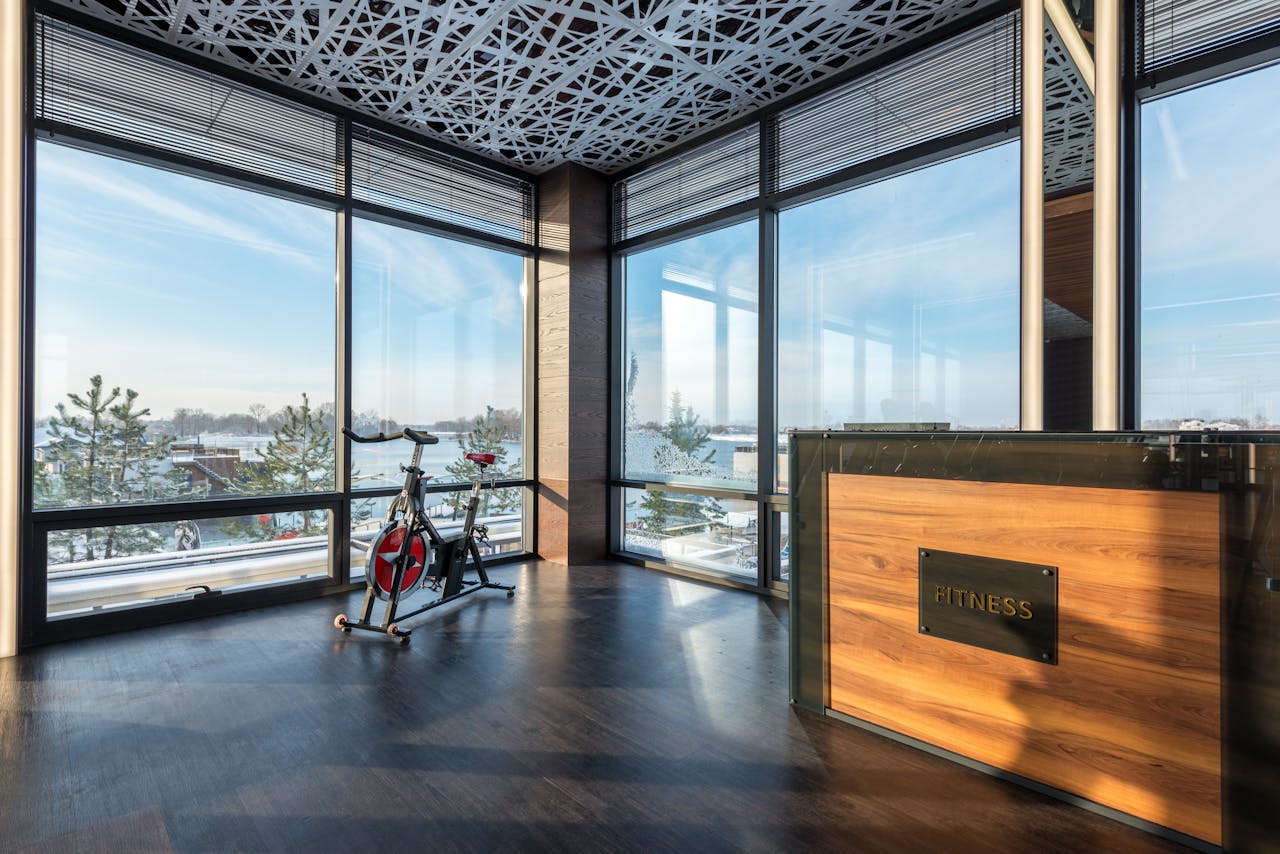
Source: Pexels
5. Upgrade the entrance and reception area
Your entrance is working harder than you think. New members get a first-look trial. It is the last they see of it before they go. And both groups form opinions about your gym based on the space's appearance.
Most studios are not designed with the front desk in mind. Maybe a folding table, a laptop, a jar of protein bars. That arrangement tells every visitor that you ran out of money before you reached the front door.
You don't need a fancy front desk. Good lighting at the entrance, consistent branding, and a clean surface are honestly gonna do way more for you than a $3,000 desk just sitting there in a dark hallway. You can also add a small shelf for retail products (resistance bands, shakers, branded merch, and protein powders) to make the space feel commercial and intentional.
If you have digital check-in (most booking platforms do these days), mount a tablet by the door at eye level. It makes the sign-in process frictionless, and it looks professional. Members see a studio running on systems, not chaos.
One thing people forget about is the smell of the gym. Like, a clean, subtle scent right at the entryway (eucalyptus, citrus, or fresh linen) can set the mood way faster than anything you can actually see. It's weird but true.
Cold-air scent diffusers are $30-$80 for an entry-level unit that covers 200-400 sq ft. That's enough for an entrance or lobby to a gym. This is probably the cheapest upgrade on the list, especially given how closely memory and smell are connected.
Budget estimate: Front desk refresh (shelving, branding, tablet mount): $100-$400. Scent diffuser: $30-$80. You could overhaul your entire entrance for under $500.
Small budgets, big changes
None of these upgrades needs a contractor, a design firm, or a five-figure budget. They want to be looked after.
The gyms that have that premium look aren't always the ones that spend the most money. They're the ones who spend with intention. A bold accent wall, with warm lighting. One branded feature anchors the room. Good line of sight and friendly entry. All these things add up to a studio that members are proud to be a part of.
Members who feel proud of their gym don't need to be retained; they stay. They bring people in. They post without being asked. That kind of loyalty isn't a marketing strategy; it's built into the walls.
The budget isn't the problem. A free weekend and an honest look at your space will tell you more than any consultant would. Most owners never slow down enough to do it.
Read next: 10 best yoga studios layout ideas in 2026
