What are heart rate zones? A guide to all 5 zones
Learn what heart rate zones are, how the five zones work, how to calculate your target heart rate, and which zones support your fitness goals.
Open your fitness app after a workout and you’ll probably see a colourful bar chart splitting your session into Zone 1, Zone 2 and so on up to Zone 5. Most people glance at it and swipe away. That chart shows how hard your heart worked, minute by minute, and what kind of fitness the session built.
What are heart rate zones?
Heart rate zones are five intensity ranges based on a percentage of your maximum heart rate. Zone 1 is very light effort at 50 to 60% of your max, and Zone 5 is an all-out effort at 90 to 100%. Each zone trains your body for a different goal, from recovery to sprint speed.
Here’s a quick look at all five:
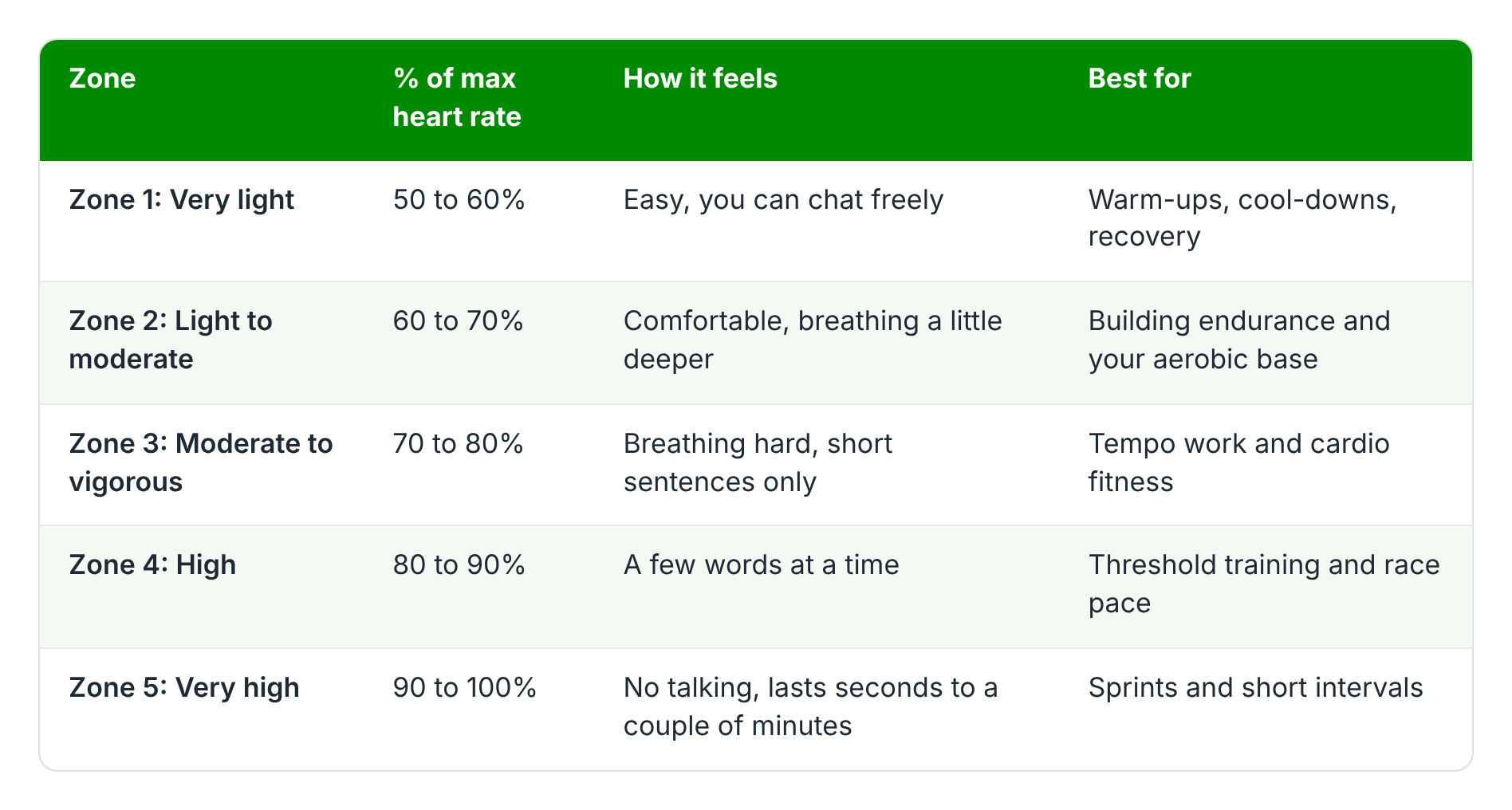
Below, you’ll find what each zone does, a heart rate chart by age, two ways to work out your own zones and advice on which zone fits your goal.
There’s also a free zone chart you can download and keep.
The figures in this guide are estimates for healthy adults. If you have a heart condition or take medication that affects your heart rate, check with your doctor before you set training targets.
I. What are heart rate zones?
Your heart beats faster as a workout gets harder, which makes your heart rate a live reading of how much effort you’re putting in. Heart rate zones sort that reading into five bands, each covering 10% of your maximum heart rate, from 50% up to 100%.
Splitting effort into bands gives you a simple way to plan a session and check it afterwards. A Zone 2 run means a pace you could hold for an hour. A Zone 4 interval means a few hard minutes followed by recovery. The zone breakdown on your watch then shows whether you trained the way you planned.
A. How do heart rate zones work?
As the effort climbs, your muscles need more oxygen and fuel, and your heart pumps faster to deliver it. The way your body makes energy also shifts as you move up the zones:
- Zones 1 and 2: Your body has plenty of oxygen and burns a fuel mix that leans on fat, so you can keep going for a long time.
- Zone 3: Your body draws more on carbohydrate, and your breathing gets heavier.
- Zones 4 and 5: Your muscles need energy faster than oxygen can supply it. They rely mostly on carbohydrate and produce lactate faster than your body can clear it, which causes the burning feeling in your legs and limits these zones to minutes or seconds.
That’s why each zone builds a different kind of fitness. Time in the lower zones builds your aerobic base: a heart that pumps more blood with each beat and muscles that use oxygen more efficiently.
Time in the higher zones raises the speed you can hold before fatigue sets in. Good training plans use both.
B. What is maximum heart rate?
Your maximum heart rate is the most beats your heart can manage in a minute of all-out effort. Every zone is a percentage of it, so it’s the number all your zones are calculated from.
It’s set mostly by your age and genes. It drops slowly as you get older, and training changes it very little. A high max also says nothing about how fit you are: two equally fit 35-year-olds can have maximums 20 beats apart.
Most people estimate their max with 220 minus their age, which gives a 30-year-old 190 bpm. That’s a reasonable starting point, although your real number can sit 10 or more beats either side of it. Section IV covers more accurate ways to find it.
C. What is the difference between heart rate zones and target heart rate?
Target heart rate is one broad range for everyday exercise. The American Heart Association’s target heart rate guidelines put it at 50 to 85% of your max, with moderate effort at the lower end and vigorous effort at the top.
Heart rate zones cover the same ground in more detail, splitting 50 to 100% into five bands so you can plan each session around a specific goal.
If you just want to hit the 150 minutes of moderate activity a week recommended for most adults, your target heart rate is all you need. If you’re training for a 10K or want to get faster, zones give you much finer control over each session.
II. What are the 5 heart rate zones?
Here’s what each zone feels like and how to train in it. The bpm figures are for a 30-year-old with an estimated max of 190 bpm, so you can see what the percentages look like as real numbers.

Source: Andrea Piacquadio on Pexels
A. Zone 1: Very light intensity (50 to 60% of maximum heart rate)
Zone 1 is the pace of a relaxed stroll and the easiest effort that still counts as exercise. You can chat the whole time and keep it up for as long as you like.
It gets more blood flowing to your muscles without stressing them, which helps you recover from harder sessions and eases stiffness.
- Heart rate (age 30): 95 to 114 bpm
- Try this: A 30-minute walk, gentle cycling, or the warm-up and cool-down of any workout
B. Zone 2: Light to moderate intensity (60 to 70% of maximum heart rate)
Zone 2 is the “I could do this all day” pace, and it’s where endurance athletes spend most of their training time. You’re breathing deeper but can still talk in full sentences, and you can hold it for one to several hours.
Sessions here make your heart pump more blood per beat and train your muscles to burn fat more efficiently, which builds the base every other zone depends on.
- Heart rate (age 30): 114 to 133 bpm
- Try this: An easy jog, a long steady bike ride or a brisk uphill walk
C. Zone 3: Moderate to vigorous intensity (70 to 80% of maximum heart rate)
Zone 3 is “comfortably hard”, and most group fitness classes land here. You’re breathing heavily, you can only manage short sentences, and most people can keep it up for 20 to 60 minutes. It trains your heart and muscles to handle sustained effort more efficiently, and it’s tiring enough that you’ll need easier days around it.
- Heart rate (age 30): 133 to 152 bpm
- Try this: A 20-minute tempo run or the steady climbs in a spin class
D. Zone 4: High intensity (80 to 90% of maximum heart rate)
Zone 4 is where you start counting down every second of an interval. It sits around your lactate threshold, the point where lactate builds up in your blood faster than your body can clear it.
You can only get a few words out, and most people hold it for intervals of 2 to 10 minutes. Training here raises that threshold, so you can hold a faster pace for longer before you have to slow down.
- Heart rate (age 30): 152 to 171 bpm
- Try this: 4 x 5 minutes hard with 2 to 3 minutes of easy recovery between efforts
E. Zone 5: Very high intensity (90 to 100% of maximum heart rate)
Zone 5 is your all-out effort, with your heart and lungs working at full capacity. Talking is out of the question, and you can only hold it for about 30 seconds to 3 minutes.
It improves your VO2 max (how much oxygen your body can use) and your top-end speed, and one or two sessions a week is plenty for most people.
- Heart rate (age 30): 171 to 190 bpm
- Try this: 30-second sprints, hill sprints or Tabata rounds
One thing to know about short sprints: your heart rate takes a little time to catch up with your effort, so you may finish a 30-second burst before your watch shows Zone 5. Go by how hard you’re working and treat the reading as a check.
III. Heart rate zones chart by age
Your max heart rate drops as you get older, and your zones drop with it. The chart below shows estimated zones for healthy adults, based on the 220 minus age formula. Treat the figures as a starting point, since they’re averages and not personal medical targets.
A. Estimated maximum heart rate by age
Using 220 minus age, the estimated max is 200 bpm at 20, 190 bpm at 30, 180 bpm at 40, 170 bpm at 50, 160 bpm at 60 and 150 bpm at 70.
The newer Tanaka formula, 208 minus 0.7 x your age, gives slightly lower estimates before 40 and higher ones after it, reaching 159 bpm at 70. The two formulas agree at 40, and if you’re older than that, Tanaka is usually the closer estimate.
B. Heart rate zone percentages and beats per minute
Here are the estimated zones for each age, in beats per minute:
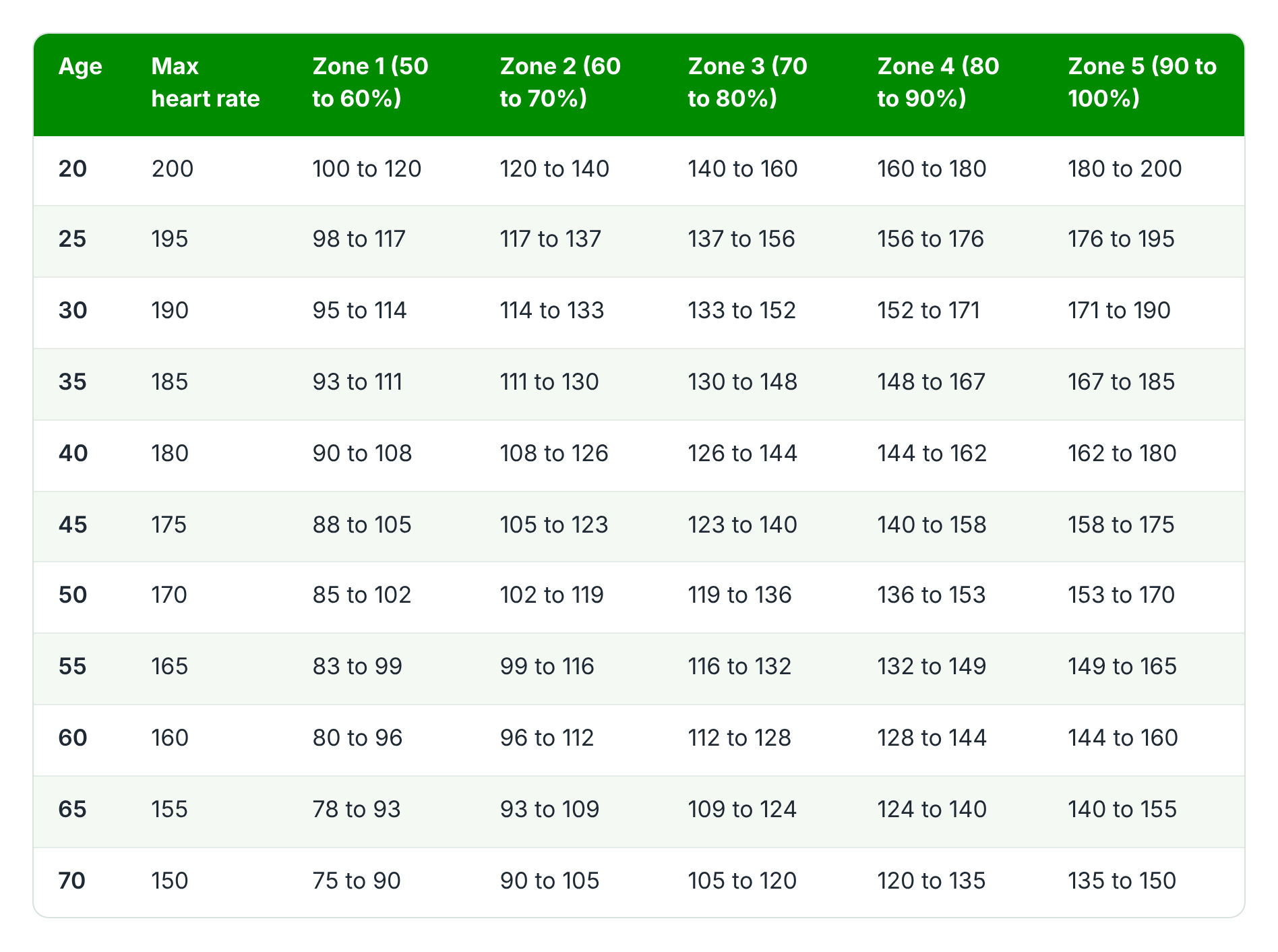
All figures are estimates, rounded to the nearest whole number.
Get the free heart rate zone chart (PDF)
C. How to read your personal heart rate zone chart
Find the row closest to your age (a 33-year-old would use the 35 row) and compare it with your heart rate during a workout. If you’re 40 and your watch shows 145 bpm on a run, you’re in Zone 4. A reading right on a boundary counts as either zone.
Then check the numbers against how you feel. If the chart puts you in Zone 2 but you can’t finish a sentence, your real max is probably lower than the formula suggests, so trust your breathing and adjust.
If you know your resting heart rate, the method in the next section gives you zones that fit you more closely. If you take medication that affects your heart rate, such as beta-blockers, these charts won’t apply to you, so ask your doctor which ranges to use.
IV. How to calculate your heart rate zones
The chart gives you a quick estimate. Working out your own zones takes about five minutes and gets you numbers that fit your body more closely. You need your maximum heart rate and, for the more personal method, your resting heart rate.
A. Estimate your maximum heart rate
The quickest option is a formula.
There are three common ones:
- 220 minus age: The classic, and the one the American Heart Association uses. At 30, it gives 190 bpm.
- Tanaka (208 minus 0.7 x age): Based on a 2001 analysis of 351 studies and usually more accurate for adults over 40. At 30, it gives 187 bpm.
- Gulati (206 minus 0.88 x age): Developed from stress tests of 5,437 healthy women, and it gives lower estimates. At 30, it gives 180 bpm. Researchers still disagree on whether women need a separate formula, so treat it as an option to test.
If you’re healthy and already used to hard exercise, a field test gets you closer to your true max. Warm up for 10 to 15 minutes, then run or cycle hard uphill for 3 minutes followed by 3 minutes of easy recovery.
Do this three times and go all out on the last one. The highest reading on a chest strap is close to your max. For an exact figure, a supervised lab test measures it directly.
B. Calculate each zone using maximum heart rate percentages
Multiply your max by each zone’s lower and upper percentage. With a max of 190 bpm, Zone 2 runs from 190 x 0.60 = 114 bpm to 190 x 0.70 = 133 bpm. Repeat this for each zone, or read your numbers off the chart in Section III. Most fitness watches use this method by default.
C. Use the heart rate reserve method for a more personalised estimate
The heart rate reserve method, also called the Karvonen formula, brings your resting heart rate into the calculation. Your resting heart rate reflects your current fitness, so the zones fit you more closely.
Start by measuring your resting heart rate. Count your pulse for a full minute first thing in the morning, before you get out of bed, and average it over three to five mornings.
Most adults land between 60 and 100 bpm, according to Mayo Clinic’s guide to exercise intensity, and fitter people often sit lower. Subtract it from your max to get your heart rate reserve, then use this formula for both ends of each zone:
Target heart rate = (heart rate reserve x zone percentage) + resting heart rate
D. Heart rate zone calculation example for a 30-year-old
Take a 30-year-old with an estimated max of 190 bpm and a resting heart rate of 60 bpm. Their heart rate reserve is 130 bpm, so their Zone 2 works out at (130 x 0.60) + 60 = 138 bpm to (130 x 0.70) + 60 = 151 bpm. Here’s how the two methods compare across all five zones:
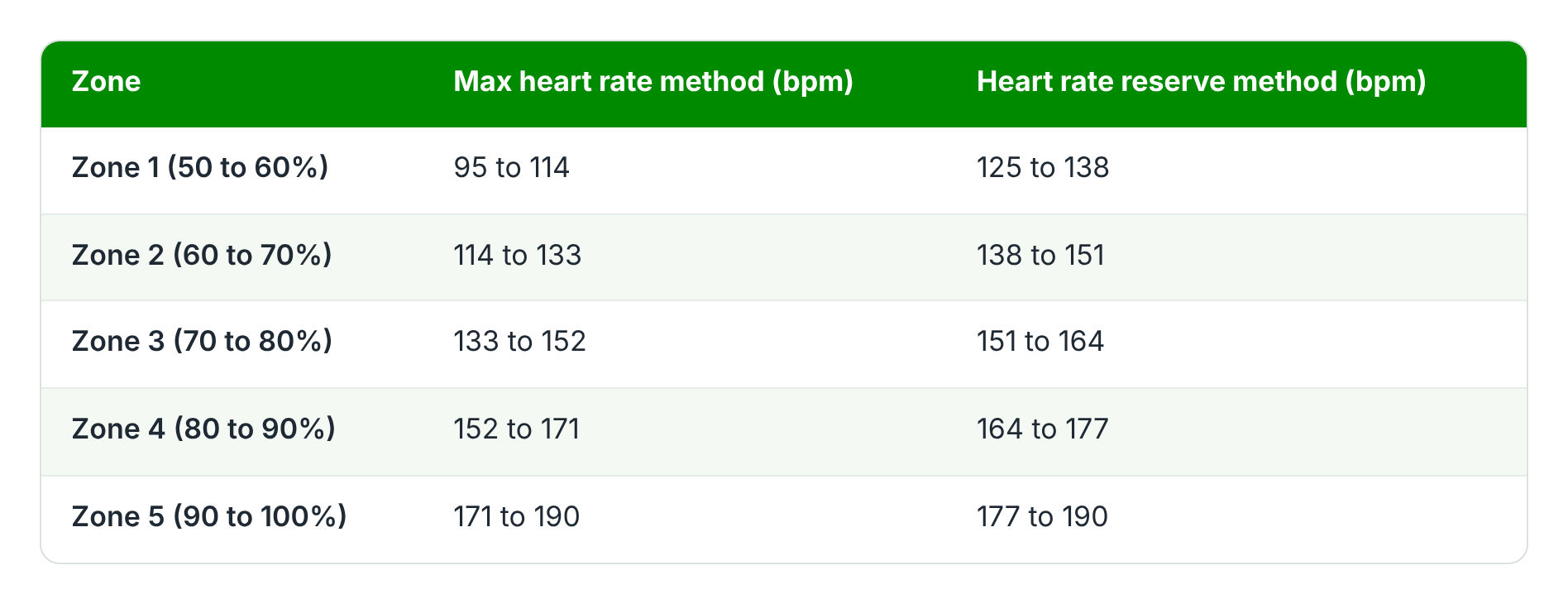
The heart rate reserve numbers are higher in every zone, and the gap is widest at the bottom: Zone 1 starts 30 bpm higher, while Zone 5 starts only 6 bpm higher. Easy efforts can feel too hard as a result, so if a Zone 2 run leaves you unable to talk in full sentences, aim for the lower end of the range.
Whichever method you choose, stick with it, because switching makes your progress hard to compare. Recalculate every few months as your resting heart rate drops.
E. Is the 220 minus your age formula accurate?
It’s a decent starting point with some known limits. According to the American College of Cardiology, the formula dates back to 1971 and was built from just 10 studies, most of them on people under 55.
People of the same age also vary by around 12 beats per minute either way, and some are 15 to 20 beats off.
The formula also tends to underestimate max heart rate in older adults, which is why the Tanaka researchers proposed their own equation.
If your zones feel wrong, check the highest heart rate your watch records across several hard workouts, or try the field test above, then recalculate with that number.
V. Heart rate zones vs. other ways to measure intensity
Heart rate is one of three common ways to judge effort. The other two, the talk test and rate of perceived exertion (RPE), need no equipment. They’re worth learning because they react faster than your heart rate and still work when your watch misreads.
A. Heart rate zones vs. the talk test
The talk test asks one question: how much can you say right now? Your breathing climbs with your effort, so your ability to talk tracks your zones closely. The table below shows how they line up.
It’s the quickest way to check your watch mid-workout. If the screen says Zone 2 and you can only manage three words, trust your breathing.
B. Heart rate zones vs. rate of perceived exertion (RPE)
RPE asks you to rate how hard a workout feels. Gunnar Borg’s original 6 to 20 scale was designed so that your rating multiplied by 10 roughly matches a healthy young adult’s heart rate, so a 13 suggests around 130 bpm.
Most people find the simpler 0 to 10 scale easier to use. Here’s how all three measures line up:
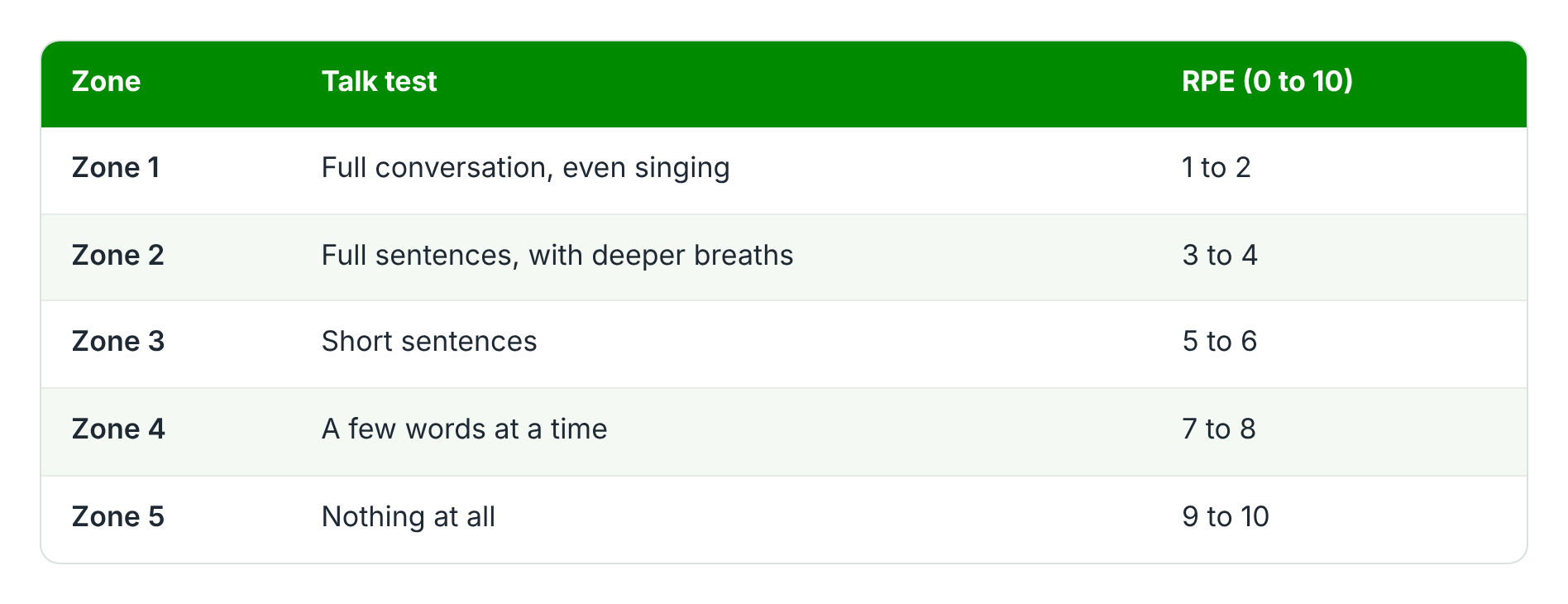
RPE is the better guide for strength training and short sprints, where your heart rate jumps around or lags behind. It’s also the main tool for people on beta-blockers, which lower the heart rate response and make standard zones unreliable.
C. Why your workout pace does not always match your heart rate zone
You run your usual route at your usual pace, and your watch shows Zone 3 when you’d normally be in Zone 2. That’s normal, because your heart rate responds to more than your speed:
- Cardiac drift: On long steady sessions, sweating reduces your blood volume and more blood goes to your skin for cooling, so your heart rate creeps up even at the same pace.
- Heat and hills: Hot, humid weather and uphill sections both raise your heart rate without any change in pace.
- Heart rate lag: At the start of a hard interval, your heart rate needs a minute or two to catch up.
- Your fitness improving: If the same pace now puts you in a lower zone, your heart has become more efficient.
The practical rule is to follow your heart rate on easy days and slow down when it drifts, and to follow pace or RPE on interval days. Section IX covers the other things that shift your numbers from one day to the next.
VI. Which heart rate zone is best for your fitness goals?
Each goal has a main zone, with the others playing a supporting role. Here’s how to match them up.
A. Best heart rate zone for building endurance
Zone 2 is your main zone. Long, easy sessions train your heart to pump more blood per beat and your muscles to use oxygen and fat more efficiently, and they’re easy enough to repeat several times a week. Add 5 to 10 minutes to your longest Zone 2 session each week, and slow down if your heart rate drifts into Zone 3, even if that means walking up hills.
B. Best heart rate zone for improving cardiovascular fitness
For general heart health, a mix of Zones 2 to 4 works well. The WHO’s physical activity guidelines recommend 150 to 300 minutes of moderate activity a week, 75 to 150 minutes of vigorous activity, or a mix of the two.
Moderate effort lines up with Zone 2 and vigorous effort with Zones 3 and 4. Five 30-minute Zone 2 sessions cover the moderate target, and three shorter sessions with Zone 3 to 4 intervals cover the vigorous one.
C. Best heart rate zone for running faster
Speed comes from Zones 4 and 5, built on a base of Zone 2. Hard intervals raise your lactate threshold and VO2 max, the two numbers that decide how fast you can hold a pace.
A 2019 meta-analysis of HIIT protocols found the biggest VO2 max gains came from intervals of 2 minutes or longer, at least 15 minutes of hard work per session, and programmes lasting 4 to 12 weeks or more.
In practice, that means one Zone 4 session and one Zone 5 session a week, with easy Zone 2 runs on the other days. Give it at least six weeks before you judge the results.
D. Best heart rate zone for recovery workouts
Recovery happens in Zone 1. A 20 to 40-minute walk, easy ride or swim the day after intervals or a long run gets blood flowing to tired muscles without adding new stress. If your heart rate creeps into Zone 2, slow down. A recovery session should feel almost too easy.
E. Which heart rate zone is best for weight loss?
You’ve probably seen the “fat burn” label on a treadmill screen, usually pointing at Zone 2. It’s based on something real. At easy efforts, fat supplies a bigger share of your energy, and as intensity rises, your body shifts towards carbohydrate. Higher zones burn more total calories per minute, though, so they can burn as much fat or more in the same amount of time.
As a rough illustration, a 45-minute Zone 2 session might burn 400 calories with 60% from fat, which is 240 fat calories. A 45-minute Zone 3 to 4 session might burn 600 calories with 45% from fat, which is 270. Zone 2 has its own advantage: it’s easier to keep up, so you can do more of it each week.
Fat loss comes down to your overall energy balance over weeks and months, how consistently you train, what you eat and how well you sleep. The zone you train in during a single session matters far less, so the best zone for weight loss is the one you’ll stick with. Adding two strength sessions a week helps you keep muscle while you lose fat.
F. How much time should you spend in each zone?
Most endurance coaches follow the 80/20 rule: about 80% of your training easy and about 20% hard. It comes from research on how top athletes train, and a 2015 review in Frontiers in Physiology describes the typical split as 75 to 80% low intensity, around 5% at threshold and 15 to 20% high intensity.
If you train three to five times a week, the simplest way to apply it is to count sessions: make one session hard and the rest easy. With six sessions, you can make two of them hard. The most common mistake is letting easy days creep into Zone 3, which leaves you too tired to push properly on hard days.
G. Do you need to train in all five heart rate zones?
It depends on your goal. For general health, regular sessions in Zones 2 to 4 cover the guidelines, and your warm-ups take care of Zone 1. For endurance events, you’ll use all five over a training block. Beginners can stick to Zones 1 and 2 for the first month or so and add intervals once exercise feels routine.
Steady training also improves fitness on its own. A 2023 meta-analysis of VO2 max training in women found that continuous training and HIIT improved VO2 max by similar amounts, so sprints are optional if they aren’t for you.
VII. How to use heart rate zones for different workouts
The zones stay the same across activities, and each type of workout uses them a little differently.
A. Heart rate zones for walking
Walking is the easiest way to start training with zones, and for many people a brisk walk is enough to reach Zone 2. If a flat route keeps you in Zone 1, add hills, a treadmill incline or a faster pace. A good first session is 30 minutes of brisk walking in Zone 2, with 5 easy minutes at each end.
B. Heart rate zones for running
Running raises your heart rate quickly, so many new runners spend every run in Zone 3 or 4 without realising it. Keeping an easy run in Zone 2 often means a much slower pace than you expect, and beginners may need short walking breaks at first. Once that base is in place, add tempo runs in Zone 3, threshold intervals in Zone 4 and short repeats in Zone 5.
C. Heart rate zones for cycling
Most people’s heart rate runs lower on a bike than on a run at the same effort, because the bike supports your weight and your legs do most of the work. Wattbike’s guide to heart rate and cycling explains that max heart rate is lower on the bike than when running or swimming.
If you use your running zones for cycling, you may struggle to reach Zones 4 and 5, so do a field test on the bike if you ride seriously. Indoors, put a fan in front of you, since the extra heat pushes your heart rate up.
D. Heart rate zones for HIIT workouts
HIIT sends your heart rate up and down all session, with work intervals in Zones 4 and 5 and recovery in Zones 2 and 3. Because your heart rate lags behind your effort, use RPE to judge the short bursts and your heart rate to judge recovery. If it doesn’t drop back to Zone 2 or 3 between rounds, take a longer rest or end the session.
Try this: A 10-minute warm-up, then 8 rounds of 30 seconds very hard (RPE 9) and 90 seconds easy, then a 5-minute cool-down.
E. Heart rate zones for strength training
Lifting raises your heart rate in short spikes during each set and lets it fall while you rest, so zones are less useful for a traditional weights session and more useful for circuits. Heart rate can also overstate how hard your heart and lungs are working during weights.
In one study of circuit resistance training, heart rate reached 165 bpm at an oxygen use that produced only 150 bpm on a treadmill.
Circuits with short rests can still build cardio fitness. A University of New Mexico review of circuit training studies found that the workouts that improved VO2 max kept participants at around 60 to 80% of their max heart rate.
Use RPE to judge your lifts, and use your heart rate to check that a circuit keeps you working.
F. How beginners should start training with heart rate zones
If you’re new to exercise or coming back after a break, keep your first two months simple:
- Weeks 1 to 4: Three or four sessions a week in Zones 1 and 2, such as brisk walks or easy cycling. Use the talk test as much as your watch.
- Weeks 5 to 8: Make one session a week harder, with short Zone 3 efforts such as 5 x 2 minutes.
- After week 8: Add one Zone 4 interval session a week if you’re recovering well.
Increase how long you train before you increase how hard you train. Mayo Clinic suggests adding about 10% to your weekly activity at a time. If you have a heart condition, high blood pressure or another health concern, check with your doctor before you start.
VIII. How to track your heart rate during exercise
Zone training is only as good as your heart rate reading. A chest strap is the most accurate option, because it reads your heart’s electrical signal.

Source: Luke Chesser on Unsplash
Smartwatches and armbands use an optical sensor that reads blood flow under your skin, which works well for steady exercise and less well when your effort changes quickly. Checking your pulse by hand is a rough fallback for when you have no device.
A. Using a fitness watch or heart rate monitor
Most watches set your zones automatically with 220 minus your age, so spend five minutes in the settings before you rely on them.
Enter your real max if you’ve measured it, choose your zone method (percentage of max or heart rate reserve) and stick with it, and pair a chest strap for interval sessions if you have one.
For better wrist readings, wear the watch snug and one to two finger widths above your wrist bone, tighten it a notch for workouts and keep the sensor clean. Sweat and sunscreen can block the light it uses.
B. Measuring your pulse manually
No device? Stop, find your pulse on the thumb side of your wrist or at the side of your neck, and count the beats for 15 seconds with your index and middle fingers. Multiply by four, so 28 beats means 112 bpm.
Count straight away, because your heart rate starts dropping within seconds of stopping.
C. How accurate are wrist-based heart rate sensors?
For steady exercise, they’re more accurate than many people assume. In Stanford Medicine’s study of seven wrist-worn trackers, six measured heart rate to within 5%, while none measured calories burned well. Error was lowest during cycling and highest during walking.
Accuracy drops when you move a lot or change pace quickly. A Duke University study of wearable heart rate sensors found that error during activity was about 30% higher than at rest, which matters most for HIIT, sprints and stop-start circuits.
Research on skin tone is mixed: the Stanford study found higher error on darker skin, while the Duke study found no significant difference. A wrist sensor is fine for steady cardio, a chest strap is the better choice for intervals, and your watch’s calorie count is a rough guide at best.
D. What to do when your heart rate monitor shows unexpected readings
Odd readings usually have a simple cause:
- A heart rate that matches your running cadence (160 to 180): The sensor is picking up your arm movement. Tighten the strap or move the watch higher up your wrist.
- A spike in the first 10 minutes on a chest strap: The electrodes are too dry. Wet them before you put the strap on.
- Spikes in cold or dry weather: Blood flow at the wrist drops in the cold, and synthetic clothing can cause static. Wear the watch under a sleeve or switch to a chest strap.
- Readings that drop out or freeze: Clean the sensor, check the fit and check the battery.
If your heart rate is unusually high at rest, races or feels irregular, or comes with chest pain, dizziness or shortness of breath, stop exercising and contact a doctor.
IX. What can affect your heart rate zones?
Some factors shift your zones for good, such as age and fitness. Others move your heart rate for a day or a single session, such as heat, poor sleep and medication. Knowing which is which tells you whether to recalculate your zones or just adjust today’s workout.
A. Age and fitness level
Your max heart rate drops by a few beats every five years, and the Tanaka study found it depends largely on age, regardless of how active people are. Fitness has a bigger effect on your resting heart rate, which drops as your heart learns to pump more blood with each beat.
Recalculate your zones every year or two for age. If you use the heart rate reserve method, also recalculate whenever your resting heart rate drops by 5 bpm or more.
B. Resting heart rate and recovery
Your morning resting heart rate is one of the easiest recovery checks you have. After a hard week, a late night or at the start of an illness, it often sits noticeably above its usual level. When it does, make that day an easy Zone 1 or 2 session, or take a rest day.
C. Heat, humidity, and dehydration
Hot, humid weather raises your heart rate from the first minute, and fluid loss pushes it higher. A systematic review of dehydration during exercise in the heat found that heart rate rose by about 3 bpm for every 1% of body weight lost through sweat. For a 70 kg person who sweats out 1.4 litres, that’s roughly 6 extra beats per minute at the same pace.
Your body does adapt. Massachusetts General Hospital’s guide to exercising in heat and humidity notes that heart rate is the first thing to improve: it starts to drop within 3 to 5 days, with most of the benefit after a week. Until then, slow down to stay in your zone, train early in the day when it’s cooler and drink before you feel thirsty.
D. Stress, sleep, and fatigue
Work stress, a bad night’s sleep or tired legs from yesterday can push your heart rate higher at your usual pace. Deep fatigue can do the opposite and stop your heart rate from climbing even when you’re working hard.
On these days, go by RPE and the talk test, and end the session early if it feels far harder than your numbers suggest.
E. Caffeine and other stimulants
Caffeine has less effect on exercise heart rate than most people expect. A 2018 meta-analysis of caffeine and submaximal exercise found that it made a fixed effort feel easier without changing heart rate.
The catch is that you may run or ride faster without noticing, and then your heart rate rises because you’re working harder. After a pre-workout coffee, check your heart rate more often. Pre-workout supplements often contain other stimulants too, so read the label.
F. Medications and underlying health conditions
Some medications change how your heart responds to exercise. Beta-blockers are the most common example, and the American Heart Association’s guide to beta-blockers and exercise explains that because they slow your heart rate, you may need a different target.
Some decongestants, asthma relievers and thyroid medications can raise your heart rate, and conditions such as fever, anaemia, thyroid problems and pregnancy can shift it in either direction.
If any of these apply to you, ask your doctor which heart rate range or RPE level to aim for. They may suggest an exercise stress test to see how your heart responds.
X. Common heart rate zone training mistakes
Heart rate zones are simple to use, and they’re just as easy to misuse. These are the five mistakes that most often stop people from getting results.
A. Treating estimated maximum heart rate as an exact number
Your watch shows your zones down to the beat, so they look precise. Most of them come from an age formula that can be 10 or more beats off.
Treat formula-based zones as a first draft: check them against the talk test for a few weeks, then set your real max with a field test or the highest reading from your hard workouts.
B. Spending too much time in high-intensity zones
Hard sessions feel productive, so easy days slowly creep into Zone 3 until most of the week is spent at the same medium-hard effort.
Warning signs include a morning resting heart rate that stays high, poor sleep, heavy legs and times that stop improving. Count your sessions and aim for roughly four easy ones for every hard one.
C. Assuming Zone 2 is always the best zone
Zone 2 has become the most talked-about zone in fitness, thanks to longevity podcasts and endurance coaches. It’s a useful zone, and the hype around it has created two problems.
The first is that “Zone 2” means different things to different people. Research on elite athletes often uses a three-zone model, and the 2015 Frontiers review uses “zone 2” for training at or near the lactate threshold. That’s closer to Zone 4 on your watch, so check which model someone means before you copy their advice.
The second is that Zone 2 on its own is a slow route to fitness if you only train two or three hours a week.
Adding intervals gets you fitter faster, and the 2019 HIIT meta-analysis found that even programmes of four weeks or less improved VO2 max. Use Zone 2 as the base of your week and give each hard session a specific job.
D. Ignoring how you feel because of your watch
A number on a screen feels more objective than your own sense of effort. Wrist sensors still misread, and heat, dehydration and medication all move your heart rate. Use your heart rate, the talk test and RPE together. If you feel dizzy, sick or short of breath, or have chest pain, stop, whatever your watch says.
E. Comparing heart rate zones across different devices
Brands set zones in different ways. Some use percentage of max heart rate and others use heart rate reserve, some use five zones and others use three, six or seven, and even the percentages vary.
Wattbike’s cycling zones, for example, put Zone 1 at 60 to 65% and Zone 2 at 65 to 75%. Forty-five minutes in Zone 2 on your watch may not equal 45 minutes in Zone 2 on a friend’s app or your gym’s screen. Track your progress on one device, and if you switch, enter the same max, resting heart rate and zone method before you compare.
XI. How coaches and studios use heart rate zones
Heart rate zones give coaches a shared language with their members. “Push harder” means something different to everyone in the room, while “stay in Zone 4 for the next three minutes” gives each person a target that fits their own body.

Source: Trust “Tru” Katsande on Unsplash
That makes zones a strong fit for group classes, where one session has to work for a beginner and a marathon runner at the same time.
A. Building zone-based class formats
Each format below targets a different zone, so members can build a balanced week from your timetable:
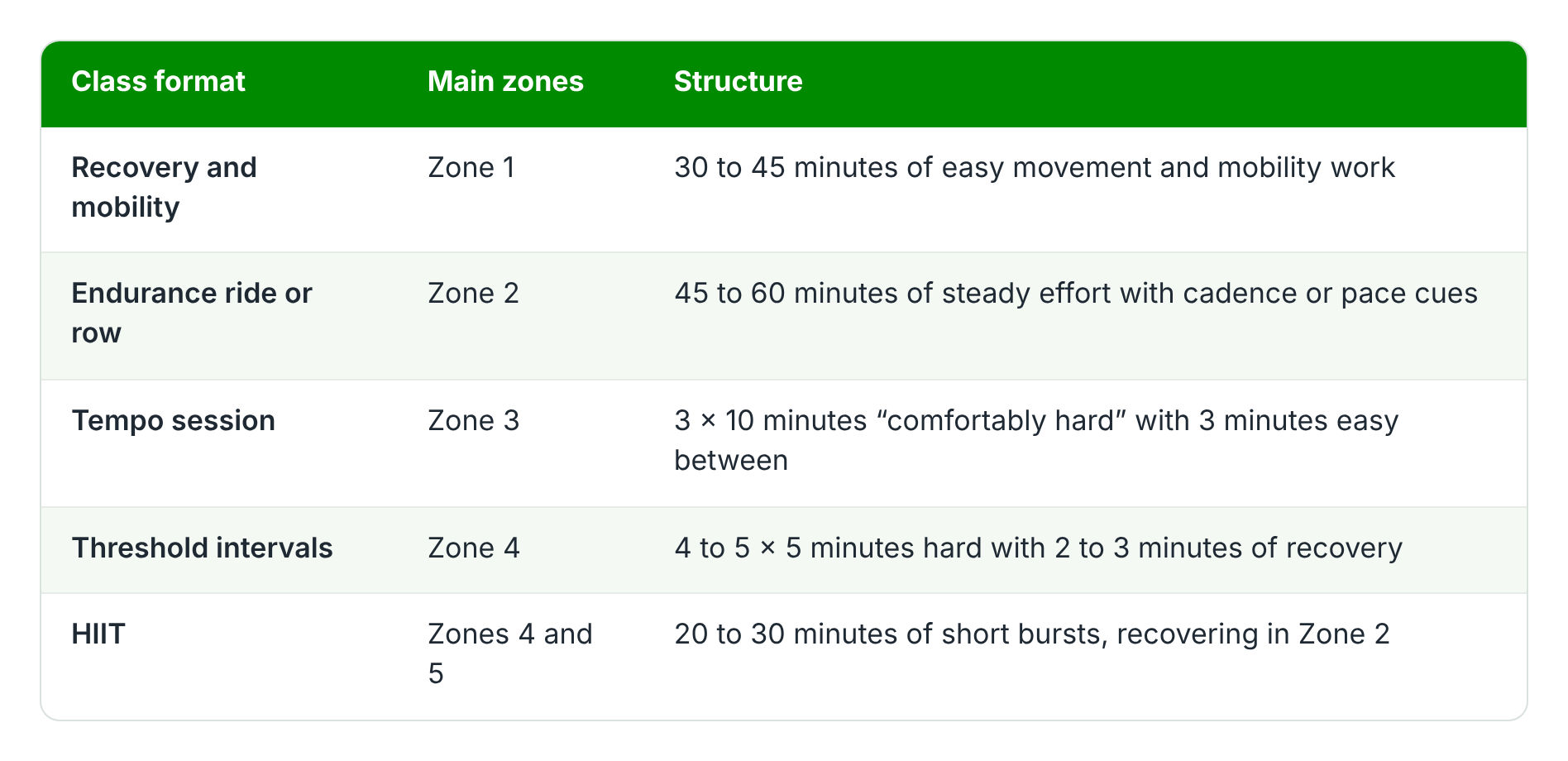
Coach the recovery as well as the work. In HIIT, tell members to let their heart rate drop back to Zone 2 before the next round, so the hard efforts stay hard.
Remind the room that a beginner on a brisk incline walk and a regular on a hard run can both be in Zone 4, and call out RPE targets for anything under a minute, since heart rate lags on short efforts.
B. Explaining zones to members in a way they’ll remember
Colours stick with members far better than percentages. A common scheme is grey for Zone 1, blue for Zone 2, green for Zone 3, orange for Zone 4 and red for Zone 5, and it works best when you use the same colours on your screens, posters and class descriptions.
Teach the talk test in a member’s first class, and give new members the zone chart from Section III so they can find their numbers.
It also helps to explain that medication, heat or a bad night’s sleep can push readings up or down, so members know to go by feel when the numbers look off.
If your studio shows heart rates on a screen, get each member’s consent first and offer nicknames in place of real names, because heart rate is personal health data.
C. Naming and scheduling classes by intensity
Your timetable can steer members towards a healthier training mix before they step into the studio:
- Put the zone in the class name, such as “Zone 2 Endurance Ride” or “Zone 4 Threshold Run”, and add a line about intensity to the listing (“steady effort, chatty pace, 50 minutes”).
- Spread hard classes across the week, with recovery and Zone 2 classes the day after your hardest sessions, so regulars can follow a rough 80/20 split.
- Package zones into a programme, such as a six-week zone training course with a test session at the start and the end.
- Offer one-to-one zone assessments so new members start with accurate numbers.
With Rezerv’s fitness management software, you can run all of this from one system. Set up zone-based classes, multi-week courses, one-to-one assessment appointments and field test events, and let members book everything through your own branded member app.
Rezerv’s AI also flags members who are at risk of dropping off and can trigger re-engagement messages, which helps when someone stops booking halfway through a six-week programme.
Rezerv handles your scheduling, bookings and memberships, and it runs alongside the heart rate system you already use, such as chest straps, wearables and class displays.
See how Rezerv helps studios run zone-based classes. Book a demo
XII. Frequently asked questions
What is a good heart rate zone for exercise?
For general health, Zones 2 to 4 cover the moderate and vigorous activity that health guidelines recommend. Most of your week should sit in Zone 2, with one or two harder sessions in Zones 4 and 5 if you’re training for performance.
How do I calculate my heart rate zones?
Estimate your max with 220 minus your age, then multiply it by each zone’s percentages. For a 30-year-old, that puts Zone 2 at 114 to 133 bpm. For more personal zones, use the heart rate reserve method in Section IV.
What is my maximum heart rate by age?
Using 220 minus age, it’s about 200 bpm at 20, 190 at 30, 180 at 40, 170 at 50 and 160 at 60. Your true max can be around 12 beats higher or lower, and the full chart is in Section III.
Is Zone 2 the best heart rate zone for fat burning?
Zone 2 burns the highest percentage of calories from fat, and higher zones burn more calories overall. For fat loss, the zone you’ll train in consistently matters more, along with what you eat and how you sleep.
Can you lose weight in Zone 3?
Yes. Zone 3 burns more calories per minute than Zone 2 and is still sustainable for 20 to 60 minutes. It’s tiring, so mix it with easier days.
What heart rate zone should beginners train in?
Start with Zones 1 and 2 for the first four to eight weeks. Once exercise feels routine, add one session a week with short Zone 3 efforts.
How long should you stay in each heart rate zone?
Across a week, aim for about 80% of your training in Zones 1 and 2 and 20% in Zones 4 and 5. In a single session, most people can hold Zone 2 for hours, Zone 4 for 2 to 10 minutes and Zone 5 for up to 3 minutes.
Is it safe to exercise in Zone 5?
For healthy adults who exercise regularly, short Zone 5 efforts are safe, and one or two sessions a week is plenty. If you’re new to exercise or have a heart condition or high blood pressure, check with your doctor first, and stop if you feel chest pain or dizziness.
Why is my heart rate different on my watch and the treadmill?
Treadmill handgrip sensors only read your heart rate while you hold them, and sweat and movement reduce their accuracy. If two readings disagree, trust a chest strap first, then your watch.
Do I need a fitness watch to use heart rate zones?
No. You can count your pulse for 15 seconds and multiply by four, or use the talk test and RPE. A watch or chest strap makes tracking easier, especially for intervals.
