Everyone is doing Pilates. Is it actually worth it?
Everyone is doing Pilates, but is it actually worth it? Explore the benefits, costs, class types, and how often you should go before booking.
.jpg)
Source: Ahmet Kurt on Pexels
Pilates is having a moment. Open Instagram or TikTok and you will probably see someone balancing on a reformer, talking about their “Pilates era,” or showing off a studio that looks more like a boutique hotel than a workout space.
New reformer studios are popping up everywhere, classes are filling quickly, and Pilates has gone from something many people barely understood to one of the most talked-about workouts around.
But once you start looking at the price of a class, the obvious question comes up: is Pilates actually worth it, or are we all just getting caught up in the hype?
That is a fair question. Reformer Pilates can cost considerably more than a regular gym membership or a basic group fitness class, especially if you want to go several times a week.
So before you buy a big class package because everyone else seems to be doing Pilates, it is worth understanding what you are actually paying for. In this article, we will break down what Pilates can do.
First, what exactly is Pilates?
If your idea of Pilates is “that workout with the sliding bed-looking machine,” you are not alone. But the reformer is only one way to practice it.
Pilates is a system of controlled exercises that focuses on strength, stability, mobility, breathing, and body awareness. It was developed by Joseph Pilates in the early 20th century and has since evolved into several styles, from simple mat-based workouts to equipment-based studio sessions. The movements are usually slow and deliberate, with more attention paid to how you move than how quickly you can finish a set.
That is also why a Pilates class can be surprisingly challenging. You may not be jumping around or lifting huge weights, but maintaining the right position while moving slowly under control can make your muscles work much harder than you expect.
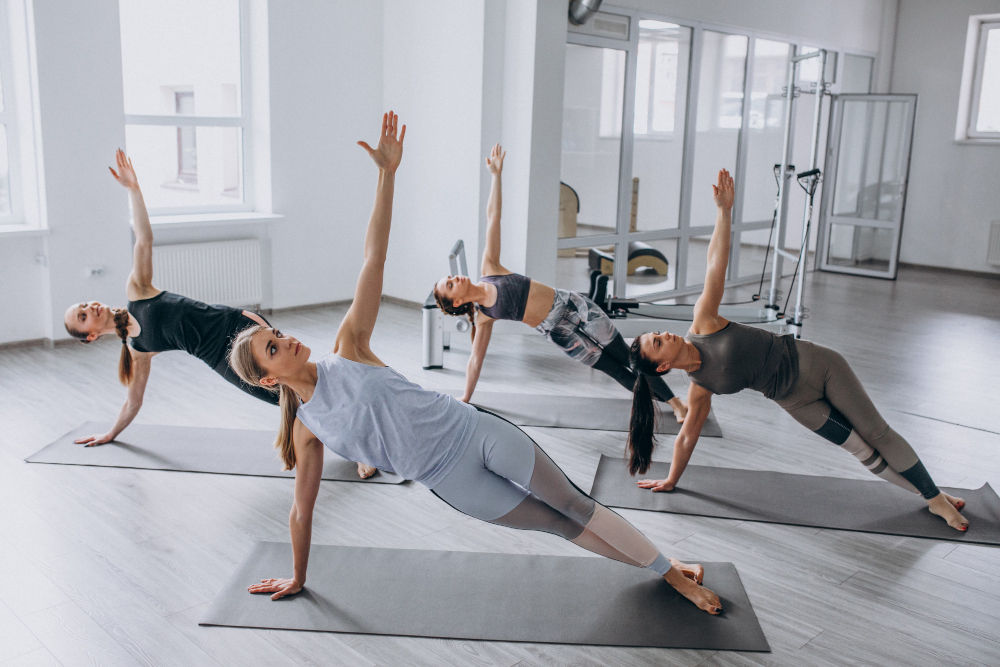
Before booking your first class, it helps to understand the three formats you are most likely to come across: mat Pilates, reformer Pilates, and private Pilates.
Mat Pilates
Mat Pilates is probably the simplest place to start. As the name suggests, most exercises are performed on a mat using your own body weight as resistance.
A typical class might include exercises such as leg circles, bridges, roll-ups, planks, or the famous Pilates Hundred. Some classes also use small props like resistance bands, Pilates rings, light weights, or exercise balls, but you do not need a large machine to get a proper workout.
Because there is less equipment involved, mat Pilates is generally more accessible. You can take a class at a studio, follow an online session, or eventually practice at home once you understand the movements.
Just do not assume “no reformer” means “easy.” On a mat, your body has to work against gravity without getting assistance from the springs and straps of a reformer. Depending on the exercise and your experience level, some mat movements can actually feel harder than their reformer versions. Cleveland Clinic specifically notes that neither mat nor reformer Pilates should automatically be considered the easier option.
Mat Pilates can be a great choice if you are curious about Pilates but do not want to commit to the higher price of reformer classes yet.
Reformer Pilates
This is the version you have probably been seeing all over social media.
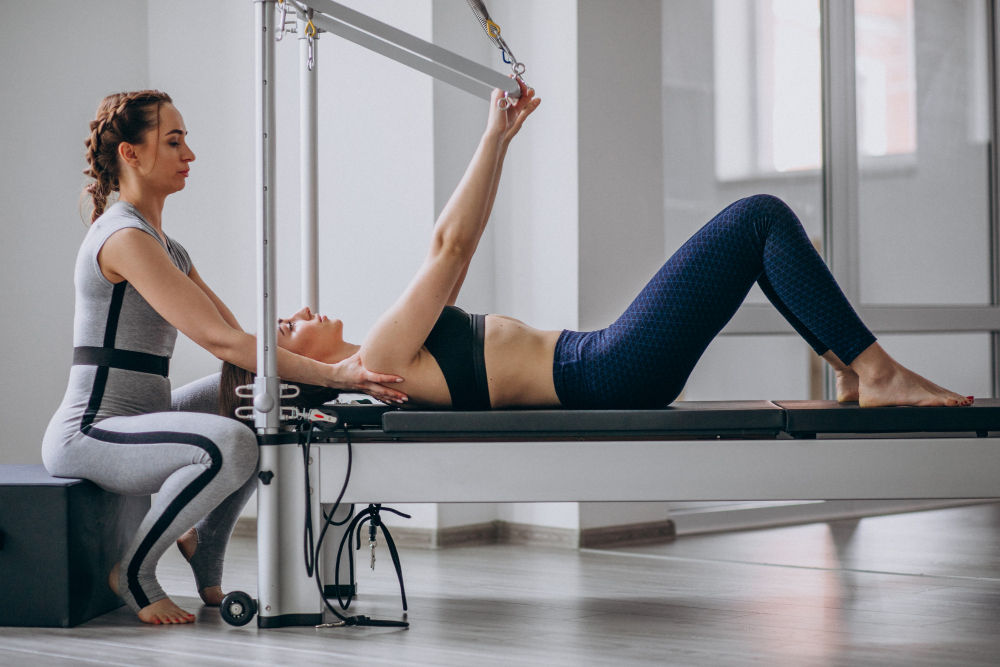
A Pilates reformer is a specialized piece of equipment with a sliding platform called a carriage, along with springs, straps, and a footbar. The springs create adjustable resistance, while the carriage allows you to perform exercises lying down, sitting, kneeling, or even standing.
And despite how complicated the machine looks, it can actually make certain movements more approachable for beginners. The resistance can be adjusted, and the straps and springs can provide support while you learn how to control a movement. At the same time, an instructor can increase the resistance or change your position to make the same exercise much more demanding as you improve.
That flexibility is a big part of reformer Pilates' appeal. Two people in the same class can perform variations of an exercise that suit their individual ability while still following the same general workout.
Reformer sessions are also usually instructor-led, so you do not have to arrive knowing what to do. The instructor guides the class through each movement, helps with alignment, and adjusts exercises when needed.
For a beginner, that guidance matters. Pilates relies heavily on positioning and control, and simply copying what the person next to you is doing does not necessarily mean you are performing the movement correctly. Cleveland Clinic recommends learning proper alignment with a qualified instructor, particularly when using a reformer.
The trade-off, of course, is price. Reformers are expensive pieces of equipment, and studios can only fit a limited number into each class. That usually makes reformer sessions more expensive than mat classes or a regular gym membership.
Private Pilates
Then there is private Pilates, where you work one-on-one with an instructor rather than joining a group class. This is the most personalized option. Instead of following a workout designed for ten other people, the instructor can build the session around your ability, goals, movement patterns, and experience.
They can also spend much more time correcting your technique. If your hips shift during an exercise or you keep compensating with the wrong muscles, there is nowhere to hide when the instructor is watching only you.
That can be useful if you are completely new to Pilates and want to learn the fundamentals before joining a group. Private instruction can also make sense for someone who needs more individualized exercise modifications.
If you are managing an injury or medical condition, though, it is important to speak with an appropriate healthcare professional and work with an instructor who has suitable training rather than treating a general Pilates session as medical rehabilitation.
The obvious downside is cost. One-on-one sessions are usually considerably more expensive than group classes.
You also do not necessarily need private sessions forever. Some people take a few private lessons to understand the basics, then move into group reformer or mat classes once they feel more confident.
Source: senivpetro on Magnific
Mat vs. reformer vs. private Pilates
So, which one should you book? There is no universally “best” type of Pilates. It depends on your budget, experience, and what kind of support you want.

What does Pilates actually do for your body?
So, what are you actually getting from all those controlled leg lifts, planks, bridges, and suspiciously tiny movements that somehow make your muscles shake?
Pilates trains your body a little differently from a typical cardio or weightlifting session. Instead of focusing on how fast you can move or how much weight you can lift, it asks you to control each movement, maintain good alignment, and keep the right muscles working throughout the exercise.
That combination can help improve strength, mobility, balance, and body control. Research on Pilates has found promising benefits across several physical outcomes, although the strength of the evidence varies depending on the population and outcome being studied.
A systematic review available through PubMed, for example, found potential benefits for outcomes including balance and pain, while also noting that the certainty of evidence ranged from very low to moderate. In other words, Pilates has real benefits, but it is worth being skeptical of anyone promising that it can fix everything.
Pilates builds more than just your abs
Pilates has a reputation for being all about the core, and there is some truth to that. But "core" means more than getting visible abs.
Your core includes muscles around your abdomen, back, hips, and pelvis that work together to stabilize your trunk. Pilates repeatedly challenges these muscles while you move your arms and legs, change positions, or resist the pull of springs on a reformer.
Imagine lying on a reformer while extending both legs away from your body.
Your legs are moving, but your torso is supposed to remain stable. Keeping your pelvis from shifting or your lower back from arching requires your trunk muscles to stay engaged throughout the movement.
That is one reason a Pilates exercise can look easy from across the room and feel completely different once you try it. But your core is not the only thing working. Depending on the class, Pilates can challenge your glutes, thighs, shoulders, arms, and back too. Reformer classes can add resistance through springs, while mat exercises use body weight, gravity, and leverage to make movements harder.
The Cleveland Clinic's guide to Pilates also highlights core strength as one of the method's main benefits, with that strength supporting other areas such as posture and movement.
Still, there is an important distinction. Pilates is a form of resistance exercise, but it is not automatically equivalent to a progressive weight-training program. If your main goal is to maximize muscle size or dramatically increase your ability to lift heavy loads, traditional strength training will usually deserve a place in your routine too.
Pilates can improve mobility and flexibility
Ever stand up after eight hours at a desk and feel about 30 years older than you did that morning?
This is another reason people are drawn to Pilates. Many exercises take your joints through controlled ranges of motion while simultaneously asking you to maintain stability elsewhere. Rather than simply holding a stretch, you learn to move into and out of different positions with control.
That distinction matters because flexibility and mobility are related, but they are not exactly the same thing. Flexibility generally refers to how much a muscle can lengthen. Mobility is more about how well you can actively move a joint through its available range while maintaining control.
A systematic review and meta-analysis published on PubMed found improvements in strength, flexibility, balance, and physical function among older adults who practiced Pilates compared with control groups. The results should not be applied equally to every age group, but they help illustrate why Pilates is often associated with maintaining controlled movement as well as strength.
For the average person, the benefit may show up in much less dramatic ways. You might notice that reaching, bending, rotating, or getting into certain positions feels smoother than it did before.
You become much more aware of how you move
One of the less flashy benefits of Pilates is body awareness.
During a good class, an instructor may ask you to keep your ribs down, maintain a neutral pelvis, relax your shoulders, control your breathing, or stop your hips from rotating.
At first, you may have no idea what half of those instructions are supposed to feel like.
Then something clicks.
You start noticing when your shoulders creep toward your ears. You realize that you always shift more weight onto one side. You become better at recognizing whether you are actually controlling an exercise or simply using momentum to get through it.
This focus on precision is part of what makes Pilates different from workouts where the main objective is completing a certain number of repetitions as quickly as possible.
That does not mean Pilates will magically give everyone "perfect posture." Posture is influenced by many factors, and there is no single ideal position your body needs to maintain all day. But developing strength, control, and awareness can make it easier to adjust how you sit, stand, and move when you need to.
Pilates challenges your balance and coordination
Some Pilates exercises are basically a negotiation between different parts of your body.
Your arms might be moving one way while your legs move another. Meanwhile, your trunk has to stay stable, you need to keep breathing, and your instructor is somehow still asking you to move more slowly.
That requires coordination. Pilates also frequently changes your base of support or asks you to maintain stability while another part of your body moves. Over time, those exercises can challenge your balance as well.
Research in older adults has been particularly encouraging in this area. A systematic review of 39 studies found that Pilates was associated with improvements in balance, strength, flexibility, and physical function compared with control conditions.
Again, that does not mean every Pilates class is specifically designed as balance training. The exercises, instructor, difficulty level, and frequency all influence what you get from it.
It can be challenging without being high impact
Perhaps one of Pilates' biggest appeals is that you do not need to jump around the room to make your muscles work. Most traditional Pilates exercises are relatively low impact. That means there is generally less repetitive jumping and landing than you would find in activities such as running, plyometric workouts, or certain HIIT classes.
Low impact, however, should not be confused with low effort. A slow set of controlled lunges on a reformer can have your legs shaking. Holding your torso stable while extending your limbs can make a seemingly simple movement surprisingly intense.
This combination makes Pilates attractive to people who do not enjoy workouts built around jumping or fast-paced movement but still want a structured physical challenge.
It is also highly adaptable. An instructor can change spring resistance, range of motion, body position, or the exercise itself to suit different ability levels.
If you have an injury, chronic pain, are pregnant, or have another health condition, though, "low impact" does not automatically mean every Pilates exercise is appropriate for you. It is worth checking with an appropriate healthcare professional and telling your instructor about anything that may require modifications before class.
What changes can you realistically expect?
This is where it helps to ignore the dramatic before-and-after videos for a minute.
Pilates can help you become stronger, more mobile, and more comfortable controlling your body.
But the results depend on how consistently you practice, the quality and difficulty of your sessions, your starting fitness level, and what else you do outside class.
One Pilates session is not going to transform your body. And doing Pilates does not automatically guarantee a particular body shape.
What you may notice first is much more practical: exercises start feeling more controlled, your balance improves, movements that once felt awkward become easier, and you can handle harder variations than when you started.
Consistency makes the biggest difference, which is why finding classes that realistically fit your schedule matters. Many studios use platforms such as Rezerv to let members check schedules, book sessions, and manage class packages online.
Because ultimately, the benefits of Pilates do not come from buying the cutest grip socks or saving workout videos to your phone. They come from actually showing up and doing it regularly.
Why does reformer Pilates feel so expensive?
This is usually the point where Pilates loses a few people. You find a beautiful studio, check the schedule, get excited about trying your first reformer class, and then see the price. Suddenly, the regular gym membership you have been ignoring for three months starts looking like a bargain.
Reformer Pilates generally costs more than a standard group fitness class because the business behind it works differently. A studio cannot simply fill a large room with 30 or 40 people. Every participant needs their own reformer, the equipment takes up significant floor space, and instructors need to supervise movements closely.
So yes, part of what you are paying for is Pilates itself. But you are also paying for the equipment, smaller class size, instructor expertise, and a more hands-on experience.
The equipment is a major investment
A reformer is not just a padded bench with a few straps attached. Professional machines include a moving carriage, adjustable springs, ropes or straps, a footbar, shoulder rests, and other components designed to provide resistance and support across many different exercises.
Commercial reformers also need to withstand repeated use throughout the day.
A studio offering a 10-person class therefore needs 10 machines before it can even open that class to customers.
Pilates equipment manufacturer Balanced Body identifies equipment investment as one of the main reasons reformer sessions are typically priced differently from standard gym classes. Studios also have ongoing costs such as maintenance, replacement parts, cleaning, rent, and enough space around each machine for people to exercise safely.
Compare that with a mat class, where the same room can potentially accommodate far more participants with much less equipment. That difference matters.
Smaller classes mean you are paying for more attention
One of the nicest things about reformer Pilates is also one of the reasons it costs more.
Classes tend to be smaller.
A big group fitness room might accommodate dozens of people, while the number of people in a reformer class is limited by how many machines the studio owns and can fit into the space.
For you, that can be a good thing. Your instructor has a better chance of noticing that your shoulders are creeping upward, your hips are rotating, or you are using momentum instead of controlling the movement. They can also offer modifications if an exercise is too difficult or progressions when you are ready for something harder.
Balanced Body notes that reformer classes typically operate with lower student-to-instructor ratios than large gym classes, allowing for more individualized guidance. (pilates.com)
You are not getting the same level of attention as a private session, of course. But a well-run small group class sits somewhere between exercising completely independently and paying for one-on-one training.
For some people, that extra guidance is where much of the value comes from.
Good Pilates instructors invest in their training too
A reformer may look intuitive once you have used one a few times. Teaching people to use it well is another story. Pilates instructors need to understand the exercises, equipment, movement principles, modifications, and how to communicate all of that to several people at once.
Training standards vary between programs and countries, so a certification alone does not automatically tell you whether an instructor is excellent. Still, reputable comprehensive education programs can involve substantial study and practical training.
For example, Balanced Body's Pilates education programs include training in movement principles, anatomy, equipment use, exercise programming, and teaching practice.
That expertise becomes particularly important when a class includes people with very different levels of experience.
One person might need additional support during an exercise. Another might need more resistance. Someone else may be doing the movement correctly but needs a small adjustment to make it more effective.
A good instructor is constantly watching, cueing, adapting, and keeping the class moving.
That skill is part of what your class fee pays for.
You are also paying for the boutique studio experience
There is another part of the price that has less to do with the reformer itself.
Pilates has become heavily associated with boutique fitness. Many studios invest in comfortable changing rooms, showers, carefully designed interiors, convenient locations, smaller classes, quality equipment, and customer service that feels more personal than a large commercial gym.
Not all of that is necessary for a good workout. Your core probably does not care whether the studio has aesthetic lighting. But these things do affect the overall experience.
The same applies to convenience.
Being able to open a studio's website, see which class still has space, buy a package, book your usual instructor, and manage your upcoming sessions without calling anyone makes the whole routine easier.
Booking platforms such as Rezerv help Pilates studios provide that experience by letting customers book classes, purchase memberships or packages, join waitlists, and manage reservations online.
Again, none of this makes your plank harder. But it can make attending consistently much less annoying.
Expensive does not automatically mean bad value
Here is where the Pilates price debate gets more interesting.
The cheapest workout is not necessarily the one that gives you the best value.
Imagine you pay for a relatively affordable gym membership but go once every three weeks. Then imagine you buy a more expensive Pilates package and attend twice every week because you genuinely enjoy it.
Which one are you actually getting more value from?
This is why looking only at the monthly price can be misleading.
A better way to evaluate a Pilates membership or package is to calculate your realistic cost per visit.
Suppose a package includes eight sessions. If you genuinely attend all eight, divide the package price by eight and compare that figure with other workouts you are considering.
But be realistic with yourself.
If you buy an unlimited membership because it looks like the best deal but realistically only have time for four classes a month, the “unlimited” part is not helping you very much.
The same goes for large class packs with short expiration periods. A cheaper cost per session is only a bargain if you actually use the sessions before they expire.
Before paying, look beyond the price per class
If you are comparing studios, do not automatically choose whichever one has the cheapest package.
Check a few other things first:
- Are there classes at times you can realistically attend?
- How many people are usually in each class?
- Do they offer beginner sessions?
- Are the instructors properly trained?
- How easy is it to book your preferred time?
- What happens if your class is full?
- How strict is the cancellation policy?
- When does your class package expire?
- Can you freeze or pause your membership if needed?
A slightly more expensive studio that has classes five minutes from your office at exactly the times you need may be far better value than the cheaper studio you never manage to visit.
And that is really the point. Reformer Pilates is expensive compared with some forms of exercise because it is equipment-heavy, instructor-led, and usually delivered in relatively small groups. Whether it is too expensive depends on what you get out of it.
If you enjoy the classes, receive good instruction, and actually keep showing up, the higher price can make sense.
If your $250 class package spends the next two months quietly expiring in your account, probably not.
Source: senivpetro on Magnific
How often should you do Pilates?
Once you decide you actually like Pilates, the next question usually comes pretty quickly: how often am I supposed to do this?
The frustrating answer is that there is no perfect number for everyone. Your ideal Pilates schedule depends on your goals, fitness level, budget, recovery, and what else you already do during the week. Someone using Pilates alongside running and strength training will need a very different schedule from someone who wants Pilates to be their main form of exercise.
That said, you do not need to do Pilates every day to make progress. Research involving healthy adults has found improvements from programs performed around two to three times per week, although the duration, exercises, and participants vary between studies.
That makes two or three sessions a useful reference point, not a rule you need to follow religiously.
Once a week
If you are completely new to Pilates, once a week is perfectly reasonable.
You get time to learn the basics without suddenly reorganizing your entire week around reformer classes. It also lets you figure out whether you actually enjoy Pilates before spending money on a larger package.
One weekly class can work especially well if you already exercise in other ways. Maybe you lift weights twice a week, walk regularly, play a sport, or go running. Pilates can simply become another piece of that routine.
You may progress more slowly than someone attending several times a week, but slower progress is still progress.
In fact, research has found improvements from once-weekly Pilates programs in certain populations, so there is little reason to dismiss one session as "not enough." The bigger question is what the rest of your activity looks like.
If Saturday morning Pilates is the one class you consistently attend every single week, keep it. Consistency beats buying a bigger package you cannot realistically use.
Twice a week
For many recreational exercisers, twice a week is where Pilates starts to feel like a proper part of the routine without taking over the calendar.
You get enough repetition to become familiar with the exercises, improve your technique, and gradually move into harder variations. At the same time, you still have plenty of room for recovery and other types of training.
Imagine going every Tuesday and Saturday. By the time Saturday comes around, Tuesday's class is still relatively fresh in your mind. You remember how the exercise felt, what correction your instructor gave you, and which movements challenged you.
That regular exposure can make learning Pilates much easier than returning after long gaps. For someone who enjoys Pilates but also wants to walk, run, lift weights, or take other fitness classes, twice a week can be a very practical balance.
Three or more times a week
If Pilates is your favorite form of exercise and you want it to play a bigger role in your fitness routine, three sessions per week can make sense.
At this frequency, you get more opportunities to practice movements, build strength and endurance, and progress through increasingly challenging exercises.
You might also mix different styles rather than taking three identical reformer classes.
For example:
- Monday: reformer Pilates
- Wednesday: mat Pilates
- Saturday: reformer Pilates
That gives you some variety while still practicing Pilates regularly. Three sessions a week can also make memberships or larger class packages better value, provided you actually attend.
If you are booking that often, platforms such as Rezerv can make it easier to check your studio's schedule, manage packages, and keep track of upcoming sessions without juggling confirmations manually.
But more is not automatically better. If every class is challenging and the same muscles are still sore when your next session begins, you may benefit from more recovery time or a lighter session. Your body adapts during recovery too, not just while you are exercising.
Do you need to do Pilates every day?
Probably not. You can practice Pilates frequently if the intensity and exercises vary, particularly if some sessions are short or focused more on mobility. But there is usually no need for the average person to take a demanding reformer class seven days a week.
More sessions also create another problem: sustainability.
If daily Pilates makes you tired, strains your budget, or turns something you enjoy into another obligation, the extra frequency may not be helping.
Your body also benefits from different types of movement.
Current U.S. physical activity guidelines recommend that adults combine aerobic activity with muscle-strengthening exercise rather than relying on one activity for everything. Walking, running, swimming, cycling, traditional strength training, sports, and Pilates can all play different roles in an active lifestyle.
So unless Pilates is part of a carefully planned training program, there is no need to chase a seven-day streak.
Your goal should shape your schedule
Instead of asking, "How many Pilates classes should everyone do?", ask what you want Pilates to do for you. If Pilates is an addition to an already active routine, once a week may be plenty.
If you want to improve your Pilates technique and make steady progress, twice a week is a practical starting point for many people. If Pilates is going to be one of your main workouts, three or more sessions may make sense, provided you recover well and can maintain the schedule.
And if you are exercising for general health, remember that Pilates does not need to carry the entire workload. You can combine it with walking, cardio, sports, or resistance training depending on what you enjoy and what your body needs.
Pick a schedule you can actually maintain
This might be the most important part. Do not plan your Pilates routine around your most motivated week of the year. Plan it around a normal week. If you work late on Tuesdays, stop convincing yourself that you will somehow make the 6 PM class every Tuesday. If Saturday mornings are consistently free, build around that instead.
Check the studio schedule before buying a package too. A great deal on 20 classes is not much of a deal if the sessions that fit your schedule are always full.
Studios using booking software such as Rezerv can let members view available classes, remaining spots, waitlists, and their existing bookings online. Use that information before committing to a membership and choose a frequency that fits your real life.
Because the best Pilates schedule is not the one that sounds most impressive.
It is the one you are still following three months from now.
So, is Pilates worth it?
For a lot of people, yes. Pilates can absolutely be worth it. But not because it is trendy, looks good on Instagram, or happens to be the workout everyone seems to be doing right now.
Pilates is worth it when it gives you something you actually value: better strength, more control over how you move, improved mobility, a workout you enjoy, or simply a reason to stay active consistently.
That last part matters more than it sounds. You can find the most scientifically perfect workout program in the world, but if you hate doing it, chances are you will not stick with it for very long. Pilates has an advantage for people who genuinely enjoy the class format, like having an instructor guide them, and prefer a more controlled style of exercise over high-impact training.
If your main goal is building as much muscle as possible, traditional resistance training will probably deserve a bigger role in your routine. If you are training for a 10K, you still need to run. If cardiovascular fitness is your priority, you will want regular aerobic activity too.
Pilates can complement all of those things rather than replace them.
And if your goal is more general, such as getting stronger, moving better, and finally finding a workout you do not dread, Pilates may be exactly what you need.
Cheers,
Friska
Read more: Pilates software Singapore: 11 Best studio platforms (2026)
.jpg)
