Pilates software philippines: 5 Best studio platforms (2026)
Compare the best Pilates software in the Philippines for 2026. Explore reformer booking, memberships, class packages, payments, pricing, and studio management features.
Source: Magnific
Running a Pilates studio sounds simple from the outside. Clients book a class, instructors teach, and the studio gets paid. In reality, there are a lot of moving parts behind every session.
A reformer class might only have six or eight spots because your capacity depends on the number of machines available. Private sessions need their own instructor schedules. Some clients pay per class, others buy 10-session packages, while long-term members may be on recurring plans.
Then you have cancellations, waitlists, expired credits, payment confirmations, and the occasional client asking, “How many sessions do I have left?”
For Pilates studios in the Philippines, payments can add another layer of complexity.
Payments take extra work for Pilates studios in the Philippines. One client pays by GCash, another by bank transfer, another by card at the front desk. If those payments are checked against bookings in a spreadsheet or a chat thread, someone on your team spends part of every day matching screenshots to names.
Pilates studio software puts scheduling, payments, and session credits in one system. Clients can book classes online, staff can monitor reformer capacity, instructors can see their schedules, and studio owners can track memberships, packages, attendance, and business performance more easily.
The right platform can also help reduce empty reformer spots. Automated reminders, cancellation rules, waitlists, and session credit tracking make it easier to fill available spaces without constantly messaging clients manually.
Booking platforms vary in how well they handle Pilates. A basic appointment calendar may work for a solo instructor, while studios offering reformer classes, mat classes, private sessions, semi-private sessions, memberships, and multiple class packages usually need more flexibility.
In this guide, we'll look at what Pilates studio software should manage, which features matter most for studios in the Philippines, how payments and class capacity can be handled, and five Pilates software platforms worth considering in 2026.
We'll also compare their pricing, booking features, memberships, payment options, mobile experience, automation, and suitability for different types of Pilates businesses.
Along the way, we'll show how Rezerv, the studio management platform we build, handles each of these for Philippine studios.
I. What is Pilates studio software?
Pilates studio software is a management platform that helps studio owners handle bookings, class schedules, memberships, payments, instructors, and client information from one place.
Think of it as the operational hub behind the studio. Instead of checking a spreadsheet for attendance, WhatsApp for bookings, and another system for payments, your team can manage the client journey through one connected platform.
Pilates businesses have extra layers to manage. A reformer class has a fixed number of machines, so the booking capacity has to match the equipment available. Private sessions depend on both instructor and room availability.
Studios may also sell mat classes, semi-private sessions, drop-ins, memberships, and packages containing a specific number of sessions. That makes Pilates scheduling more complex than a standard appointment-based business.
This is why many Pilates platforms connect scheduling with capacity, packages, memberships, and client records. When someone books a class, for example, the system can reserve their spot, deduct a session from their package, update the remaining class capacity, record their attendance, and keep the activity attached to their client profile.
Some systems also support waitlists, cancellation rules, automatic reminders, recurring billing, and staff scheduling.
Rezerv's Pilates studio software brings these functions together in one system: online booking, class and appointment scheduling, memberships, packages, local payments, staff management, and client records.
For reformer studios, it adds spot booking so clients can choose their machine, plus reports on bookings, attendance, waitlists, cancellations, and no-shows.
A useful Pilates management system reduces the small administrative tasks that pile up during the day and gives clients an easier way to book, pay, and manage their sessions.
For the studio owner, that means fewer manual updates and a clearer view of how classes, instructors, memberships, and available reformer spots are being used.
II. Why are Pilates studios in the Philippines moving to studio management software?
A Pilates studio can become surprisingly complicated once the schedule starts filling up. On a busy day, you may be coordinating a limited number of reformers, several instructors, private appointments, class packages, waitlists, cancellations, and payments at the same time.
That complexity becomes harder to manage with spreadsheets, chat messages, and manual payment checks. A missed update can mean two clients expecting the same reformer, someone booking with an expired package, or an empty spot that could have gone to a waitlisted client.
Client expectations are changing too. Digital payments accounted for 64.69% of retail transaction volume in the Philippines in 2025, up from 57.45% in 2024, according to the Bangko Sentral ng Pilipinas' 2025 Report on E-payments Measurement.
Merchant payments were also the largest contributor to electronic payment activity. For studios, this makes convenient online booking and payment workflows increasingly relevant to the overall client experience.
1. Managing reformer class capacity
Reformer Pilates has a hard capacity limit. If your studio owns eight reformers, you generally cannot sell a ninth reformer spot just because there is more space in the room.
That makes capacity management especially important. Your booking system should stop reservations once every available machine is taken and, ideally, move additional clients to a waitlist. When someone cancels, that newly available space can then be offered to another client instead of sitting empty.
This matters because every reformer represents potential class revenue. Unlike many mat-based formats, a studio cannot simply add several more participants when demand suddenly increases. Pilates scheduling platforms therefore tend to treat equipment availability as part of the booking process, alongside instructors and class capacity.
Some systems go further. Rezerv's booking and scheduling tools include map-based spot booking, so clients can tap the exact reformer they want when they book. Rezerv also manages room and equipment dependencies across the schedule, which prevents the same machine or room from being double-booked.
2. Handling class packages and session credits
Pilates studios often sell several kinds of plans alongside drop-in classes. You might offer a five-class intro package, 10 reformer sessions, monthly memberships, private-session packs, or packages that expire after a certain period.
Tracking those manually gets messy fast.
Good studio software connects the client's purchase to their bookings. When a member reserves an eligible class, the system can deduct the appropriate credit and show how many sessions remain. Rules can also be set around package validity, eligible services, and expiration dates. In Rezerv, for example, a reformer class can cost two credits and a mat class one, so a single package or membership covers both at the right rate.
This reduces awkward situations where staff have to search through spreadsheets or previous messages to answer a simple question like, "Do I still have one session left?"
It also gives the studio a cleaner view of outstanding credits and package usage.
That becomes particularly useful when you have clients taking several different services, such as reformer classes during the week and private sessions with an instructor on weekends.
3. Reducing manual booking and payment follow-ups
Without an integrated system, one booking can create several small administrative tasks.
A client sends a message asking for Friday's 6 p.m. class. Someone checks the schedule. The client transfers the payment. They send a screenshot. A staff member verifies it. Then someone updates the class list and package balance.
For one client, that takes a few minutes. Across dozens of bookings a day, it can fill a large part of a staff member's shift.
Online booking lets clients see available classes and reserve them without waiting for staff to respond. If payments are connected to the booking process, there is also less back-and-forth around payment confirmation.
This is particularly relevant in the Philippines, where studios may need to accommodate different payment preferences. Maya Business, for example, supports several merchant payment options, including cards, Maya, QR Ph, and GCash through its payment products.
The exact methods available inside a Pilates platform will depend on its payment integrations, so studios should confirm this before choosing software.
Automating the booking and payment steps above leaves your team more time for the conversations that need a person, such as greeting first-timers and checking on clients returning from an injury.
4. Managing private and group Pilates sessions
Private Pilates sessions work differently from group classes.
For a group reformer class, the system needs to track the instructor and the number of available machines. For a private session, availability may depend on one specific instructor, a treatment or training room, and certain equipment. Semi-private sessions add another variation because two or three clients may share the same appointment.
A generic calendar can struggle with these differences.
Pilates studio software can separate each service by duration, capacity, instructor availability, price, and booking rules. A 50-minute private session can follow one schedule, while an eight-person reformer class follows another. Mat Pilates can have a larger capacity, while specialised sessions may only be bookable with qualified instructors.
That flexibility becomes increasingly important as the studio's service menu grows. Modern Pilates platforms commonly support combinations of group reformer classes, private sessions, duets, semi-private training, packages, and memberships within the same scheduling environment.
Rezerv handles this with parallel appointment booking, which lets two or three clients book the same semi-private slot on their own, and resource overlap tracking, which blocks an instructor from private bookings while they are teaching a class. Clients booking a semi-private session can also see how many spots are left before they confirm.
5. Keeping members engaged between classes
Studio management does not end when the class finishes.
Clients need reminders about upcoming bookings. Someone who hasn't attended in several weeks may need a gentle nudge. A member whose package is about to expire may be ready to purchase another one. Someone on a waitlist needs to know quickly when a reformer becomes available.
Trying to handle all of those messages manually makes consistent follow-up difficult.
Studio software can use booking and attendance data to support automated confirmations, reminders, waitlist notifications, and other client communications. It also gives owners a clearer picture of attendance patterns and booking history, making it easier to identify clients who have become less active.
For example, Rezerv's Pilates studio software combines booking history and attendance visibility with reminders and waitlist management. Its reporting shows popular classes, cancellations, and client activity without separate records.
Rezerv's automated campaigns can also send a promo code when a client's credits run low or their package is about to expire, prompting them to buy their next package before the current one runs out. These messages go out by email, or by SMS and WhatsApp with a connected Twilio account.
Ultimately, studios move to management software to remove friction. When booking, capacity, packages, payments, and client information work together, staff spend less time checking records and chasing confirmations. Clients get an easier experience, while owners gain a much clearer view of what is happening inside the studio.
III. What should Pilates software manage?
Pilates software should connect the main parts of running your studio, from the moment a client books to the moment their session is completed and recorded.
The best systems go beyond scheduling. They help you control limited reformer capacity, manage different session types, track packages and credits, coordinate instructors, and keep accurate client records.
This matters because Pilates studios often run several business models at once. You might have eight-person reformer classes in one room, private sessions in another, mat classes with higher capacity, and clients paying through memberships, packages, or individual sessions.
Your software has to coordinate instructors, equipment, capacities, memberships, client profiles, packages, waitlists, and payments across all of them.
Here are the core areas your Pilates software should be able to manage.
Reformer and equipment-based class scheduling
Reformer classes have a physical limit: the number of machines available.
Your software should let you create classes with a fixed capacity that reflects the equipment in the room. If you have eight reformers, the system should stop taking regular bookings once all eight places are reserved.
For studios using several types of apparatus, it is also useful to manage equipment or resources alongside the schedule. That way, you coordinate the instructor, room, time slot, and equipment for each booking.
Some platforms provide even more control. Rezerv's scheduling software, for example, supports equipment and facility management as well as spot booking, which allows clients to reserve particular positions within a class. Capacity is set per class, so a reformer class, a smaller chair class, and a larger mat class can run from the same schedule.
Private and one-on-one sessions
Private Pilates requires a different booking setup from group classes.
Instead of choosing one place in a class, the client may need to book a specific instructor for 50 or 60 minutes. The booking might also depend on a particular room or piece of equipment being available.
Your software should therefore allow separate availability, duration, pricing, and booking rules for private sessions. Ideally, instructor availability updates automatically so clients cannot book an instructor who is teaching another class at the same time.
This becomes even more important when your studio offers duets or semi-private sessions alongside one-on-one training.
For regulars who book the same private slot every week, Rezerv's recurring appointments let staff create the whole series in one step, with daily, weekly, monthly, or custom repeats. The series can be paid in full upfront, started with the first session paid and the rest collected later, or booked against a package the client already owns.
Class packages and memberships
Not every Pilates client wants the same payment arrangement.
Some may buy 10 reformer classes at once. Others prefer an unlimited monthly membership, private-session package, introductory offer, or simple drop-in class.
Your software should let you create these different products and determine which services each one can access. For example, a standard group-class package should not automatically allow someone to book a private session if private training has a different price.
Rezerv's pricing plans cover packages, recurring memberships, drop-in prices, and introductory offers that only first-time clients can buy. You choose which classes and appointments each plan can book.
Session credits and expiration
Once you start selling class packs, keeping track of credits becomes essential.
If a client purchases 10 sessions and has already attended seven, your system should show that three remain. When they make another eligible booking, the appropriate credit should be deducted according to your studio's rules.
You should also be able to set validity periods. A five-class introductory package, for example, might expire sooner than a regular 20-session package.
Automating this removes a surprisingly common source of admin. Staff no longer need to count visits manually or search through payment records every time someone asks how many sessions they have left.
Rezerv's Pricing Plan Expiration report goes a step further, showing how much of each expiring package or membership was used and how much went unused.
Class capacity and waitlists
A full class should not mean lost demand.
Once a reformer class reaches capacity, your software should allow additional interested clients to join a waitlist. When someone cancels, the open place can then be offered to a waiting client.
This feature is especially useful for Pilates because each unused reformer represents a spot that cannot be recovered once the class begins.
Rezerv pairs capacity limits with waitlist management, so when a client cancels, the open reformer can be offered to the clients waiting for it.
Cancellations and no-shows
A late cancellation can leave an expensive reformer unused during one of your busiest periods.
Your system should let you define clear cancellation rules, such as how many hours before class a client can cancel without losing their credit. Depending on the platform and your policies, you may also be able to record late cancellations, charge fees, or automatically deduct session credits.
Automated reminders can work alongside these rules. Clients receive a confirmation after booking and another reminder before the session, reducing the chance that someone simply forgets their class.
Rezerv's booking tools include booking reminders, cancellation settings, waitlists, attendance management, and check-in controls. For repeat late cancellations and no-shows, its strike system lets you set how many a member can accrue within a period, then apply a temporary booking block or a fee once they pass the limit.
Instructor scheduling
As your team grows, instructor scheduling becomes just as important as client scheduling.
Software should show who is teaching each class, when instructors are available for private sessions, and where scheduling conflicts exist. Ideally, instructors can also see their own upcoming schedules without relying on a manually updated spreadsheet.
For private appointments, the system should connect instructor availability directly with the booking calendar. This prevents clients from selecting times when the instructor is unavailable or already assigned elsewhere.
In Rezerv, instructors can log in from any device to see their upcoming classes and appointments, and the scheduler blocks an instructor from private bookings while they are assigned to a class. At the end of the month, payroll reports calculate pay and commission from the classes each instructor taught.
Member attendance
A booking does not necessarily mean someone attended.
Pilates software should distinguish between booked, attended, cancelled, and no-show clients. This gives you a much more accurate picture of what is happening in the studio.
Attendance data can help you identify your busiest classes, quiet time slots, frequent cancellations, and clients whose attendance has started to decline.
It can also support everyday decisions. If Tuesday evening reformer classes regularly fill while Friday afternoons remain half empty, you have useful information for adjusting the schedule instead of relying on intuition alone.
Rezerv's Booking Insights report shows bookings, attendances, cancellations, and no-shows by client or by service for any period. Its Customer Activities report shows how many days have passed since each client last attended, which helps you reach lapsing clients early.
Client profiles and booking history
Finally, your software should maintain a clear record for each client.
A client profile can include contact information, memberships, package balances, booking history, attendance, cancellations, purchases, and other information relevant to their relationship with the studio.
This becomes increasingly useful as your member base grows. Instead of relying on individual staff members to remember each client's history, the information stays connected to their account.
In Rezerv, each client profile holds their bookings, purchases, package balances, memberships, and signed waivers, along with tags and staff notes. Notes can include attached files, so an injury history or a doctor's clearance letter stays with the client's record.
Ultimately, good Pilates software should make all these parts work together. A booking should affect capacity. Attendance should update the client's history. A package booking should use the correct credit. A cancellation should reopen the spot. And your staff should be able to see what happened without checking three different systems.
That connection is what turns a simple booking tool into actual Pilates studio management software.
IV. How Pilates studios in the Philippines can handle online payments
Clients in the Philippines may prefer GCash, Maya, QR Ph, bank transfers, or cards, and offering their preferred method affects how easily someone completes a booking.
Digital payments already represented 64.69% of retail payment transactions in the Philippines in 2025, according to data from the Bangko Sentral ng Pilipinas. QR Ph transactions also overtook debit and credit card transactions for the first time that year, reaching 2.47 billion, which shows how common wallet and QR-based payments have become.
For a Pilates studio, the key question is how each payment connects with the booking. Ideally, once a client pays, the system should confirm the transaction, activate their package or membership, and update their account without requiring your team to check screenshots manually.
Not every Pilates platform supports every Philippine payment method, so always check the available payment gateway and local payment options before choosing your software.
GCash payments
GCash is an important option to consider for Philippine studios because clients can already use it for merchant payments both online and in person. GCash for Business offers merchant tools for online payments, QR payments, cards, and transaction tracking.
For in-studio payments, QR Ph can also make things simpler. A QR Ph merchant code can accept payments from participating banks and e-wallets, so clients are not necessarily limited to one wallet provider.
The smoother option for online bookings is to connect GCash directly to your booking checkout through a supported payment gateway. This means someone can choose a reformer class, pay, and receive confirmation within the same flow.
For example, Rezerv lists GCash and Maya among the local payment methods on its pricing page, and its Xendit integration supports Philippine methods such as QR Ph and GCash. A client can book a reformer class and pay with GCash in the same checkout.
Maya payments
Maya gives studios another way to accept digital payments from Philippine clients.
Maya Checkout currently supports Maya, GCash, QR Ph, Visa, Mastercard, JCB, American Express, and several other payment methods. Its published pricing also separates transaction fees by payment type, which is useful when estimating the real cost of accepting different methods.
A studio can use Maya directly through Maya's merchant products or through studio software that connects to a compatible gateway.
The distinction is important. A platform that advertises "online payments" may still lack Maya support in the Philippines, so ask which gateway your Philippine account will use and which payment methods will actually appear at checkout.
Credit and debit card payments
Cards remain useful for clients who prefer Visa, Mastercard, or other supported card networks. They can also be particularly convenient for higher-value purchases such as private-session bundles or longer memberships.
Card payments are usually processed through a payment gateway connected to the Pilates software. The gateway securely processes the transaction and sends the result back to the booking platform.
Before choosing a provider, check its merchant discount rate, additional transaction charges, settlement schedule, refund process, and supported card networks.
For example, Maya currently publishes starting rates of 3.5% plus ₱10 per transaction for Visa and Mastercard payments through its Checkout product. Rates and commercial terms can change, so studios should confirm current pricing before calculating costs.
GCash for Business also publishes separate merchant discount rates for card and QR Ph transactions.
Bank transfers
Some clients will still prefer transferring directly from their bank account, particularly when purchasing larger packages.
You can accept traditional bank transfers and verify them manually, but this creates additional admin. Someone has to match the amount and sender to the correct client, confirm the booking, and update their package.
Integrated bank transfer or virtual account payments are easier to reconcile because the payment can be associated with a specific transaction.
Rezerv, for example, supports purchases through bank transfers, virtual accounts, e-wallets, and debit or credit cards through its available payment integrations.
QR Ph can also reduce some of the friction around bank and wallet payments. Because it is interoperable, participating banking apps and e-wallets can scan the same merchant QR, so you don't need a separate code for every provider.
Payment confirmation and verification
Accepting a payment is only part of the process. The studio also needs to know who paid and what they purchased.
Consider a client buying a ₱5,000 reformer package through bank transfer. If they send the payment separately and message a screenshot afterward, someone still has to:
- verify that the payment arrived,
- find the client's account,
- activate the package,
- add the correct number of credits, and
- confirm the purchase.
That workflow might be manageable with 20 clients. It becomes much harder with hundreds.
An integrated checkout can reduce these steps because the transaction is attached directly to the customer's purchase. Once payment succeeds, the booking platform can record the sale and update the client's account.
GCash for Business, for example, provides transaction records and real-time visibility into merchant payments.
This is one reason payment integration matters just as much as the number of payment methods supported.
For clients who still prefer paying by QR code or bank transfer, Rezerv's Direct QR Pay replaces most of the steps above with a single approval. You add your studio's own QR code or bank details to checkout and can require clients to upload proof of payment before they finish.
Staff approve the payment inside Rezerv, the purchase is recorded against the client's account, and the proof stays attached to the transaction in the Daily Transaction report. Rezerv charges 0% transaction fees on these payments.
Recurring membership payments
Recurring billing is particularly useful for studios selling monthly Pilates memberships.
Instead of reminding every member to pay again each month, the system can automatically collect the next payment according to the agreed billing schedule. This makes membership management easier for the studio while reducing interruptions for clients.
However, recurring payment capabilities depend on both the studio software and the payment provider.
Maya's payment infrastructure supports recurring e-commerce transactions when a customer has provided the required authorisation. Before launching monthly memberships, confirm which payment methods your provider can charge automatically.
Studio platforms can build these billing functions directly into memberships too. Rezerv's memberships auto-renew on the interval you set, issue credits each cycle, and can roll unused credits into the next one. Members can add or switch the card their membership charges from their own account, and your team can receive an email alert when a recurring payment fails.
The key is to test the whole workflow before committing to a platform. Check how payments are collected, what happens after a failed charge, and how membership credits are renewed.
Class package payments
Class packages work differently from recurring memberships because the client usually pays upfront for a defined number of sessions.
For example, you might sell:
- five reformer classes valid for 30 days,
- ten reformer sessions valid for three months,
- five private Pilates sessions,
- an introductory three-class package, or
- a combination of group and private credits.
The payment system should connect the purchase directly to the package. Once payment is successful, the correct credits should become available on the client's account so they can immediately start booking eligible sessions.
Rezerv separates packages from memberships for this reason. Packages provide prepaid credits clients can use at their own pace, while memberships can support recurring billing and recurring credit allocation.
This connection between payments, packages, and bookings is what studios should look for. The biggest operational benefit comes when your software knows who paid, what they purchased, how many credits they received, and which classes those credits can book.
For Philippine Pilates studios, a strong payment setup should therefore combine convenient local payment options with reliable back-office automation. The easier it is for clients to pay and the easier it is for your system to reconcile that payment, the less time your team has to spend chasing screenshots and updating accounts manually.
V. How much does Pilates software cost in the Philippines?
Pilates studio software can range from relatively affordable tools for independent instructors to several hundred US dollars per month for platforms built for larger or multi-location studios.
The advertised subscription price is only a starting point, though. Your actual cost may depend on the number of locations, features included, payment processing, messaging, branded apps, onboarding, and other add-ons.
Pilates software pricing comparison
Here is a quick comparison of current publicly available pricing from several Pilates and boutique fitness platforms. Most international providers publish prices in US dollars, so Philippine studios should confirm local availability, taxes, payment processing rates, and final pricing directly with the provider. Rezerv's figure below is its Philippine peso price.

Rezerv publishes its pricing in local currency. In the Philippines, plans start from ₱850 a month. Starter covers one owner account at one location, which suits a solo instructor.
Studios with several instructors will usually need Team or Business, which include unlimited staff accounts and are charged per location. Paying annually saves 20%, and every plan starts with a one-month free trial. Rezerv's pricing page displays the prices for the region you visit it from.
Mindbody currently starts at US$79 per month per location. That entry price covers its Starter plan, while businesses need to contact sales for pricing on Accelerate and Ultimate. Mindbody also notes that pricing can vary by country, selected capabilities, and optional products, so a Philippine studio should request a local quote.
ABC Glofox advertises pricing starting from US$99 per month per location for eligible fitness studios. However, the company says the final amount depends on the business, plan, and available offers, so treat this as a starting price and confirm the Philippine rate directly.
Momence takes a different approach. Its current pricing page does not provide one standard paid studio subscription price and instead asks businesses to discuss their requirements before receiving tailored pricing.
Momence's Pilates and boutique studio pages also advertise a free starting option, making it worth checking what is included before comparing it directly with full paid plans from other providers.
Walla currently lists Core at US$299 per location per month and Pro at US$599. Core includes scheduling, equipment management, waitlists, reporting, and retention tools.
The Pro plan adds its full marketing suite, automated lead management, two-way texting, and a branded app. Studios using Core can add the branded app separately for US$149 per month plus a US$500 one-time build fee.
These figures also show why comparing software purely by the lowest monthly price can be misleading. A US$99 plan may eventually cost more once you add messaging, apps, or additional locations, while a higher-priced plan may already include those features.
The better comparison is the total monthly cost for the setup your studio actually needs.
Transaction fees belong in that total too, since they apply to every package and membership you sell. Rezerv charges 0% transaction fees on Direct QR Pay, where clients pay straight into your own account by scanning your QR code. Direct QR Pay is included on the Business plan and available as an add-on on Starter and Team.
VI. How to choose the right Pilates software in the Philippines
The best Pilates software is the one that fits how your studio actually operates.
Before comparing demos and pricing plans, map out a normal week at your studio. How many reformers do you have? Do you offer private sessions? How do clients pay? What happens when someone cancels? How are class credits deducted? Which tasks still require someone on your team to open a spreadsheet or answer a message manually?
Once you understand those workflows, it becomes much easier to tell which features are essential and which ones are simply nice to have.
Start with your studio's class model
Begin with what you actually sell.
A studio focused primarily on private Pilates sessions needs strong appointment scheduling and instructor availability. A reformer studio needs strict equipment capacity controls and waitlists. A larger business offering reformer, mat, private, duet, and semi-private sessions needs software flexible enough to manage all of them without creating separate systems.
Pilates scheduling may involve instructors, reformers, rooms, class-size limits, private-session availability, memberships, and packages at the same time.
Write down your current session types and ask each software provider to show you exactly how they would be configured.
Check reformer and class capacity features
If reformer classes are an important part of your business, test capacity management carefully.
The software should prevent a class from exceeding the number of machines available. If you have eight reformers, the ninth client should not be able to make a normal reservation.
Also check what happens when the class fills. Can clients join a waitlist? Does the system automatically recognise a newly available spot after a cancellation? Can clients choose individual reformer positions if you want to offer spot booking?
In Rezerv, class capacity follows the number of machines you set. Clients pick their reformer from a map of the room and can join the waitlist once every machine is taken.
A demo is useful here. Ask the provider to create a sample eight-person reformer class, fill every place, cancel one client, and show you exactly what happens next.
Evaluate memberships and class packages
Pilates studios rarely sell only one type of membership.
You may have monthly memberships, introductory packages, 10-session reformer packs, private-session bundles, drop-ins, or packages restricted to certain classes.
Your software should let you control:
- how many credits clients receive,
- which sessions those credits can book,
- when credits expire,
- how renewals work,
- what happens after cancellations, and
- which memberships renew automatically.
Rezerv covers each of these. You can set different credit costs per class type, roll unused membership credits into the next billing cycle, restrict intro packages to first-time clients, and let members choose a membership start date within a window you set. That last option helps when you want to pre-sell memberships before a new studio or schedule launches.
The most important thing is that packages connect directly to bookings. Your team should not need to manually check a spreadsheet every time someone books their eighth session from a 10-class package.
Check local payment options
For a Philippine Pilates studio, "online payments" is too vague.
Ask exactly which payment methods will be available to your clients in the Philippines. Depending on your market, you may want GCash, Maya, QR Ph, cards, bank transfers, or several of these.
Then check how deeply payments are integrated.
Can someone purchase a package and immediately receive their credits? Does the transaction automatically appear on their account? Can recurring memberships be billed automatically? What happens if a payment fails?
Rezerv answers these questions directly for Philippine studios. Clients can pay with GCash or Maya through Xendit, or by card, and the purchase appears on their account with credits ready to book. Studios that prefer QR payments can add Direct QR Pay with 0% transaction fees, and recurring memberships can charge a saved card automatically.
Whichever platform you shortlist, confirm the gateway available for Philippine businesses, supported payment methods, settlement terms, and processing fees before signing.
Look at the mobile booking experience
Your clients will judge your software by the booking screen on their phone.
They care about how quickly they can open the schedule, find tomorrow's class, book a reformer, join a waitlist, and check how many credits remain.
Test the booking process from a phone before making your decision.
Count how many steps it takes from opening the schedule to confirming a class. Check if users need to repeatedly log in, whether class availability is obvious, and whether purchasing another package is easy.
Some platforms provide a mobile web experience, while others offer a shared member app or a dedicated branded app.
Rezerv includes a shared client app for iOS and Android on every plan, where clients can book classes and appointments, buy packages and memberships, and check in by scanning a QR code. A custom-branded app carrying your studio's name is included on the Business plan and available as an add-on on Starter and Team.
A branded app becomes more valuable as your studio grows. When you are starting out, focus on how quickly a client can book from their phone.
Evaluate messaging and reminders
Ask how the software communicates with clients before and after a booking.
Useful messages can include:
- booking confirmations,
- class reminders,
- cancellation confirmations,
- waitlist notifications,
- package expiry reminders,
- payment reminders, and
- membership renewal messages.
Automate the repetitive messages that take up staff time, and save personal conversations for your team.
Rezerv's automated campaigns cover messages like these, including reminders for clients whose package is about to expire and re-engagement messages for clients who have stopped booking. You can also customise the content and design of its booking and payment emails to match your studio's brand.
Check the communication channels too. Email may be included while SMS or messaging services cost extra. Ask about message allowances and additional charges before comparing subscription prices. In Rezerv, SMS and WhatsApp messages run through a connected Twilio account.
Consider your cancellation and no-show policies
Your software needs to support the policies you want to enforce.
Suppose clients can cancel without penalty until 12 hours before class. After that, they lose their session credit.
Can the software apply that rule automatically?
Also check what happens to the newly available reformer. Ideally, the cancellation should immediately update capacity and trigger your waitlist process.
This combination matters because cancellation policies and waitlists solve different sides of the same problem. One encourages clients to release unwanted bookings earlier. The other helps you sell the spot again.
Rezerv combines cancellation rules and waitlists with the strike system described earlier, so repeat late cancellations carry a consequence and the freed reformer can be offered to someone else.
Check reporting and analytics
Good reporting helps you make decisions.
Before buying software, think about the questions you actually want your data to answer.
For example:
Which classes regularly sell out?
Which sessions have the most cancellations?
What percentage of available reformer spots are being filled?
Which memberships generate the most revenue?
Which clients have stopped attending?
Which instructors and time slots have the highest utilisation?
Rezerv's AI Business Insights answers several of these in one report. It compares your last completed month with the month before, flags changes in revenue, bookings, no-shows, churn risk, and time-slot utilisation, and lists recommended actions in order of priority.
Its standard reports, including Booking Insights and Customer Activities, cover the rest, and every report can be filtered across up to a year of data and exported to CSV.
In a demo, ask the provider to open the actual report on sample data.
Consider data privacy and security
Your studio software will hold a significant amount of personal information.
At minimum, that may include names, phone numbers, email addresses, payment information, attendance history, and booking records. Studios offering clinical or specialised Pilates may also need to be particularly careful if they collect health-related information.
Philippine businesses that process personal information are subject to the Data Privacy Act of 2012. The law covers the collection, recording, storage, use, and other processing of personal information and requires appropriate protection of that data.
The National Privacy Commission also emphasises that businesses should conduct due diligence when third-party providers process personal information on their behalf.
When evaluating Pilates software, ask about:
- account permissions and staff access,
- authentication and access controls,
- data backups,
- where information is stored,
- how data can be exported,
- what happens to your data if you leave the platform, and
- which third parties process client information.
The NPC specifically recommends access controls for systems dealing with personal and sensitive information, including appropriate authentication and authorisation.
This becomes even more important if your Pilates studio keeps injury histories, medical information, or clinical notes, since health information is considered sensitive personal information under Philippine law.
Rezerv protects Business Portal logins with two-factor authentication and reCAPTCHA, lets you control what each staff role can see and do, and lets you export your data tables whenever you need them.
Plan for future studio locations
Your software should fit the studio you have today without making growth unnecessarily difficult tomorrow.
If opening another location is even a realistic possibility, check how multi-location management works before signing a long-term contract.
Ask questions such as:
Can one client use their membership at both branches?
Can staff work across multiple locations?
Can I see combined revenue and attendance reports?
Can each location maintain its own schedule and reformer capacity?
Can packages be restricted to one location if needed?
How much does adding another location cost?
It is much easier to answer these questions now than migrate years of client, payment, and booking data later.
Good multi-location functionality gives you centralised reporting and customer information while leaving each studio enough control to run independently.
Rezerv's Team and Business plans support unlimited locations, charged per location. Clients can be asked to choose a home location when they buy a plan, so each sale is credited to the right studio even when the client trains at several.
If your studios run as separate businesses under one brand, Rezerv's Organisation feature links their accounts into a franchise network, where clients can use shared packages at participating studios and every redemption is tracked for cross-billing.
Test your real client journey before choosing
Finally, test the software with your real workflows before you decide.
Use the demo or free trial to recreate a real client journey:
- Create a new client.
- Sell them a 10-session reformer package.
- Let them book a class.
- Check that one credit is used correctly.
- Fill the class.
- Add another client to the waitlist.
- Cancel one reservation.
- See what happens to the waitlist.
- Test a late cancellation.
- Check the client's remaining credits and attendance history.
Then repeat the process on your phone from the client's perspective.
You'll quickly discover which platform feels natural and which one requires workarounds.
Rezerv's one-month free trial on every plan gives you time to run this journey with your real classes, packages, and payment methods. If you decide to switch, the Rezerv team handles the migration from your current system for free.
The right Pilates software should make your studio simpler to operate as bookings increase. If staff still need spreadsheets to track credits, chat messages to manage waitlists, and manual checks to confirm every payment, the software probably is not solving enough of the problem.
5 best Pilates software platforms in the Philippines in 2026
There is no single Pilates platform that fits every studio. A six-reformer boutique studio may care most about simple booking and GCash payments, while a growing brand with several locations may prioritise centralised reporting, a branded app, automation, and advanced retention tools.
For studios in the Philippines, local payment compatibility deserves extra attention. Several international platforms offer excellent Pilates functionality but rely primarily on global payment processors. Others have built more specifically around Southeast Asian payment habits.
Here is how five relevant options compare in 2026. Rezerv is our own platform, so the other four entries are based on each provider's published information.
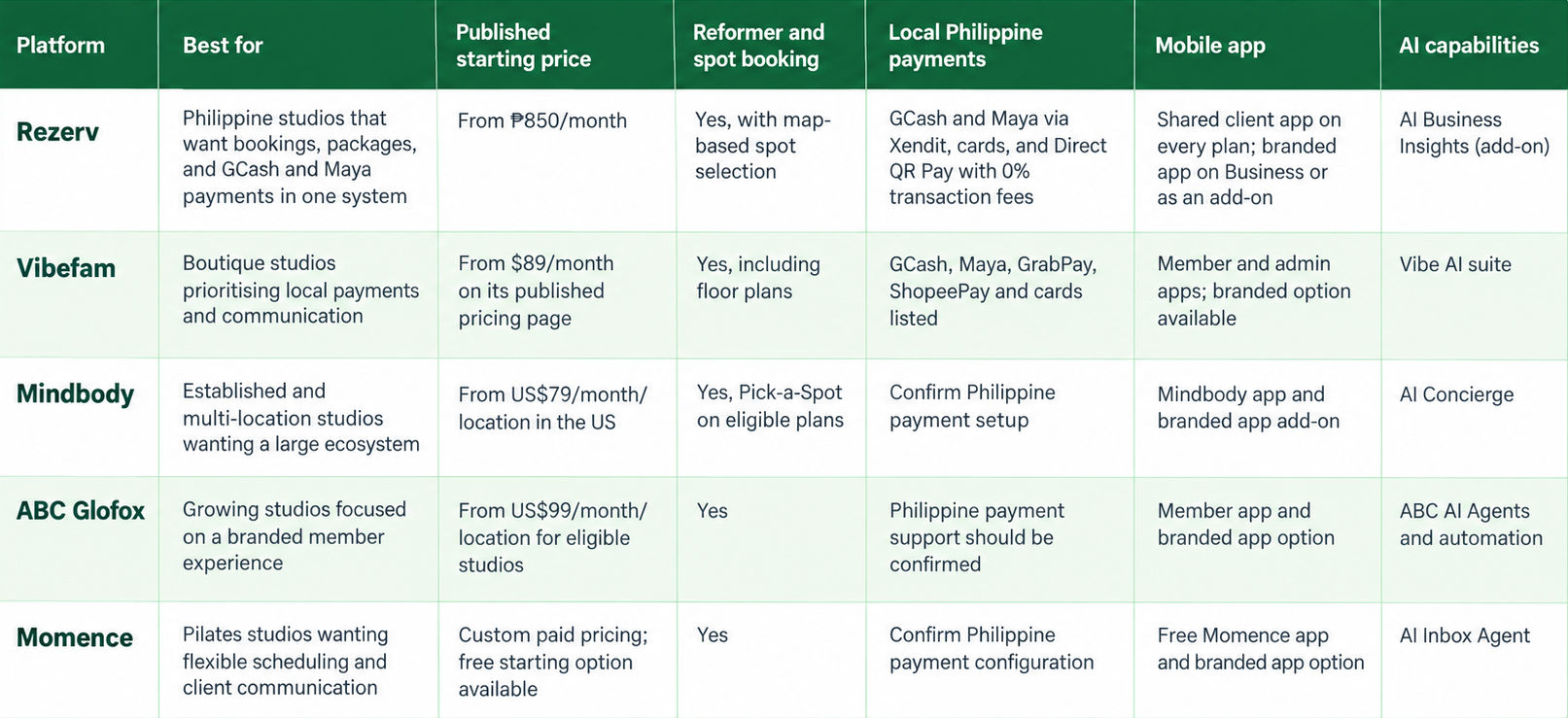
Pricing and feature availability can change by market, plan, and payment provider, so Philippine studios should request a local quote before making a final cost comparison.
.jpg)
1. Rezerv
Best for: Pilates studios in the Philippines that want reformer booking, flexible packages, and local payments managed in one platform.
Rezerv is a Singapore-built platform used by fitness and wellness businesses across Southeast Asia and beyond, and its Pilates studio software covers the full studio workflow in one system: reformer and mat classes, private and semi-private appointments, packages, memberships, waitlists, staff schedules, attendance, and online payments.
Businesses on Rezerv have taken more than six million bookings through the platform.
Reformer and equipment classes. Each class takes its capacity from the number of machines you set, and clients choose their exact reformer from a map of the room when they book. A reformer class can cost two credits and a mat class one from the same package or membership, and resource tracking stops a machine, room, or instructor from being double-booked.
Private and semi-private sessions. Parallel appointment booking lets two or three clients book the same semi-private slot on their own, with remaining spots shown before they confirm. For regular private clients, staff can set up a full series of recurring sessions in one step and charge it upfront or against the client's package.
Local payments. Rezerv lists GCash and Maya alongside cards and other regional methods, and its Xendit integration supports QR Ph and GCash for Philippine transactions. Clients buy packages and memberships in the same checkout they use to book, so staff no longer check transfer screenshots.
Direct QR Pay adds a 0% transaction fee option for clients who prefer scanning your own QR code. It is included on the Business plan and available as an add-on on Starter and Team.
Retention and marketing. Automated campaigns reach clients by email, SMS, and WhatsApp when their credits run low, their package is close to expiring, or they stop booking.
Auto-Tagging moves buyers of selected plans into pricing groups such as VIP, where they can see members-only packages and prices, and a built-in referral programme rewards members for bringing friends. For extra reach, Rezerv also integrates with ClassPass, with an optional cap on ClassPass bookings per class.
Client safety and records. Required waivers can stop staff from adding a client to a class until the waiver is signed, and each client profile keeps signed forms, injury tags, and staff notes with attached files in one place.
Reporting and AI. AI Business Insights compares your last completed month with the month before, highlights changes in revenue, bookings, no-shows, churn risk, and utilisation, and recommends what to act on first. It is available as an add-on, alongside standard reports on bookings, attendance, sales, and client activity.
Pricing. Plans start from ₱850 a month in the Philippines, with Team and Business charged per location and 20% off annual billing. Every plan includes a one-month free trial, and the Rezerv team handles migration from your current system for free.
Local consideration: Rezerv is one of the most straightforward options on this list for a Philippine studio that wants GCash and Maya built into its booking, package, and membership system, with peso pricing and 0% transaction fees on Direct QR Pay.
2. Vibefam
Best for: Boutique Pilates studios that want Southeast Asian payment support, mobile booking, and strong communication automation.
Vibefam is another platform with a strong Asia-Pacific focus. It supports class scheduling, appointments, memberships, packages, staff management, reports, marketing, and multi-location operations. Its support documentation also includes floor-plan management, which can be useful for equipment-based classes.
The platform can also manage class capacity, packages, waitlists, instructor schedules, and mobile bookings, making it suitable for reformer-focused boutique studios.
Its public pricing page currently starts at $89 per month on its lower-priced billing option, with a higher month-to-month rate. More advanced plans add features such as local payment methods, booking websites, family accounts, group bookings, payroll, marketing, and additional AI tools. Vibefam also states that businesses can request quotations in their local currency.
Local consideration: The combination of GCash and Maya support, mobile booking, messaging, and an APAC-focused operation makes Vibefam worth considering for Philippine boutique studios.
However, request a Philippine-specific quote that includes payment-processing costs and AI add-ons, since the public pricing page shows international rates.
.jpg)
3. Mindbody
Best for: Established Pilates studios that need deep functionality, consumer discovery, and room to scale into multiple locations.
Mindbody is one of the most established platforms in fitness and wellness software, and its Pilates tools go well beyond basic scheduling.
Studios can manage reformer and mat classes, private sessions, packages, memberships, staff, payments, client profiles, marketing, and reporting. Mindbody also connects businesses to its consumer marketplace, which it says reaches more than three million monthly users searching for fitness and wellness services.
Its resource-management features are particularly relevant to Pilates. On eligible plans, studios can manage rooms and equipment and use Pick-a-Spot so clients can select a specific position during booking. This lets studios represent each reformer as its own bookable position.
Mindbody also offers a business app for studio teams, the standard Mindbody consumer app, and an optional custom-branded mobile app.
On the AI side, Mindbody introduced AI Concierge for businesses using appointments, classes, packages, and memberships. It can respond to calls and online questions and help clients make bookings around the clock. AI Concierge is currently included in Mindbody's Ultimate plan.
Pricing currently starts at US$79 per month per location in the United States. Starter includes booking, payments, reporting, website tools, and the Mindbody marketplace. Accelerate adds features such as resource management and Pick-a-Spot, while Ultimate adds marketing automation, lead management, additional analytics, and AI front-desk capabilities.
The important detail for Philippine studios is that the advertised US$79 price is explicitly a US starting price. Philippine pricing, payment processing, and available features should therefore be confirmed directly with Mindbody.
Local consideration: Mindbody is compelling when operational depth and scalability matter more than native Philippine payment methods. If GCash or Maya is essential to your checkout experience, ask Mindbody to demonstrate exactly how those payments would work for a Philippine merchant before signing.
.jpg)
4. ABC Glofox
Best for: Growing Pilates studios that want a polished branded booking experience and strong membership automation.
ABC Glofox is built around fitness and boutique studio operations and now has dedicated Pilates workflows.
Its Pilates software supports mat and reformer scheduling, equipment capacity, waitlists, memberships, class packs, automated billing, reminders, late-cancel rules, staff management, and reporting. Clients can book through a web portal or member app, while studios can add a custom-branded app for a more consistent brand experience.
For equipment-heavy Pilates studios, Glofox supports equipment and premium-spot booking so clients can reserve inventory such as reformers directly. Its waitlist system can also backfill openings after cancellations.
Its membership capabilities are flexible enough to combine recurring memberships, class packs, drop-ins, and credits, which makes it useful for studios running several pricing models simultaneously.
Glofox also integrates with ClassPass, allowing participating studios to publish classes and receive ClassPass reservations inside their Glofox schedule.
AI is becoming a larger part of the ABC Fitness ecosystem. ABC AI Agents can act as front-desk and sales assistants across calls, texts, chats, and lead follow-ups, although studios should confirm which AI capabilities are included with their specific Glofox plan.
Published pricing currently starts as low as US$99 per month per location for eligible studios, but Glofox notes that final pricing varies by business requirements, region, currency, and selected features.
There is one important Philippine consideration: Glofox's March 2026 list of countries supported by its Stripe-based Glofox Payments does not list the Philippines.
Payment configuration and platform availability can differ by market, so a Philippine studio should confirm payment processing with Glofox before choosing the platform, particularly if integrated GCash, Maya, or recurring local payments are essential.
Local consideration: Glofox is attractive for studios prioritising polished booking, branded apps, reformer capacity, automation, and multi-location growth, but local payment compatibility needs more due diligence than with Southeast Asia-focused platforms.
.jpg)
5. Momence
Best for: Pilates studios that combine group reformer classes, private sessions, marketing, and high-touch client communication.
Momence has developed a particularly strong Pilates-specific feature set.
Studios can manage reformer classes, private appointments, memberships, class packs, recurring subscriptions, waitlists, instructor schedules, payroll reporting, and multiple locations. Classes and appointments can appear within the same system, which is helpful for studios that earn revenue from both group sessions and one-on-one Pilates.
Its spot-booking feature is especially relevant to reformer studios. Clients can select an exact reformer or mat position from a room map, while the studio caps capacity according to available equipment.
Momence also handles prepaid packs and recurring subscriptions using credits. Studios can control which services credits apply to and create different expiration and renewal rules.
Clients can book through the free Momence mobile app, while studios that want a fully branded experience can add a custom app carrying their own studio name and visual identity.
One of Momence's more interesting 2026 additions is its AI Inbox Agent. The agent can answer questions about schedules, prices, classes, memberships, and studio policies.
Depending on the permissions configured by the studio, it can also help clients book or modify reservations, join waitlists, manage memberships, update payment methods, and handle other supported requests.
For payments, Momence primarily integrates with Stripe in supported markets. Its own help documentation notes that payment processing arrangements can differ by country.
Momence operates an APAC-specific Pilates offering, so it is relevant to studios in this region, but Philippine businesses should still ask specifically about merchant onboarding, settlement, GCash, Maya, and recurring payments before choosing it.
Momence currently does not display a simple universal paid-studio price on its main pricing page. Businesses can start through its free entry option or request a demo and tailored paid pricing.
Local consideration: Momence is strongest when sophisticated Pilates booking and client communication are priorities. Philippine studios that need native local wallets should investigate the payment setup carefully before committing.
Choosing the right Pilates software for your studio
The right Pilates software keeps reformer capacity, packages, payments, and client records connected, which frees your team's time for teaching and client care.
For studios in the Philippines, local payments deserve as much attention as scheduling features. Check that GCash, Maya, and QR payments work inside the booking flow, test how credits are deducted and restored after cancellations, and compare the total monthly cost of the setup you need, including transaction fees.
Rezerv brings all of this into one platform for Philippine Pilates studios, from map-based reformer booking to GCash and Maya checkout, with plans from ₱850 a month. Start your one-month free trial to set up your own classes and packages, or book a demo to see how Rezerv fits your studio's schedule and pricing plans.
.jpg)